
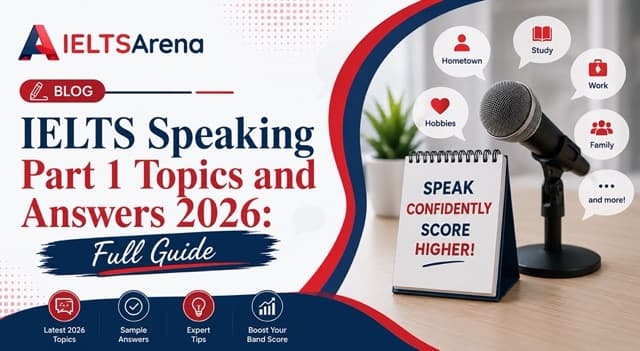
Most candidates underestimate IELTS Speaking Part 1. They walk into the exam assuming the introductory questions are straightforward and get caught off guard when their answers sound flat, vague, or unnaturally rehearsed. Examiners hear those patterns every single day of testing.
IELTS speaking part 1 topics 2026 cover familiar everyday subjects: home, work, hobbies, transport, food, weather, travel, and technology. These topics feel approachable. The mistake most candidates make is treating them as simple, and that mindset produces simple, low-scoring answers.
This guide covers what the examiner is actually assessing in Part 1, the most common IELTS speaking part 1 topics 2026 with sample answers at Band 7 and above, and how to use IELTSArena to build the kind of natural, extended responses that score consistently well.
What Actually Happens in IELTS Speaking Part 1
IELTS Speaking Part 1 lasts four to five minutes. The examiner introduces themselves, confirms your identity, and then asks a series of questions across two or three topic areas.
You will not choose the topics. The examiner selects them from a standardised bank of IELTS speaking questions part 1 that covers predictable everyday subjects.
Each topic includes two to four short questions. The examiner is assessing your ability to speak fluently and naturally about yourself and familiar situations. They are evaluating Fluency and Coherence, Lexical Resource, Grammatical Range and Accuracy, and Pronunciation.
Part 1 is not scored on how interesting your life is. It is scored on how effectively you use language to communicate about it. Understanding this distinction changes how you prepare.
Advertisement
Why Common Approaches to Speaking Part 1 Fail
The most widespread error is memorisation. Candidates learn scripted answers to likely IELTS speaking part 1 topics 2026 and recite them during the exam.
Examiners are specifically trained to detect memorised responses. When they identify one, they probe with follow-up questions that the script does not cover. The candidate's fluency collapses immediately, and the band score falls.
The second common error is giving answers that are too brief. When asked "Do you enjoy cooking?", answering "Yes, I do" is grammatically correct but scores poorly. Band 7 and above requires extended, developed responses that demonstrate a range of vocabulary and grammatical structures.
The third error is prioritising accuracy over fluency. Many candidates slow down dramatically to avoid grammar mistakes. The result is halting, hesitant speech with long pauses, which directly damages the Fluency and Coherence score. A confident, naturally paced answer with minor errors typically scores higher than a slow, stilted attempt at perfect grammar.
Understanding what examiners are actually listening for is the first step to preparing effectively for IELTS speaking part 1 2026.
How One Candidate Improved Her Speaking Band by 1.5 Points
Priya had sat IELTS twice before reaching her target. Both times, her Speaking score came back at Band 6.0, while her other sections were performing at 7.0 or above. Her overall band was being held down by a single section.
"I was too anxious in Part 1," she said. "I kept giving one-sentence answers and then going silent. I knew I had more to say but I was not saying it."
She began using IELTSArena's Speaking practice module, which delivers randomised IELTS speaking introduction questions and records her responses for AI feedback. She practised for 15 minutes every day using IELTSArena.
"IELTSArena showed me exactly where my answers were too short and where my vocabulary was repetitive," she said. "After two weeks of daily practice, my answers became natural and extended. I stopped needing to think about what structure to use."
On her third attempt, she scored Band 7.5 in Speaking overall. Her total preparation time between her second and third exam was less than six weeks.
What the Research Shows About Speaking Part 1 Performance
Analysis of IELTS examiner reports consistently shows that the most common cause of Band 6 or below in Speaking is restricted vocabulary range, not grammatical inaccuracy. Candidates who use the same words repeatedly across their answers suppress their Lexical Resource score regardless of how correct their grammar is.
A second consistent pattern is that candidates who give two to three extended sentences per response score higher on average than those who give either single-sentence answers or overly long, rambling responses. The effective range for IELTS speaking questions part 1 is approximately 30 to 45 seconds per answer: long enough to demonstrate range, short enough to remain natural.
Research also shows that candidates who practise with recordings of their own voice perform significantly better in the real exam than those who only mentally rehearse. Listening back to yourself reveals patterns you cannot hear in real time: filler words, repetition, and unnaturally short answers.
IELTSArena's speaking practice environment is built specifically around these evidence-based preparation principles.
The Most Common IELTS Speaking Part 1 Topics 2026 with Sample Answers
These are the topic areas appearing most frequently in IELTS speaking part 1 topics 2026. Each example includes an examiner commentary noting what lifts the answer to Band 7 and above.
Topic: Home and Accommodation
Question: "Do you live in a house or an apartment?"
Band 6 answer: "I live in an apartment. It is not very big but it is comfortable."
Band 7+ answer: "I rent an apartment in the city centre, which suits me well at this stage of my life. It is fairly compact, but the location more than makes up for the size. I am within walking distance of work and public transport, which I genuinely value."
Examiner note: The Band 7+ answer uses wider vocabulary (compact, suits me well, within walking distance), natural hedging language (fairly, which I genuinely value), and extends the response with a specific reason. The answer sounds conversational rather than rehearsed.
Topic: Work and Study
Question: "Do you prefer working in the morning or in the evening?"
Band 6 answer: "I prefer morning because I am more productive."
Band 7+ answer: "I am definitely more of a morning person. I find I can concentrate far better in the first few hours of the day before emails and meetings start to interrupt my focus. By mid-afternoon, my concentration tends to drop quite noticeably."
Examiner note: Compound reasons, discourse markers (definitely, far better, tends to), and vocabulary variation lift this answer clearly above a single-clause response.
Topic: Hobbies and Free Time
Question: "What do you enjoy doing in your free time?"
Band 7+ answer: "I spend quite a lot of my free time reading, particularly long-form journalism and non-fiction on history. I find it a good way to decompress after work without looking at a screen. I also try to get out for an evening walk most days, which helps me switch off completely."
Examiner note: Specific vocabulary (decompress, long-form journalism, switch off), natural connectives, and a two-part response structure demonstrate strong Lexical Resource and natural Fluency.
Topic: Technology
Question: "How much time do you spend on your phone each day?"
Band 7+ answer: "Probably more than I would like to admit. I would estimate somewhere around four to five hours, which includes both work-related messaging and personal browsing. I have actually tried to set usage limits on certain apps, with rather mixed results."
Examiner note: Self-reflective language, a conversational tone, and natural hedging (probably, I would estimate, rather mixed results) make this answer feel genuine and spontaneous rather than scripted.
Topic: Food and Cooking
Question: "Do you enjoy cooking?"
Band 7+ answer: "Yes, I do, though it very much depends on the type of cooking. I enjoy preparing proper meals at the weekend when I have time, particularly Asian cuisine. But on busy weeknights I tend to keep things fairly simple. I find cooking relaxing when there is no time pressure involved."
Examiner note: The conditional extension (though it very much depends), specific detail (Asian cuisine), and contrast structure (weekends vs weeknights) demonstrate the kind of natural elaboration that examiners associate with Band 7 and above.
The Right Approach to Practising IELTS Speaking Part 1 Topics 2026
Effective Part 1 preparation follows a structure that most candidates skip entirely.
Step 1: Record yourself answering questions from the current IELTS speaking part 1 topics 2026 bank. This is uncomfortable initially but is critical for improvement. Listening back to your own responses reveals patterns you cannot hear in real time: vocabulary repetition, excessive filler words, and answers that are shorter than they feel when you are speaking them.
Step 2: Practise extending every answer. After your first statement, add a second. Add an example. Add a contrast. "I enjoy cooking. I find it relaxing" becomes "I enjoy cooking, particularly Asian food. I find it a good way to unwind after a long day, and it gives me something to focus on that is entirely separate from work."
Step 3: Build a topic-specific vocabulary bank for each common subject. For home and accommodation: compact, spacious, convenient, within commuting distance, well-maintained. For technology: streamline, multitask, screen fatigue, instant connectivity, digital dependency. Practise using these words naturally in sentences, not memorising them as lists.
Step 4: Practise with randomised questions, not the same set each time. Real IELTS speaking topics 2026 vary significantly session to session. Your preparation must reflect that variety so you are not caught off guard by an unfamiliar question sequence.
How IELTSArena Transforms IELTS Speaking Part 1 Preparation
IELTSArena's Speaking module is built for exactly this kind of structured, evidence-based practice.
The platform delivers randomised IELTS speaking introduction questions drawn from the current topic bank. Each practice session mirrors the real exam structure: an introduction, identity verification, and then multiple question sets across different topic areas.
IELTSArena records your spoken responses and analyses them for fluency, vocabulary range, and grammatical complexity. After each session on IELTSArena, you receive AI feedback that identifies specific vocabulary gaps, flags repetition, and notes precisely where your answers were too brief to demonstrate the range examiners expect.
The feedback from IELTSArena also includes example vocabulary extensions and sample Band 7+ answers for each topic you practised. If your response to a technology question was underdeveloped, IELTSArena shows you exactly what a high-scoring version of that answer would include.
IELTSArena tracks your Speaking score estimate across multiple sessions. Candidates who practise consistently on IELTSArena can observe their score trajectory and see whether their improvement rate is on target for their exam date.
Unlike static answer lists or generic tutorials on IELTS speaking part 1 2026 topics, IELTSArena provides feedback specific to your actual spoken response. Every session on IELTSArena generates data you can act on immediately.
Self-Diagnosis: Is Your Speaking Part 1 Practice Working?
Before your next session, answer these questions honestly.
Are your answers to IELTS speaking questions part 1 consistently longer than two sentences, with at least one extended reason or example?
Do you practise with recorded responses that you listen back to and analyse critically?
Can you list at least eight vocabulary items for five of the most common IELTS speaking part 1 topics 2026?
Are you practising with new, randomised questions each session rather than repeating the same ones?
Have you received specific feedback on a recorded speaking response in the past week?
If you answered no to two or more of these, your current approach is not replicating the conditions or standards you need. IELTSArena is designed specifically to address each of these gaps, giving you the feedback, variety, and tracking your current practice lacks.
Practise IELTS Speaking Part 1 Topics 2026 on IELTSArena
Your IELTS Speaking band score in Part 1 is not determined by your personality or your life experiences. It is determined by how effectively you use language to communicate those experiences.
Register for free on IELTSArena and access the Speaking practice module today. Get AI feedback on your real spoken responses, build your vocabulary range across every common topic area, and walk into your exam with the confidence that comes from structured, data-driven preparation.
Start Practising Speaking Free on IELTSArena →
Frequently Asked Questions
What topics come up most in IELTS Speaking Part 1 in 2026?
The most frequently appearing IELTS speaking part 1 topics 2026 include home and accommodation, work or study, hobbies and leisure, travel and transport, food and cooking, technology and social media, weather and seasons, and daily routines. The examiner selects two or three topic areas per session. Practising across all common subjects on IELTSArena ensures you are prepared regardless of which combination appears in your exam.
How long should my answers be in IELTS Speaking Part 1?
Aim for 30 to 45 seconds per answer, which typically means two to four sentences with at least one extended reason or specific example. Single-sentence answers score poorly on Lexical Resource and Fluency even when grammatically correct. Overly long answers can disrupt the natural conversational flow of Part 1 and sound unnatural to the examiner. IELTSArena's feedback specifically flags answers that are too short and provides example extensions for each topic.
What mistakes do students make in IELTS Speaking Part 1?
The most common errors are memorising and reciting scripted answers, giving single-sentence responses, using basic or repetitive vocabulary, speaking too slowly out of fear of grammatical errors, and failing to extend answers with reasons or examples. All of these directly reduce band scores even when the candidate's underlying English proficiency is solid. IELTSArena's Speaking feedback module identifies and addresses each of these patterns after every practice session.
Can I memorise answers for IELTS Speaking Part 1 and still get Band 7?
Memorised answers almost always produce a lower band score, not a higher one. Examiners are trained to identify scripted responses and will ask follow-up questions your script cannot anticipate. This causes fluency to break down visibly under the probe. The correct approach is to have strong vocabulary patterns and flexible language structures ready for each IELTS speaking topics 2026 area, not word-for-word scripts. IELTSArena helps you build that kind of adaptable, topic-ready language rather than rehearsed answers.
How does the examiner score IELTS Speaking Part 1 answers?
The examiner assesses four criteria across the entire Speaking test: Fluency and Coherence, Lexical Resource, Grammatical Range and Accuracy, and Pronunciation. Part 1 is not marked separately; it contributes to your overall Speaking band score. Strong Fluency and Lexical Resource in Part 1 establish a positive impression that carries through the entire interview. IELTSArena's AI feedback reports on each of these four criteria after every speaking practice session so you always know where to focus next.
![Will IELTS Examiners Know You Memorised Your Answers? [2026]: The 4 Signals, the Penalty, and the Recovery Script](/_next/image?url=%2Fblog%2Fcover-ielts-memorised-answers-penalty.jpeg&w=3840&q=75&dpl=dpl_GYEKaGV5BCFmb21AbDnxrbdK56fd)
![IELTS Speaking Part 1 Questions and Answers [2026]: 40+ Real Questions From the Current Cycle](/_next/image?url=%2Fblog%2Fcover-ielts-speaking-part-1-questions-and-answers.jpeg&w=3840&q=75&dpl=dpl_GYEKaGV5BCFmb21AbDnxrbdK56fd)