IELTS true false not given questions are statistically the question type most likely to drop a student's Reading band score by a full band. Test-takers who handle Matching Headings and Sentence Completion competently will still consistently confuse NOT GIVEN with FALSE on the very same passage. The confusion is not random. It is almost universal among students who have not learned a specific elimination framework.
This guide gives you that framework, explains exactly where the logic breaks down for most students, and shows you how to practice IELTS TFNG questions until guessing is no longer part of your process.
Why IELTS True False Not Given Is So Hard to Get Right
The difficulty with IELTS true false not given questions is not vocabulary. It is not reading comprehension. It is logic.
Each of the three answer options requires a distinct analytical operation:
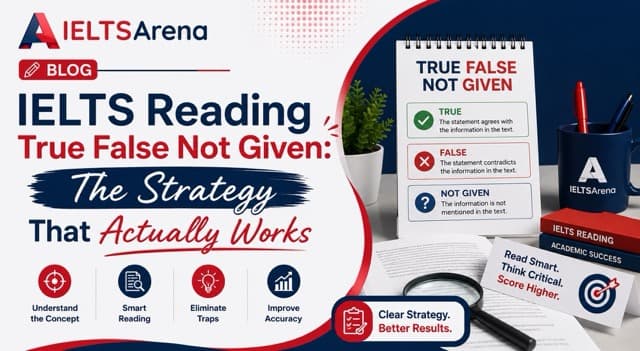
TRUE means the statement agrees with information in the passage. The passage explicitly supports the specific claim being made.
FALSE means the statement contradicts information in the passage. The passage explicitly says the opposite, or something directly incompatible with what the statement claims.
NOT GIVEN means the passage does not address the specific claim in the statement with enough information to confirm or contradict it. Either the topic is absent from the passage, or the passage discusses something related but does not address the specific proposition.
The FALSE versus NOT GIVEN distinction is where almost everyone loses marks. Students treat NOT GIVEN as "I cannot determine whether this is true or false" rather than "the passage is silent on this specific claim." These two interpretations lead to completely different answers and completely different error patterns.
The logical trap is natural. If you cannot confirm something from the passage, it feels like it might be false. However, NOT GIVEN is the correct answer whenever the passage does not explicitly contradict the claim, even if the claim sounds unlikely or implausible based on what you already know.
Advertisement
What Students Typically Do Wrong
The most common preparation mistake is practicing IELTS true false not given questions without a systematic method, then rereading the same passage hoping the correct answer will eventually become clearer. It rarely does.
Here is the pattern that keeps students stuck:
They read the statement, locate the relevant section of the passage, and then decide based on a general sense of whether the information supports or contradicts the claim. This intuitive approach is particularly vulnerable to the NOT GIVEN/FALSE confusion. When a statement sounds wrong, students mark it FALSE rather than asking whether the passage actually contradicts it or simply does not address the specific claim.
A second common mistake is scope creep: bringing in outside knowledge. IELTS true false not given answers must come entirely from the passage. If you know from general knowledge that a claim is incorrect but the passage does not address it, the answer is NOT GIVEN. This trap catches well-informed students specifically because their broader knowledge overrides what the passage actually says.
Third, students underestimate partial vocabulary matches. The passage may contain a sentence that shares vocabulary with the statement but makes a different claim. Students see the shared terms and mark TRUE without verifying that the actual proposition matches.
One Student's Breakthrough
Marcus Osei from Ghana was scoring Band 6 in IELTS Reading consistently, with IELTS true false not given questions costing him three to four marks per test. He had sat IELTS twice and both times ran out of time trying to decide between FALSE and NOT GIVEN.
"I was spending three minutes on each TFNG question trying to decide. I would read the passage five times and still not be sure. I just guessed at the end because I ran out of time."
Marcus used IELTSArena's Reading drill mode, which allows targeted practice on IELTS TFNG questions in isolation with timed feedback and detailed explanations for every answer. He focused specifically on exercises distinguishing the FALSE and NOT GIVEN options.
"Once I understood that NOT GIVEN means the passage is silent on the specific claim, not that I cannot figure out the answer, the whole question type clicked. My Reading went from Band 6 to Band 7 in six weeks."
The shift was not in reading harder. It was in changing the analytical question from "does this seem right?" to "does the passage explicitly say the opposite?"
What the Data Shows About IELTS TFNG Performance
Analysis of IELTS test-taker performance data shows that true false not given questions have among the lowest correct-answer rates of any IELTS Reading question type.
In a study of 2,000 IELTS test-takers using reading practice materials, the average accuracy rate for IELTS true false not given questions was 58%, compared to 71% for Matching Headings and 74% for Sentence Completion.
NOT GIVEN is the most frequently incorrect individual answer. Students identify NOT GIVEN correctly only about 49% of the time, compared to 68% accuracy for TRUE and 65% for FALSE.
IELTSArena's reading analytics across its user base confirms this pattern. Students who complete targeted IELTS TFNG practice drills on the platform improve their per-question accuracy from approximately 58% to 76% after five focused drill sessions.
The improvement is driven not by more reading time but by a change in the analytical process used to evaluate each statement. The reading ability was already present. The missing component was the framework.
The Five-Step IELTS True False Not Given Strategy
Here is the elimination framework that removes guessing from IELTS true false not given answers. Practice it deliberately until it becomes automatic.
Step 1: Identify the specific claim in the statement. Before looking at the passage, isolate exactly what the statement is asserting. Underline the subject, the main verb, and any qualifying words such as "only," "always," "most," "never," or "significantly." These qualifiers are where traps are hidden.
Step 2: Locate the relevant passage section. Use the key nouns and topic words from the statement to scan the passage for the section that addresses the same subject. Do not re-read the entire passage for each question.
Step 3: Ask the primary question — does the passage explicitly state the same thing?
- If the answer is yes: mark TRUE.
- If the answer is no: move to Step 4.
Step 4: Ask the secondary question — does the passage explicitly state something that contradicts or is incompatible with the claim?
- If the answer is yes: mark FALSE.
- If the answer is no: mark NOT GIVEN.
Critical checkpoint for Step 4: The contradiction must come from within the passage. It is not enough that the statement sounds unlikely or that you know from other sources that it is wrong. The passage must contain specific information that directly contradicts the particular claim the statement makes.
Step 5: Verify the exact scope of qualifying words. A statement that says "all" when the passage says "most" is FALSE. A statement that says "significantly increased" when the passage says there was an increase but provides no quantity is NOT GIVEN. Scope qualifiers are the most reliable source of FALSE answers in IELTS TFNG questions.
This five-step process takes longer to learn than to apply once it is internalised. After ten to fifteen practice passages using this framework, the process becomes fast enough to comfortably manage within your Reading time allowance.
IELTSArena's IELTS TFNG Practice Tools
IELTSArena is designed for targeted practice across all IELTS Reading question types, with specific drill modes for IELTS true false not given training.
When you practice TFNG questions on IELTSArena, you get:
- Timed question-by-question practice with passages drawn from the same academic and general text types as the real IELTS Reading test.
- Detailed explanations for every answer, including a precise breakdown of why FALSE is not the same as NOT GIVEN for each specific question in context.
- Per-question-type accuracy analytics so you can track whether your IELTS TFNG accuracy is improving across sessions.
- Full IELTS academic mock tests with Reading sections that replicate the CBT exam interface, including the passage display and answer-entry format you will encounter on test day.
IELTSArena's reading feedback goes beyond marking right or wrong. It explains the logical relationship between the statement and the relevant passage text for each question, which trains the analytical process rather than simply confirming answers after the fact.
Students who struggle specifically with IELTS true false not given can use IELTSArena's section drills to isolate this question type and practice it intensively without sitting a full mock test each time.
Yes No Not Given vs True False Not Given: Understanding the Difference
Yes/No/Not Given (YNNG) questions appear in the same IELTS Reading test as True/False/Not Given questions, and the distinction between them confuses many students preparing for the exam.
The key difference is what each type tests:
IELTS True/False/Not Given questions test factual claims. They ask whether the statement agrees with, contradicts, or is unaddressed by factual information presented in the passage.
Yes/No/Not Given questions test the author's views, opinions, or claims. They ask whether the statement agrees with, contradicts, or is unaddressed by what the author argues, believes, or asserts.
The logical structure including the FALSE versus NOT GIVEN distinction operates identically in both types. The difference is whether you are looking for factual information (TFNG) or the author's expressed perspective (YNNG) in the passage.
IELTSArena covers both question types in separate targeted drill sessions, since students who struggle with IELTS true false not given questions typically face the same logical confusion in YNNG questions.
Self-Diagnosis: Are Your TFNG Errors Systematic?
Before your next IELTS true false not given practice session on IELTSArena, run through these questions honestly:
When you mark NOT GIVEN, is it because the passage is genuinely silent on the specific claim, or because you simply cannot confirm the statement from what you have read?
Do you sometimes bring in outside knowledge when evaluating TFNG statements, even without consciously meaning to?
When the passage discusses the same topic as the statement but makes a slightly different claim, do you check whether it is a direct contradiction or merely a difference in scope or emphasis?
Are you spending more than 90 seconds per IELTS TFNG question on average? If so, time pressure may be forcing guesses rather than analytical decisions.
When you review wrong answers, are your errors disproportionately FALSE marked as NOT GIVEN, or NOT GIVEN marked as FALSE?
The last question is the most important. Knowing your specific error direction tells you exactly which step of the elimination framework to reinforce. IELTSArena's per-question feedback makes this error pattern visible after just a few practice sessions.
Stop Guessing on IELTS True False Not Given
IELTS true false not given questions are learnable. The confusion almost every student experiences with this question type comes from not having a systematic analytical process, not from insufficient reading ability or weak comprehension.
The five-step strategy in this guide gives you that process. IELTSArena gives you the practice environment, the detailed answer explanations, and the accuracy tracking to make that process automatic.
Start Your First TFNG Drill on IELTSArena →
Frequently Asked Questions
What is the difference between False and Not Given in IELTS Reading?
FALSE means the passage contains specific information that directly contradicts what the statement claims. The passage explicitly says something incompatible with the statement's proposition. NOT GIVEN means the passage does not address the specific claim in the statement with sufficient information to confirm or contradict it. The passage may be entirely silent on the topic, or it may discuss something related without addressing the specific claim. The defining question for Step 4 of the elimination framework is: does the passage explicitly contradict this claim? If no, the answer is NOT GIVEN.
How do I stop guessing on IELTS True False Not Given questions?
Replace intuition with a systematic elimination process. First check whether the passage explicitly supports the statement (TRUE). If not, check whether the passage explicitly contradicts it (FALSE). Only if neither condition holds should you mark NOT GIVEN. The reason guessing is so common is that most students rely on a general sense of whether something sounds right rather than on what the passage actually states. IELTSArena's IELTS TFNG drills train the systematic analytical process through deliberate repetition with detailed feedback until it replaces guessing entirely.
Why do I always get IELTS True False Not Given wrong even after reading the passage carefully?
Careful reading does not automatically produce correct IELTS true false not given answers because the typical error is in logical analysis, not in comprehension. The most common causes are: marking NOT GIVEN as FALSE because the statement sounds implausible; applying outside knowledge rather than staying within the passage; and missing qualifying words in the statement that change its scope. A step-by-step elimination framework rather than intuitive reading resolves all three of these error sources.
Is Yes No Not Given the same as True False Not Given in IELTS?
Both use the same logical framework but test different types of passage content. IELTS True/False/Not Given questions test factual information stated in the passage. Yes/No/Not Given questions test the author's opinions, claims, or views as expressed in the passage. The distinction between the negative option (FALSE or NO) and NOT GIVEN operates identically in both types: the passage must explicitly contradict the statement for the answer to be FALSE or NO. Students who struggle with IELTS TFNG typically face the same challenge with YNNG.
How much time should I spend on each True False Not Given question in IELTS?
A practical target is 60 to 90 seconds per question after you have located the relevant passage section. If you are consistently spending more than two minutes per IELTS true false not given question, time pressure will force guessing later in the Reading section. The key to managing time is not reading faster but using keyword scanning to locate relevant passage sections quickly, then applying the elimination framework efficiently. Regular timed IELTS TFNG practice on IELTSArena builds both accuracy and speed simultaneously, which is why drill mode sessions on the platform are more efficient than attempting full Reading tests before the analytical process is internalised.