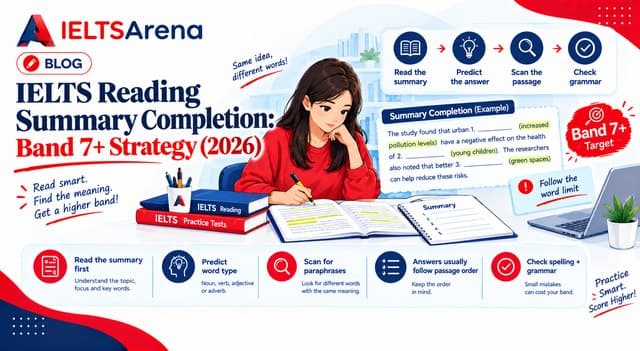
Summary completion is the IELTS Reading question type where candidates lose marks because they do not realise it comes in two different formats. With-word-bank summary completion gives you a list of words to choose from. Without-word-bank summary completion requires you to find the exact answer in the passage. The two formats need different strategies, and candidates who use one strategy on the other version almost always underperform. If your summary completion accuracy is below 7 out of 10, start a free IELTS Reading practice on IELTSArena and look at your errors by format before continuing. The fix is a different approach per format, not more general Reading practice.
Quick answer: IELTS reading summary completion is a question type where you complete a short summary of a passage (or part of a passage) by filling in missing words in blanks. There are two formats. In with-word-bank summary completion, you are given a list of 8 to 15 words to choose from, and you select the correct word for each gap. The listed words include distractors (same part of speech, similar meaning) designed to catch imprecise matches. In without-word-bank summary completion, you must find the exact word or short phrase from the passage that fills each gap. The word-count instruction (usually "NO MORE THAN TWO WORDS" or "NO MORE THAN THREE WORDS AND/OR A NUMBER") must be respected or the mark is lost. Both formats test paraphrase recognition and grammatical fit, but the strategies differ meaningfully.
Try it before you read. The fastest way to confirm summary completion is your specific Reading gap is to attempt one timed set of each format. Take a free IELTS Reading practice test on IELTSArena and check whether your accuracy differs between with-word-bank and without-word-bank sets. If it does, you are using the wrong strategy for one of them.
In This Guide
- What Summary Completion Actually Is
- The Two Formats: With Word Bank vs Without Word Bank
- How Summary Completion Compares to Other Reading Question Types
- The 3 Word-Choice Traps Unique to Summary Completion
- Summary Completion Raw Scores and Your Overall Reading Band
- A Real Student's Story: 5/10 to 10/10 on Summary Completion in Four Weeks
- The Data Behind This Question Type
- The Right Approach: A 4-Week Summary Completion Fix Plan
- The Two-Pass Summary Completion Framework
- The 5 Word-Type Categories to Expect in Gaps
- Sample Passages with Full Walkthrough
- How IELTSArena Helps You Drill Summary Completion Specifically
- Self-Diagnosis: Is Summary Completion Capping Your Reading Band?
- Key Takeaways
- Frequently Asked Questions
Advertisement
What Summary Completion Actually Is
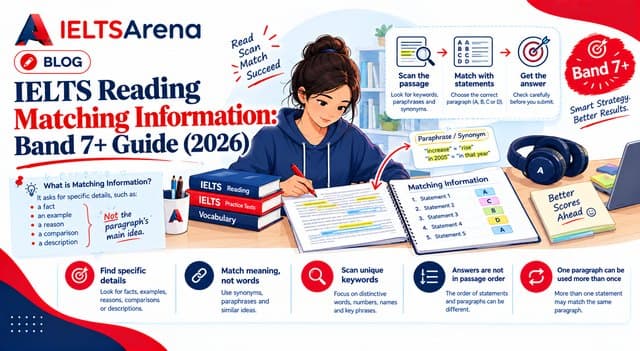
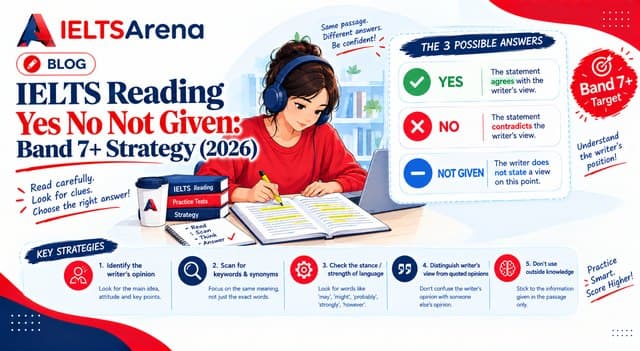
IELTS reading summary completion is one of the standard IELTS Reading question types, alongside multiple choice, matching headings (see our IELTS Matching Headings guide), matching information (see our IELTS Reading Matching Information guide), True/False/Not Given (see our IELTS Reading True False Not Given guide), Yes/No/Not Given (see our IELTS Reading Yes No Not Given guide), and sentence completion.
In summary completion questions, you are given a short summary of the Reading passage or a section of it. The summary has gaps where specific words have been removed. Your job is to fill each gap with the correct word. The summary itself is usually a paraphrased condensation of 1 to 3 paragraphs from the original passage, not a word-for-word excerpt. Each correct answer is worth 1 mark toward your 40-question Reading raw score. The full raw-score-to-band conversion is published in our IELTS Band Score Chart and calculated instantly in the IELTS Band Score Calculator.
Summary completion appears in both Academic Reading and General Training Reading. Each set usually contains 4 to 8 gaps. The question type is especially common in Academic Reading where the passage is a long structured argument, because the summary format tests whether you can follow the passage's overall meaning and locate specific supporting detail. Summary completion is less common in General Training Reading Section 1 (short practical texts) but appears in Section 2 and Section 3.
The Two Formats: With Word Bank vs Without Word Bank
The single most important thing to understand about summary completion is that it comes in two formats, and the two need different strategies.
With word bank: You are given a list of 8 to 15 words at the end of the summary (usually labelled A, B, C, D, E, F, G, H). You select the correct word from the list for each gap. The list always contains more words than gaps, so some words will not be used. The words in the list are deliberately chosen to include semantic distractors (words that could fit the sentence grammar but do not match the passage's meaning). Your task is paraphrase recognition under distractor pressure.
Without word bank: You must find the exact word or short phrase from the passage that fills each gap. The word-count instruction tells you the maximum (usually "NO MORE THAN TWO WORDS" or "NO MORE THAN THREE WORDS AND/OR A NUMBER"). You must use words from the passage, not substitute with your own synonyms. Your task is passage location plus word-count discipline.
The practical implication is specific. With-word-bank summary completion rewards paraphrase recognition skill. You read the gap context, understand what meaning is needed, and select the word that matches that meaning from the list. Without-word-bank summary completion rewards passage-location skill plus word-count precision. You read the gap context, locate the relevant information in the passage, and extract the exact words from the passage that fit grammatically and semantically.
Candidates who use with-word-bank strategy on without-word-bank gaps often produce their own synonyms rather than extracting from the passage, which fails. Candidates who use without-word-bank strategy on with-word-bank gaps often ignore the provided word list and try to recall exact passage wording, which wastes time and introduces errors. Both failures are strategy mismatches, not comprehension gaps.
For candidates working through the Band 6.5 to Band 7 plateau, summary completion often sits in a cluster of underperforming question types alongside matching information and sentence completion (covered extensively in our IELTS Band 7 guide). For Band 7.5, Band 8, and Band 8.5, both summary completion formats need near-perfect accuracy.
How Summary Completion Compares to Other Reading Question Types
Understanding where summary completion sits in the full Reading question-type set is the fastest way to prepare for it correctly.
| Question type | What you write | Source of answer | Primary challenge |
|---|---|---|---|
| Summary completion (with word bank) | Letter (A, B, C) | Provided word list | Paraphrase recognition, distractor resistance |
| Summary completion (without word bank) | Exact word from passage | Reading passage itself | Location, word-count precision |
| Sentence completion | Exact word from passage | Reading passage itself | Grammar fit, semantic fit |
| Short answer | 1 to 3 words | Reading passage itself | Precision, word count |
| Matching information | Letter (A, B, C) | Paragraph letters | Locating paraphrased detail |
| Multiple choice | Letter (A, B, C, D) | Provided options | Resisting distractors |
| Matching headings | Letter (i, ii, iii) | Provided heading list | Main idea identification |
Three distinctions matter most. First, summary completion is the only question type that comes in two formats requiring meaningfully different strategies. Candidates who do not recognise this split underperform on one format or the other. Second, with-word-bank summary completion shares its underlying skill (paraphrase recognition under distractor pressure) with multiple choice and matching headings. Candidates who have mastered those two question types often transfer that skill to with-word-bank summary completion easily. Third, without-word-bank summary completion shares its underlying skill (locating and extracting exact passage wording with grammar fit) with sentence completion and short answer. These three question types are a natural drill cluster.
The 3 Word-Choice Traps Unique to Summary Completion
Three specific traps account for most summary completion marks lost at the Band 6.5 to Band 7 level.
Trap 1: Grammar fit without semantic fit. You find a word that grammatically completes the sentence but does not match the passage's actual meaning. This trap is heavily exploited in with-word-bank format where the distractor words are deliberately chosen to grammatically fit. For example, if the gap is "the main ____ of urban heat islands" and the word bank includes "cause", "effect", "feature", and "symptom", all four fit grammatically. Only one matches what the passage actually says. Fix: for every candidate word, verify by locating the relevant passage section and confirming the specific meaning, not just the grammar.
Trap 2: Semantic fit without grammar fit. You identify the correct meaning but select a word that does not fit the gap grammatically. This is more common in without-word-bank format where candidates extract a word from the passage that captures the meaning but has the wrong part of speech or wrong number (singular versus plural). For example, if the gap needs a noun but you write a verb form, the mark is lost. Fix: always identify the required grammatical function of the gap (noun, verb, adjective, adverb) before extracting the word.
Trap 3: Word-count violation. You find the right meaning and the right grammar but write too many or too few words. Without-word-bank summary completion is strict on word count. "NO MORE THAN TWO WORDS" means two or fewer, and three words loses the mark even if the answer is otherwise correct. Fix: count the words in your answer against the limit before moving on. Hyphenated words count as one word. Numbers written as digits count as "a number" and do not add to the word count.
These three traps are specific to gap-fill question types that require word selection. The techniques in IELTS Reading Tips and IELTS Reading Skimming vs Scanning apply across all Reading question types, but summary completion needs this specific word-choice framework on top of them.
Summary Completion Raw Scores and Your Overall Reading Band
Summary completion typically appears in sets of 4 to 8 questions per passage. Across the full Reading test, total summary completion mark weight is usually 5 to 10 marks out of 40.
If your summary completion accuracy is 5 out of 10 with 8 out of 10 on other Reading question types, your overall raw score sits around 29 to 30, which maps to Reading Band 7. If you lift summary completion to 9 out of 10 while holding the other types, your raw score moves to 33 to 34, which lifts the Reading band by 0.5 to 1 full band depending on your Reading version (Academic or General Training) and exact distribution.
For candidates targeting Band 8 (approximately 35 out of 40 in Academic Reading, 37 out of 40 in General Training) or Band 9 (39 or 40 out of 40), summary completion accuracy must be 10 out of 10 consistently. The one or two careless answers that separate Band 8 from Band 9 almost always include at least one summary completion word-count or part-of-speech error.
For context on how overall Reading band maps to visa, university, and professional registration thresholds, see our IELTS Score for Canada PR 2026, IELTS Score for Australia PR 2026, IELTS Score for Ireland, IELTS for New Zealand, IELTS for UK Visa, and IELTS for NMC UK Nursing threshold guides.
Mid-article check. If your summary completion accuracy is 5 or 6 out of 10, especially with a visible gap between with-word-bank and without-word-bank formats, you are likely applying the wrong strategy to one of them. Start structured summary completion practice on IELTSArena with Academic Reading question sets filtered by format.
A Real Student's Story: 5/10 to 10/10 on Summary Completion in Four Weeks
Dmitri, a software engineer from Minsk applying for the Netherlands Highly Skilled Migrant visa, needed IELTS Academic 7.0 overall with 6.5 in each component. His first attempt returned Reading 7, with summary completion at 5 out of 10 and other question types averaging 8. His without-word-bank sets were close to 9 out of 10. His with-word-bank sets dropped to 2 out of 10.
I thought with-word-bank was supposed to be easier because the words were given to me. But I kept picking the wrong word. I would read the gap, think I knew what it should mean, pick a word that sounded right, and move on. The problem was the word list had three or four words that all sounded right. I was choosing on instinct and the test was designed to defeat that.
His diagnostic was clean. He had the comprehension skill. He did not have the paraphrase-verification discipline that with-word-bank format requires. For his second attempt, he spent four weeks exclusively on summary completion.
Week 1: he drilled the with-word-bank verification method. For every candidate word, he located the exact passage section and confirmed the specific meaning before committing to the answer. No instinct selections. Week 2: he drilled distractor awareness. For each gap, he explicitly identified which other word-bank options were semantic distractors and why they were wrong. Week 3: he drilled without-word-bank word-count discipline, counting every answer against the stated word limit before moving on. Week 4: he did full Academic Reading mocks with summary completion focus, tracking accuracy by format.
His second sitting scored Reading at 8, with summary completion at 10 out of 10 across both formats. Overall band: 7.5. Netherlands HSM visa cleared within the standard processing window. The techniques Dmitri used are compatible with the broader programme in our IELTS Study Plan 3 Months and IELTS 30-Day Study Plan guides. For candidates using the One Skill Retake route to lift Reading alone, see the IELTS One Skill Retake 2026 guide.
The Data Behind This Question Type
Cambridge Assessment English publicly identifies summary completion as one of the Reading question types with highest within-type accuracy variance, meaning candidates often score very well or very poorly on summary completion with few in-between results (Cambridge Assessment English, IELTS Test Statistics 2024 to 2025). This bimodal pattern reflects the strategy-dependence of the question type: candidates with the right strategy score 9 or 10 out of 10 consistently, candidates without it score 4 or 5.
British Council guidance confirms the two-format structure of summary completion and emphasises that candidates should prepare for each format separately. IELTS.org (2026 test specification) lists summary completion as a standard Reading question type across both Academic and General Training versions, unchanged in format for 2026.
For the broader academic skill summary completion tests (locating specific supporting information within a long argumentative text and selecting precise vocabulary that matches the author's intended meaning), university study places disproportionate weight on this ability. For candidates targeting Academic study abroad through routes like UK universities or Australian student visas, summary completion preparation has downstream value beyond the IELTS test itself.
The Right Approach: A 4-Week Summary Completion Fix Plan
Fixing summary completion is a focused four-week process, structured around the two-format split and the three word-choice traps.
Week 1: With-word-bank verification method. Spend 30 minutes per day on with-word-bank practice sets. For every candidate word, locate the exact passage section the gap refers to and confirm the specific meaning before writing the letter. Refuse to answer on instinct. Build the habit of linking every word-bank answer to a specific passage sentence.
Week 2: Distractor awareness. Spend 30 minutes per day on with-word-bank practice. For each gap, after selecting your answer, identify which other word-bank options were semantic distractors and explain why they were wrong. This trains your eye to recognise distractor patterns in real time: synonyms with slightly different meaning, antonyms, partial-overlap words, and category-confusion words.
Week 3: Without-word-bank word-count discipline. Spend 30 minutes per day on without-word-bank practice. For every answer, count the words against the stated limit before moving to the next gap. Train yourself to identify when a longer phrase would be correct but needs trimming to fit the word count. Also drill part-of-speech verification: identify whether the gap needs a noun, verb, adjective, or adverb before extracting from the passage.
Week 4: Full Academic Reading mocks with summary completion focus. Take 2 full timed Academic Reading mocks per week and track summary completion accuracy by format. Target 9 or 10 out of 10 on both formats consistently. If you reach the threshold, your summary completion fix is complete. If not, extend the plan by two weeks on the specific trap (verification, distractor awareness, or word count) that is still weakest.
For parallel Reading improvement across all question types, see IELTS Reading Tips, IELTS Reading Skimming vs Scanning, and the dedicated question-type guides for matching headings, matching information, True/False/Not Given, and Yes/No/Not Given.
The Two-Pass Summary Completion Framework
Summary completion rewards a specific two-pass approach that handles both formats efficiently.
Pass 1: Read the summary carefully, gaps and all. Before looking at the word bank or the passage, read the entire summary once. Identify what the summary is about, what the overall argument is, and what specific meaning each gap requires. For each gap, write a quick mental note of the meaning required (not the exact word) and the grammatical function (noun, verb, adjective, adverb).
Pass 2: Match gaps to passage sections. The summary follows the structure of the passage. The first gap usually matches the first passage section the summary covers, the second gap the next section, and so on. Work through the gaps in order, locating each one's source paragraph and extracting the required information. For with-word-bank, select the matching word from the list. For without-word-bank, extract the exact word from the passage within the word count.
Within this two-pass structure, apply format-specific discipline. For with-word-bank: verify every answer by linking it to a specific passage sentence, and consciously consider the distractor options you rejected. For without-word-bank: verify every answer by counting words against the limit and confirming part-of-speech match.
The framework becomes automatic by end of Week 2 of the fix plan. Candidates targeting Band 7, Band 7.5, Band 8, or above should apply this framework in under 90 seconds per gap once drilled.
The 5 Word-Type Categories to Expect in Gaps
Summary completion gaps draw from five recurring word-type categories. Knowing the type guides your extraction target.
Type 1: Specific nouns naming an entity or concept. Gaps where the answer is a concrete noun (species, system, institution, country, policy). The passage usually introduces the entity in the relevant section. Scan for named entities.
Type 2: Abstract nouns capturing a concept. Gaps where the answer is an abstract noun (reduction, increase, development, consequence, cause, effect, solution, problem). These are the most common summary completion answers because summaries by nature condense specific events into abstract categories.
Type 3: Verbs describing an action or process. Gaps where the answer is a verb (increase, decline, establish, develop, replace, require). Verb gaps often need tense matching to fit the summary grammatically.
Type 4: Adjectives describing a quality or characteristic. Gaps where the answer is a descriptive adjective (significant, limited, controversial, effective, problematic). The passage usually attributes the quality to the entity being discussed.
Type 5: Numbers, dates, or measurements. Gaps where the answer is a specific numerical value. These are usually easier to spot in the passage because numbers stand out visually. Word-count instruction usually says "AND/OR A NUMBER" to allow for these.
Candidates targeting Band 7 or above should classify each gap by type within 10 seconds of reading the summary. The IELTSArena practice library includes drills across all five word types with timed verification challenges.
Sample Passages with Full Walkthrough
Here is a sample Academic Reading summary completion task covering a passage on urban climate adaptation.
Passage excerpt (abbreviated):
Cities have adopted various strategies to mitigate urban heat islands. Toronto's green infrastructure programme, launched in 2019, planted over 50,000 trees in heat-vulnerable neighbourhoods and achieved average summer temperature reductions of 1.8 degrees Celsius within five years. Los Angeles's cool pavement initiative painted reflective coatings on asphalt streets, reducing surface temperatures by up to 10 degrees Celsius in treated areas. Singapore's integrated approach combined tree planting with building-level cooling and achieved city-wide temperature improvements of 1.1 degrees Celsius.
The economic case for urban heat mitigation is well established. A 2024 World Bank analysis estimated that unmitigated urban heat will cost major cities globally an average of 1.4 percent of GDP annually by 2050 through healthcare costs, labour productivity losses, and energy consumption increases.
Summary (with-word-bank format):
Many cities have implemented programmes to address urban heat. Toronto's approach has focused primarily on 1. ________, achieving a 1.8 degrees Celsius 2. ________ within five years. Los Angeles has taken a different route, applying 3. ________ to streets. Research indicates that the economic 4. ________ of inaction is substantial, with the World Bank estimating annual GDP losses of 1.4 percent by 2050.
Word bank: A. increase B. reduction C. tree planting D. coatings E. cost F. reflective G. consequence H. benefit
Walkthrough:
Gap 1 asks what Toronto's approach has focused on. The passage says Toronto planted over 50,000 trees. The matching word in the bank is C. tree planting.
Gap 2 asks what the 1.8 degrees Celsius achievement was. The passage says temperature "reductions". The matching word in the bank is B. reduction.
Gap 3 asks what Los Angeles applied to streets. The passage says "reflective coatings". The word bank contains both "coatings" and "reflective". The gap grammatically needs a noun phrase, and "coatings" alone is incomplete without a modifier. The matching single word is D. coatings. (Note that "reflective" would be a grammatical and semantic distractor if the gap allowed two words, but the format here is one word per gap.)
Gap 4 asks what the economic ________ of inaction is. The passage frames the economic case in terms of GDP cost. The matching word is E. cost. Distractors include "consequence" (semantically close but less specific) and "benefit" (opposite direction).
Summary (without-word-bank format, same passage):
Many cities have implemented programmes to address urban heat. Toronto's approach has focused primarily on 1. ________ [NO MORE THAN TWO WORDS], achieving a 1.8 degrees Celsius temperature 2. ________ [ONE WORD] within five years. Los Angeles has applied 3. ________ [NO MORE THAN TWO WORDS] to asphalt streets.
Walkthrough:
Gap 1: the passage says Toronto's programme "planted over 50,000 trees". Within two words, the answer is tree planting.
Gap 2: the passage says "temperature reductions". Within one word, the answer is reduction (singular, since the summary uses "a 1.8 degrees Celsius temperature").
Gap 3: the passage says "painted reflective coatings on asphalt streets". Within two words, the answer is reflective coatings.
Notice the format difference. With-word-bank testing is about selecting from a controlled list with distractors. Without-word-bank testing is about extracting exact passage wording within word-count constraints. Both require the same comprehension, but the strategies differ.
For practice with full summary completion question sets at multiple band levels across both formats, take the Free IELTS Reading Practice Test 2026. Candidates should also drill sibling question types like sentence completion, matching information, and matching headings.
How IELTSArena Helps You Drill Summary Completion Specifically
IELTSArena's Reading library lets you filter practice by question type, so you can drill summary completion in isolation without taking a full 40-question Reading test every session. Each summary completion practice uses the CBT interface used in the real exam, with authentic Academic and General Training passages and the exact answer-selection mechanics of the official test.
The platform's analytics track summary completion accuracy by format, so you can see whether your gap is with-word-bank or without-word-bank. For candidates targeting Band 8 or Band 9, this granularity is what makes four-week improvement realistic. If your with-word-bank accuracy sits at 9 out of 10 and your without-word-bank drops to 5 out of 10, the dashboard surfaces the gap directly.
IELTSArena also provides full IELTS Academic Practice Tests, IELTS General Training Practice Tests, and section-by-section results that highlight exactly where marks are being lost.
Start your free IELTS Reading practice on IELTSArena and take a summary-completion-focused practice this week.
Self-Diagnosis: Is Summary Completion Capping Your Reading Band?
Work through these questions honestly against your last Reading practice session or mock test.
Compare your summary completion accuracy on with-word-bank versus without-word-bank sets. Is there a gap of 2 or more marks between the two formats? When you see a summary completion question, do you consciously identify which format you are working with and switch strategies accordingly? For every with-word-bank answer, do you verify by locating the specific passage sentence it matches, or do you select on instinct? Do you identify distractor words in the bank and explain why they are wrong, or do you ignore the words you rejected? For every without-word-bank answer, do you count the words against the stated limit before moving on? Do you identify the required part of speech (noun, verb, adjective, adverb) before extracting from the passage? Can you classify summary completion gaps by word type (specific noun, abstract noun, verb, adjective, number) within 10 seconds?
If you hesitated on more than two of these, summary completion is likely the specific question type capping your Reading band. Four weeks of targeted drilling using the two-pass framework should move summary completion to 9 or 10 out of 10 consistently on both formats.
For broader skill-level diagnostics, see our guides on IELTS Writing Mistakes to Avoid, IELTS Speaking Common Mistakes, and IELTS Listening Section 3 for parallel work on the other three skills.
Key Takeaways
- IELTS reading summary completion is a gap-fill question type where you complete a short summary of the passage. It comes in two formats requiring different strategies: with word bank (select from provided list) and without word bank (extract exact passage wording within a word count).
- With-word-bank summary completion tests paraphrase recognition under distractor pressure. Distractor words grammatically fit but semantically miss. Verify every answer by linking it to a specific passage sentence.
- Without-word-bank summary completion tests passage location plus word-count precision. Extract exact wording from the passage, respect the stated word limit, and verify part of speech.
- The three word-choice traps are: grammar fit without semantic fit (fix with passage verification), semantic fit without grammar fit (fix with part-of-speech verification), and word-count violation (fix with counting discipline).
- The two-pass summary completion framework: Pass 1 read the summary carefully and note required meaning plus grammatical function for each gap. Pass 2 match gaps to passage sections and extract or select accordingly.
- The five word-type categories to expect are: specific nouns, abstract nouns, verbs, adjectives, and numbers or dates. Classifying each gap by type guides the extraction target.
- Four weeks of focused summary completion drilling (verification method, distractor awareness, word-count discipline, full mocks) typically moves accuracy from 5 out of 10 to 9 or 10 out of 10 across both formats.
Related Guides on IELTSArena
Reading cluster:
- IELTS Reading Matching Information: Which Paragraph Contains This?
- IELTS Reading Yes No Not Given: Band 7+ Strategy
- IELTS Reading True False Not Given: The Strategy That Actually Works
- IELTS Matching Headings: Stop Getting It Wrong
- IELTS Reading Tips: 10 Proven Strategies to Score Band 8
- IELTS Reading Skimming vs Scanning Explained
- IELTS Academic Reading vs General Training Reading
- IELTS Reading Practice Test 2026
- IELTS Reading Multiple Choice Questions
Listening cluster:
- IELTS Listening Form Completion: Band 8 Precision Guide
- IELTS Listening Section 3: Academic Discussion Strategy
- IELTS Listening Section 4: The Academic Monologue Guide
- IELTS Listening Tips 2026
Band target posts:
- IELTS Band 6: How to Reach It
- How to Get Band 7 in IELTS
- How to Get Band 7.5 in IELTS
- IELTS Band 8 Guide 2026
- How to Get Band 8 in IELTS
- IELTS Band 9 Guide 2026
Visa and immigration routes:
- IELTS for UK Visa: Score Requirements
- IELTS Score for Canada PR 2026
- IELTS Score for Australia PR 2026
- IELTS Score for Ireland 2026
- IELTS for New Zealand 2026
- IELTS for NMC UK Nursing
Study plans and tools:
- IELTS Study Plan 3 Months
- IELTS 30-Day Study Plan
- IELTS One Skill Retake 2026
- IELTS Band Score Chart 2026
- IELTS Band Score Calculator 2026
- IELTS Practice Tests Online 2026
- IELTS General Training 2026
Fix Summary Completion This Month
Take a free summary-completion-focused Reading practice on ieltsarena.com, apply the two-pass framework, and drill both formats separately for four weeks. By the end of the month, your summary completion should be a reliable 9 or 10 out of 10.
Start your free IELTS practice on IELTSArena
Frequently Asked Questions
What is summary completion in IELTS reading? Summary completion is a Reading question type where you complete a short paraphrased summary of a passage by filling in missing words in blanks. It appears in two formats. In the with-word-bank format, you are given a list of 8 to 15 words at the end of the summary and you select the correct word for each gap, writing a letter (A, B, C, D) as the answer. The word list includes distractors designed to catch imprecise matches. In the without-word-bank format, you must find the exact word or short phrase from the passage that fills each gap, respecting a word-count instruction such as "NO MORE THAN TWO WORDS". Summary completion appears in both Academic and General Training Reading, typically in sets of 4 to 8 gaps per passage. The question type tests paraphrase recognition, passage location, and precision in word selection or extraction.
How do I answer summary completion questions in IELTS reading? Use the two-pass framework. Pass 1: read the entire summary carefully before looking at the word bank or the passage. For each gap, write a quick mental note of the meaning required and the grammatical function (noun, verb, adjective, adverb). Pass 2: work through the gaps in order, matching each one to the relevant passage section. For with-word-bank format, select the matching word from the list and verify by linking to a specific passage sentence. For without-word-bank format, extract the exact word from the passage within the word count and verify part-of-speech match. The summary structure usually follows the passage structure, so gap 1 typically matches the earliest section covered and later gaps match later sections. The framework becomes automatic after two weeks of drilling.
What is the difference between summary completion with and without a word bank? With-word-bank and without-word-bank summary completion are different formats requiring different strategies. With-word-bank gives you a list of 8 to 15 words to choose from, and you select the correct word for each gap. The list includes semantic distractors that grammatically fit the gap but miss the passage's actual meaning. Your task is paraphrase recognition under distractor pressure. Without-word-bank requires you to find the exact word or short phrase from the passage that fills each gap, within a stated word limit (usually two or three words). You must use words from the passage, not substitute with your own synonyms. Your task is passage location plus word-count discipline. Using with-word-bank strategy on without-word-bank gaps leads to writing your own synonyms, which fails. Using without-word-bank strategy on with-word-bank gaps leads to ignoring the word list and wasting time.
Why do I get summary completion wrong? There are three common reasons. First, grammar fit without semantic fit: you select a word that grammatically completes the sentence but does not match the passage's actual meaning. This trap is heavily exploited in with-word-bank format where distractor words are chosen precisely to grammatically fit. Second, semantic fit without grammar fit: you identify the correct meaning but select a word with wrong part of speech or wrong number (singular versus plural). This is more common in without-word-bank format where candidates extract from the passage without verifying grammatical fit. Third, word-count violation: you find the right meaning and the right grammar but write too many words. "NO MORE THAN TWO WORDS" means two or fewer, and three loses the mark even if otherwise correct. The fix for all three is the two-pass framework with format-specific verification discipline.
Can I use sentence completion strategy for summary completion? Partially, but not entirely. Without-word-bank summary completion shares its underlying skill with sentence completion: both require extracting the exact word from the passage within a word-count limit. For this format, sentence completion strategy transfers well, with the added consideration that summary completion requires understanding the summary's overall meaning (not just the gap's local sentence) because the summary is a paraphrased condensation of multiple paragraphs. With-word-bank summary completion is a different task. Sentence completion strategy does not transfer here because you are selecting from a controlled word list with distractors, not extracting from the passage. For with-word-bank, the closer skill transfer is from multiple choice and matching headings, both of which require resisting distractor options. Train each format with its own strategy rather than assuming one approach covers both.
Last updated September 2026 by the IELTSArena Editorial Team, a team of IELTS tutors, certified CBT examiners, and Reading preparation specialists who publish weekly research-backed guides on ieltsarena.com.