You are three minutes into the first IELTS Reading passage and you have already met four words you do not recognise. Your eyes stop. You read the sentence again. Then a third time. The clock keeps moving, and you still have two more passages and 33 questions to go.
This is not a grammar problem. This is a vocabulary problem. Weak IELTS reading vocabulary is the single biggest reason capable readers run out of time and miss questions they should have answered easily.
The good news is that reading vocabulary is fixable, and faster than most people think. You do not need to memorise a dictionary. You need the right words, the right method, and enough practice under real exam conditions.
The Real Problem With IELTS Reading Vocabulary
The IELTS Academic Reading test gives you three passages, 40 questions, and exactly 60 minutes. That is 20 minutes per passage, including reading, understanding, and answering.
Every unknown word costs you time. When you stop to decode a word, you lose your reading rhythm. When you lose rhythm, comprehension drops, and you start re-reading. Re-reading is where minutes disappear.
The passages come from journals, textbooks, and serious newspapers. They cover science, history, environment, technology, business, and social research. The writers use precise academic vocabulary because they are describing complex ideas.
Here is the trap. You do not need to understand every word to answer the questions. But you do need to understand enough words to follow the main argument and locate specific information quickly.
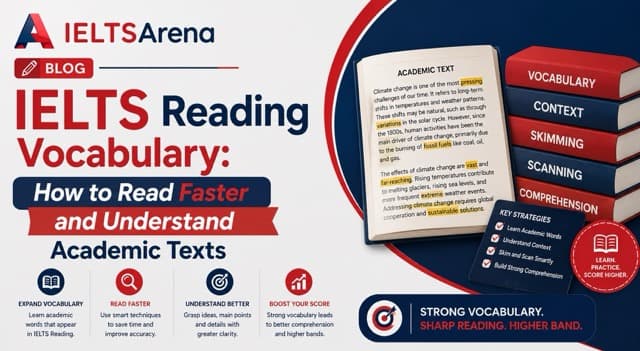
Strong IELTS reading vocabulary is not about knowing rare words. It is about instantly recognising the common academic words that appear again and again, so your brain never stops on them.
Advertisement
Why Common Approaches Fail
Most test-takers make one of three mistakes with vocabulary for IELTS reading.
The first mistake is memorising long word lists in isolation. You learn a word, its meaning, and move on. Two days later the word is gone because you never saw it in context and never used it.
The second mistake is translating everything into your first language. This slows you down badly. In the exam you have no time to translate. You need to think directly in English, and word lists studied through translation do not build that reflex.
The third mistake is ignoring vocabulary completely and hoping speed-reading tricks will save you. Skimming and scanning are useful, but they collapse the moment you hit words you do not know. You cannot scan for an answer if you cannot recognise the words that signal it.
There is also a quieter problem. Many students only recognise a word in one form. They know "analyse" but freeze at "analytical" or "analysis." IELTS passages shift word forms constantly, and this is where a limited vocabulary range quietly costs marks.
Reading vocabulary is not about how many words you have seen once. It is about how many words you recognise instantly, without stopping.
A Realistic Student Story
Miguel, a mechanical engineer from the Philippines, needed Band 7.0 in Reading for a skilled migration application. His first two attempts stalled at Band 6.0.
His problem was not comprehension. When he read a passage slowly at home, he understood it well. Under timed conditions, he panicked. "I kept meeting words like 'mitigate' and 'inherent' and my brain just froze," he said. "By the third passage I was rushing and guessing."
Miguel changed his method. Instead of memorising random word lists, he practised full timed passages and kept a running log of every academic word that stopped him. He grouped words by topic and by word family. He reviewed them inside real sentences, not as isolated entries.
Within six weeks his recognition speed improved sharply. On his next attempt he scored Band 7.5 in Reading. "The words stopped being obstacles," he said. "I could finally read at a normal pace and actually finish."
Miguel did not learn thousands of new words. He learned the few hundred that IELTS academic reading passages use repeatedly, and he learned them properly.
Data and Insight: How Vocabulary Shapes Your Band
Research on academic English gives a useful benchmark. Studies published in applied linguistics journals suggest that understanding around 95 to 98 percent of the words in a text is needed for comfortable reading comprehension. Below that threshold, comprehension drops steeply and reading slows down.
The most widely cited academic vocabulary research, the Academic Word List developed at Victoria University of Wellington, identified 570 word families that appear across academic texts in every subject. These words make up a large share of the vocabulary in IELTS-style passages.
That number matters. It means the vocabulary you need for IELTS reading comprehension is finite and learnable. You are not chasing an endless dictionary. You are targeting a defined set of high-frequency academic words.
There is also a scoring reality. The IELTS Reading band is raw and unforgiving. On Academic Reading, roughly 30 correct answers out of 40 typically maps to around Band 7.0, and about 23 correct maps to around Band 6.0, according to published IELTS band conversion guidance. A handful of questions lost to unknown words can drop you a full band.
This is why IELTS word knowledge is one of the highest-return areas to train. Small vocabulary gains convert directly into faster reading and more correct answers.
The Right Approach to Building IELTS Reading Vocabulary
Here is a method that builds usable IELTS reading vocabulary instead of forgotten lists.
- Learn word families, not single words. When you learn "economy," also learn "economic," "economics," "economical," and "economically." IELTS passages switch forms constantly. Learning the family means no form can surprise you.
- Master the Academic Word List first. These 570 word families are the backbone of academic reading vocabulary. Prioritise them over rare topic words. They give you the widest coverage across every passage type.
- Build topic-specific word lists. Certain themes appear repeatedly in IELTS academic reading passages: environment and climate, technology and innovation, health and medicine, education, business and economics, history and archaeology, and animal behaviour. Build a short IELTS reading word list for each theme.
- Learn to guess from context. You will always meet unknown words in the exam. Use the surrounding sentence, the logic of the paragraph, and signal words like "however," "because," and "as a result" to work out meaning. You do not need the exact definition, only the general sense.
- Study words inside real sentences. Never learn a word alone. Learn it inside a sentence so you absorb how it is actually used. This builds recognition speed, which is what the exam tests.
- Practise under time pressure. Vocabulary you can recall slowly is not enough. You need to recognise words at reading speed. The only way to train that is timed practice with real passages.
- Review with spaced repetition. Revisit new words after one day, three days, and one week. Spacing your review is what moves a word from short-term memory into instant recognition.
How IELTSArena Builds Your Reading Vocabulary in Context
Word lists alone will not fix reading speed. You build IELTS reading vocabulary by meeting academic words repeatedly inside real passages, under real timing. That is exactly what IELTSArena is designed for.
IELTSArena gives you a large library of authentic IELTS-style reading passages across every common academic topic, from climate science to economics to archaeology. You meet the same high-frequency academic vocabulary again and again, in context, which is how recognition speed actually develops.
The platform replicates the real IELTS CBT interface, including the highlighter and notepad. You can highlight unfamiliar words as you read, then review them afterwards. This turns every practice test into a personalised vocabulary lesson built from your own gaps.
IELTSArena also tracks your performance across every mock test. Its progress analytics show which passage types and question types cost you marks, so you know whether your weakness is vocabulary, timing, or a specific question format. Over 10,000 learners have used IELTSArena to move from guessing at unknown words to reading academic texts with confidence.
Because IELTSArena is free to start, you can take a full timed reading test today and see exactly where your vocabulary is holding your band score back. You can begin on IELTSArena and read your first real passage in minutes.
Self-Diagnosis: Is Vocabulary Holding Your Reading Score Back?
Answer these honestly to find out whether your IELTS reading vocabulary needs work.
- Can you finish all three passages and 40 questions in 60 minutes without rushing the last one?
- When you meet an unknown word, can you guess its meaning from context without stopping your reading?
- Do you recognise different forms of the same word instantly, such as "sustain," "sustainable," and "sustainability"?
- Can you read a passage on an unfamiliar topic, like archaeology or economics, and still follow the main argument?
- Do you know the common academic words for the most frequent IELTS topics without translating them first?
If you hesitated on two or more of these, vocabulary is likely your main barrier, and it is one of the fastest areas to improve.
Start Reading Faster Today
Your IELTS reading vocabulary is not fixed. It is a skill you can train in weeks with the right words and the right practice.
Take one free timed reading test on IELTSArena and see where you stand. In a single passage you will learn exactly which words slow you down and how close you are to your target band.
Take a Free Reading Mock on IELTSArena →
Frequently Asked Questions
How much vocabulary do I need to understand IELTS academic reading passages?
You need to recognise roughly 95 to 98 percent of the words in a passage to read it comfortably, according to applied linguistics research. In practice this means mastering the Academic Word List of 570 word families plus common topic vocabulary for themes like environment, technology, and health. You do not need rare or technical terms, because IELTS gives context for those. The priority is instant recognition of high-frequency academic words so your reading never stops. Practising full timed passages on IELTSArena is the fastest way to build this recognition, because you meet the same academic vocabulary repeatedly in real exam context.
How do I guess the meaning of unknown words in IELTS reading passages?
Use three clues. First, read the whole sentence and the sentence before it, because writers often define or explain difficult words nearby. Second, watch signal words like "however," "because," "such as," and "as a result," which show whether the word carries a positive, negative, or contrasting meaning. Third, look at the word parts, since prefixes and roots often reveal the general sense. You rarely need the exact definition to answer a question, only enough meaning to follow the argument. This guessing skill is trainable, and it becomes automatic once you practise on enough real IELTS reading passages.
Should I build vocabulary from IELTS word lists or by reading widely?
Do both, but in the right order. Start with a focused IELTS reading word list, especially the Academic Word List, to cover the high-frequency words efficiently. Then reinforce those words by reading widely in academic-style material and by practising real IELTS passages, so you see the words in natural context. Lists alone build shallow knowledge that fades. Reading alone is slow and unfocused. The combination is what builds durable IELTS word knowledge. On IELTSArena you get both, because every practice passage naturally recycles the core academic vocabulary you are trying to learn.
Which vocabulary topics appear most often in IELTS academic reading passages?
The most frequent themes are environment and climate change, technology and innovation, health and medicine, education, business and economics, history and archaeology, and animal behaviour and biology. Building a short topic-specific word list for each of these covers the vast majority of academic reading passages. You do not need deep subject expertise, just the common vocabulary each topic uses. IELTSArena organises its reading library across these exact themes, so you can practise the vocabulary for each topic in real passages and track which ones still slow you down.
How does a limited vocabulary range affect my IELTS reading band score?
A limited vocabulary range slows your reading, forces re-reading, and makes you miss answers hidden behind unfamiliar words. Because the IELTS Reading band is based on raw correct answers, small losses add up quickly. On Academic Reading, dropping from around 30 correct to around 23 correct can mean the difference between Band 7.0 and Band 6.0, based on published band conversion guidance. Weak vocabulary is often the hidden reason strong readers stall below their target. Building your IELTS reading vocabulary and testing it under timed conditions on IELTSArena is one of the highest-return ways to lift your Reading band.