IELTS Reading is 60 minutes, 40 questions, 3 passages, no extra time for transferring answers. 40 marks out of 40 is Band 9. One wrong answer is still Band 9 on Academic. Thirteen wrong answers on Academic is Band 6, the difference between a Canadian Express Entry pass and a resit. The margins are narrow and the clock is the test.
Most test-takers walk into Reading under-prepared on timing. They can read the passages and understand them. They cannot do it fast enough to answer 40 questions in 60 minutes while also being accurate enough to lose fewer than 10 marks. Reading is the skill where the band is almost entirely determined by how well you manage the clock across three increasingly difficult passages.
This is the complete guide to IELTS Reading in 2026. It covers the full test format for both Academic and General Training, all 14 question types, the raw-to-band conversion tables that decide your score, the four skills Reading actually tests, and a six-week preparation plan that lifts the band by half to one band for most test-takers. Practise every question type at IELTSArena with full-length timed tests and detailed answer explanations.
Quick Answer: The IELTS Reading test is 60 minutes long, with 3 passages and 40 questions. Academic Reading uses three increasingly difficult academic texts. General Training Reading uses three sections (workplace notices, work-related texts, one long general-interest article). The test covers 14 question types across the three passages, including matching headings, true/false/not given, sentence completion, multiple choice, and matching features. There is no extra time to transfer your answers to the answer sheet. The test is marked out of 40 and converted to a band score using a published raw-to-band table: Academic Band 7 is 30 to 32 correct, General Training Band 7 is 34 to 35 correct. From June 2026 the test is only available in computer-delivered format, paper IELTS having been discontinued globally.
Who this is for: Anyone preparing for IELTS Reading, Academic or General Training, from first-time test-takers learning the format to repeat test-takers trying to break Band 6.5 and reach Band 7 or above.
What IELTS Reading Actually Tests
IELTS Reading is not a test of general comprehension. It is a test of four specific skills under tight time pressure: locating information in long texts, understanding the main ideas of paragraphs and passages, identifying the writer's opinion and stance, and recognising paraphrased information. Each question type targets one or two of these four skills.
The passages are not designed to be enjoyable. They are extracted from academic journals, newspapers, textbooks, workplace handbooks, and general-interest magazines, then edited to be exactly 700 to 900 words each. The vocabulary is dense. The topics are deliberately unfamiliar to most candidates, so prior subject knowledge does not help. What matters is whether you can process the specific text in front of you quickly and accurately enough to answer 40 questions correctly.
The time constraint is what makes Reading hard. Most Band 6 candidates can score Band 7 on Reading if they are given 90 minutes instead of 60. The band drops because they run out of time on the third passage, which is the longest and the hardest. Band 7 preparation is 70 percent about timing and strategy, 30 percent about vocabulary.
Academic vs General Training Reading
The two Reading tests share the format but differ in content and in how raw scores convert to bands.
Academic Reading has three passages extracted from academic texts, each 700 to 900 words. Passage 1 is the shortest and easiest. Passage 2 is longer and more complex. Passage 3 is the longest and most abstract, usually drawn from a research journal or a specialist publication. Total: 2,100 to 2,700 words across the three passages.
General Training Reading has three sections with multiple shorter texts mixed in. Section 1 has two or three short texts on everyday topics (notices, advertisements, timetables) totalling around 700 words. Section 2 has two short texts on work-related topics (workplace policies, training materials) totalling around 700 words. Section 3 has one long text on a general-interest topic, 700 to 900 words. Total: around 2,100 to 2,300 words.
Both tests have 40 questions, 60 minutes, and are marked out of 40. The raw-to-band conversion is stricter for General Training because the texts are easier, so GT candidates need more marks correct for the same band. 34 marks correct is Band 7 on GT. 30 marks correct is Band 7 on Academic.
In the 2026 marking approach, the raw-to-band tables stay close to the long-published historical patterns. The exact threshold for a given band can vary by one or two marks between test versions, because IELTS equates the difficulty of each version so that raw scores map to the same real ability regardless of which version you sit.
Test Format: 60 Minutes, 3 Passages, 40 Questions
The full IELTS Reading structure:
| Section | Passages | Questions | Suggested time |
|---|---|---|---|
| Passage 1 | 1 academic text (easiest) | 13-14 questions | 17 minutes |
| Passage 2 | 1 academic text (medium) | 13-14 questions | 20 minutes |
| Passage 3 | 1 academic text (hardest) | 13-14 questions | 23 minutes |
| Total | 3 passages | 40 questions | 60 minutes |
The suggested time split is not official. It is the pacing that most Band 7+ test-takers converge on because the third passage is the longest and most complex, so it needs the most time.
From June 2026, paper IELTS was discontinued globally. All Reading tests are now computer-delivered. There are two modes:
IELTS on Computer (at the test centre). You sit in a test centre and take the Reading section on a computer provided by the centre. The passages appear on screen with a scroll bar, and the question types use native computer interfaces (dropdown menus for multiple choice, drag-and-drop for matching headings, text fields for completion).
IELTS Online (at home or in a booth). You take the Reading section by video-supervised test from home or a test centre booth, with mandatory pre-test ID verification and a stable camera requirement. The content, timing, and marking are identical to the test-centre version.
In both modes, there is no extra time to transfer answers to a separate answer sheet. You type or click answers directly in the computer interface, and the system times out at 60 minutes exactly. This differs from the old paper test, which gave you no extra time on Reading either, but the computer-delivered format makes answer transfer automatic rather than something you had to budget time for.
The 14 IELTS Reading Question Types
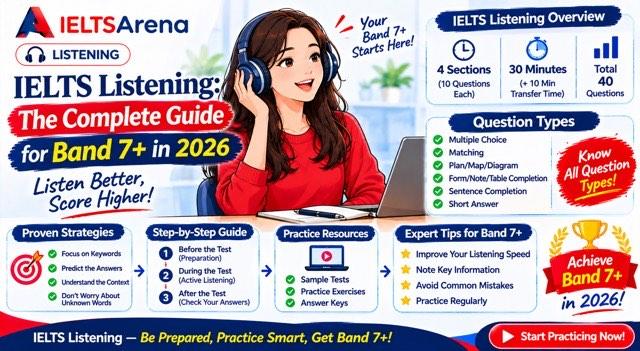
IELTS uses 14 distinct question types across Academic and General Training Reading. Each question type tests a specific skill and has its own strategy. Knowing the type tells you where to look in the text and how to look.
Multiple choice. Pick one of four options. Tests main idea understanding. Answers follow the passage order.
Identifying information (True / False / Not Given). Decide whether a statement matches the passage. Tests precise fact-checking. Answers follow the passage order.
Identifying the writer's views (Yes / No / Not Given). Decide whether a statement matches the writer's opinion or claim. Tests opinion recognition. Answers follow the passage order.
Matching information. Find which paragraph contains a specific piece of information. Tests scanning and location. Answers do not follow passage order.
Matching headings. Match a list of headings to paragraphs in the passage. Tests main-idea recognition at paragraph level. Answers do not follow passage order.
Matching features. Match statements to a list of options (such as people, places, or things). Tests ability to track references. Answers do not follow passage order.
Matching sentence endings. Complete half-sentences with the correct endings from a list. Tests sentence-level comprehension. Answers follow passage order.
Sentence completion. Complete sentences using words from the passage, subject to a word limit (usually "no more than three words"). Tests precise location and copy. Answers follow passage order.
Summary completion. Complete a summary paragraph using words from the passage or from a word bank. Tests passage-wide comprehension. Word-bank version allows synonyms; passage-word version requires exact copy from the text.
Note completion. Complete notes using words from the passage. Tests selective reading. Answers follow passage order.
Table completion. Complete a table using words from the passage. Tests ability to read structured information.
Flow-chart completion. Complete a flow chart or process diagram using words from the passage. Tests ability to read a process.
Diagram label completion. Complete labels on a diagram using words from the passage. Tests ability to connect text to visual.
Short-answer questions. Answer a question in a few words from the passage (word limit applies). Tests specific fact location. Answers follow passage order.
A typical Reading test uses 5 to 8 different question types across the three passages. Matching headings and matching information are the two most common question types across Academic. Multiple choice and sentence completion are the two most common across General Training.
Raw Score to Band Conversion
The raw-to-band table for Academic Reading in 2026 is approximately as follows. Exact thresholds vary by one or two marks between test versions because IELTS equates difficulty across versions.
Academic Reading (approximate 2026 thresholds):
| Raw score | Band |
|---|---|
| 39-40 | 9.0 |
| 37-38 | 8.5 |
| 35-36 | 8.0 |
| 33-34 | 7.5 |
| 30-32 | 7.0 |
| 27-29 | 6.5 |
| 23-26 | 6.0 |
| 19-22 | 5.5 |
| 15-18 | 5.0 |
| 13-14 | 4.5 |
| 10-12 | 4.0 |
General Training Reading (approximate 2026 thresholds):
| Raw score | Band |
|---|---|
| 40 | 9.0 |
| 39 | 8.5 |
| 37-38 | 8.0 |
| 36 | 7.5 |
| 34-35 | 7.0 |
| 32-33 | 6.5 |
| 30-31 | 6.0 |
| 27-29 | 5.5 |
| 23-26 | 5.0 |
| 19-22 | 4.5 |
| 15-18 | 4.0 |
Two practical implications. First, Academic Reading is more forgiving on raw score for the same band. A test-taker aiming Band 7 can lose 8 to 10 marks on Academic but only 5 to 6 marks on General Training. Second, at Band 7 and above, there is very little margin. Every wrong answer costs something, and two or three wrong answers at the top end can drop the band by half a point.
Asel's Story: Band 6 to Band 7.5 in Six Weeks
Asel is a 30-year-old banking analyst from Bishkek applying to the University of Toronto Rotman MBA. The programme required IELTS 7.0 overall with no band below 6.5. Her first mock test came back at Band 6 on Academic Reading, with the specific pattern: Passage 1 at 11 out of 13 correct, Passage 2 at 9 out of 14, Passage 3 at 4 out of 13.
Asel did not have a vocabulary problem. Her Passage 1 score showed she could read academic English comfortably. Her Passage 3 score showed she ran out of time. By the time she reached the third passage, she had 10 minutes left for 13 questions, and the passage was the longest and most abstract of the three.
For six weeks, Asel practised Reading with a specific focus on pacing. She set a 17-minute timer for Passage 1, a 20-minute timer for Passage 2, and forced herself to finish within time regardless of how many questions she could answer. The first two weeks she consistently ran over on Passage 2 and had almost no time for Passage 3. The next two weeks she started skipping Passage 2 matching-headings questions she was stuck on and marking them for review so she could reach Passage 3 on time.
"I was trying to answer every question in order. I would get stuck on one matching-headings question for four minutes and never make it to Passage 3. Once I learned to skip and come back, my overall score went up by 10 marks even though I was spending less time per question."
Her next official test came back at Band 7.5 on Reading. Vocabulary and comprehension did not change. What changed was pacing discipline, question-skipping strategy, and timer-enforced practice. 10 extra marks across the test came entirely from reaching Passage 3 with time left.
The Four Skills IELTS Reading Actually Tests
Every question type maps to one or more of these four skills. Diagnosing which skill is holding your band back is the first step to targeted preparation.
Skill one: locating information (scanning). Finding a specific piece of information in a 700 to 900 word passage without reading it word for word. Tested by matching information, matching features, short-answer questions, sentence completion, and most completion types. The most mechanical skill and the one that improves fastest with practice.
Skill two: understanding main ideas (skimming). Grasping what a paragraph or passage is about in 30 to 60 seconds without reading every sentence. Tested by matching headings, multiple choice, summary completion. The skill most Band 6 to 6.5 candidates lack because they default to reading every word.
Skill three: identifying writer's opinion (inference). Deciding what the writer thinks about the topic, not just what facts they present. Tested by yes/no/not given and some multiple choice. The skill that caps most candidates at Band 6.5, because the difference between a stated opinion and an implied opinion is subtle.
Skill four: recognising paraphrase (vocabulary range). Understanding that the question wording and the passage wording often use different words for the same idea. Tested by all question types but most directly by sentence completion and summary completion. The skill that caps most candidates below Band 6, because missing the paraphrase means missing the answer even when you have found the right part of the passage.
Most candidates have strong skill one and skill four and weak skill two and skill three. Targeted practice on skimming for main ideas and inference on writer's opinion typically produces the fastest band lift.
Band 6 vs Band 7 vs Band 8 Reading Strategy
Same passage, same question type, three different approaches to the same text.
Band 6 approach. Reads the passage from start to finish, highlighting key words as they go. When they reach the first question, they have spent 8 minutes reading. They answer the first few questions correctly but run out of time on later passages. Typical score: 23 to 26 correct, Band 6.
Band 7 approach. Skims the passage for 2 to 3 minutes to get the main idea of each paragraph. Goes to the first question, uses key words from the question to scan back to the relevant paragraph, reads that paragraph carefully, answers the question, moves on. Answers follow passage order where the question type allows it, so the scanning is efficient. Typical score: 30 to 32 correct, Band 7.
Band 8 approach. Spends 60 to 90 seconds on an initial skim to map paragraph topics. Goes directly to the questions. Uses question key words and paraphrase recognition to locate answers quickly. Skips any question that takes more than 90 seconds and comes back to it at the end. Rarely reads a full paragraph word for word. Typical score: 35 to 36 correct, Band 8.
The jump from Band 6 to Band 7 is almost entirely about not reading the passage before the questions. The jump from Band 7 to Band 8 is about faster scanning, better paraphrase recognition, and disciplined skipping.
Common Mistakes That Cap Reading at Band 6
Seven habits that consistently stop otherwise strong candidates from reaching Band 7.
Reading the full passage first. Burns 6 to 10 minutes per passage with nothing scored. Reaches Passage 3 with no time left.
Answering questions strictly in order and getting stuck. A single matching-headings question can swallow 4 minutes. Band 7 candidates skip and come back.
Confusing True/False/Not Given with Yes/No/Not Given. The first tests facts, the second tests the writer's opinion. Treating them the same way drops marks.
Choosing "Not Given" by default when uncertain. The three answer distributions are approximately equal, so defaulting to one option drops marks. If you are genuinely unsure, pick the one that best matches the passage logic.
Changing answers at the end without strong reason. First-instinct answers on IELTS Reading are correct about 70 percent of the time. Second-guess changes are correct about 40 percent of the time. Only change an answer if you find a specific error in your original reasoning.
Over-reading the question wording. The question wording is a clue to where to look in the passage, not the answer itself. Band 7 candidates spend 10 seconds reading the question and 50 seconds locating the answer.
Writing more words than the word limit allows. "No more than three words" means three words maximum. Four words marks the answer wrong even if the content is correct. Band 7 candidates always count their words before moving on.
Where IELTSArena Fits Into Your Reading Preparation
Reading preparation needs three things: a volume of practice passages that match real test difficulty, enforced timing, and detailed answer explanations so you understand why you got each answer wrong. Most free online Reading practice gives you one or two of these three. Few give you all three.
IELTSArena's Reading practice runs on the Real CBT Interface, which means every passage you practise uses the same scroll, highlight, and interface features as the actual computer-based test. The 60-minute timer is enforced, with a warning at the five-minute mark. The passage bank is drawn from Cambridge-equivalent material calibrated to match the real test difficulty, with Passage 1, 2, and 3 at the correct ascending complexity.
After every practice test, you get a question-by-question explanation: which part of the passage the answer came from, why the correct option matches, why each incorrect option fails, and which skill the question was testing. The feedback lets you see whether your wrong answers clustered on one skill (locating information, main ideas, writer's opinion, paraphrase) or on one question type (matching headings, yes/no/not given).
For the two or three mock tests closest to your official exam, Expert Tutor Review is available on request. A trained IELTS examiner reviews your test, identifies the two question types most responsible for your lost marks, and gives you a focused drill plan for the final weeks.
More than 10,000 learners have used IELTSArena to lift their Reading band. Take your first full-length Reading practice test today at IELTSArena, and you will know your current band and your weakest question type within 70 minutes of starting.
The Six-Week Reading Preparation Plan
A realistic plan for a test-taker currently at Band 6 aiming for Band 7. This assumes 45 to 60 minutes per day, five days a week.
Week 1: format and diagnosis. Learn all 14 question types. Take one full-length Reading test on IELTSArena under the 60-minute timer. Review the detailed explanations and identify which question types you got wrong most often and which passage (1, 2, or 3) dragged your score down.
Week 2: pacing drills. Three sessions. Each one: one passage under a strict timer (17 minutes for Passage 1, 20 for Passage 2, 23 for Passage 3). Focus: reach the end of the passage with time to check before moving on. Do not worry about accuracy yet.
Week 3: question-type drills. Three sessions. Each one focused on your two weakest question types. 20 to 30 questions of that type per session with explanations reviewed after. Target: raise your accuracy on those two types by 30 percent.
Week 4: strategy drills. Three sessions. Each one a full passage with the explicit instruction to skip any question taking more than 90 seconds and come back at the end. Target: build the muscle memory for skipping without panic.
Week 5: full mock tests. Three full 60-minute Reading tests with per-question feedback. Review every wrong answer. By end of week 5 your overall band should be at Band 6.5 to 7.
Week 6: pre-test polish. Two full mock tests, the second with Expert Tutor Review. Focus on any question type still showing weakness. Rest for two days before the official test.
30 practice sessions across six weeks, half to one band of improvement for most candidates at Band 6 to 7. The improvement comes almost entirely from pacing, strategy, and question-type familiarity, not from vocabulary expansion.
Self-Diagnosis: Where Is Your Reading Right Now
Take a full-length Reading test under timed conditions and answer honestly.
- Did you reach Passage 3 with at least 20 minutes of time left on the clock?
- Did your accuracy drop by more than 20 percent between Passage 1 and Passage 3?
- Can you name which two question types you got wrong most often?
- Did you skip any question and come back to it, or did you answer strictly in order?
- Did you change more than two first-instinct answers at the end of the test?
If you answered no to question 1 or question 4, pacing and skipping are your top fixes. If you answered yes to question 2, mental fatigue management across three passages is your focus. If you answered no to question 3, you need more detailed question-by-question feedback. If you answered yes to question 5, trust your first-instinct answers more.
Take Your First Reading Mock Test Today
60 minutes, three passages, 40 questions, detailed answer explanations within minutes. Start free at IELTSArena. No credit card and no commitment.
Related Guides
These sit inside the Reading cluster on IELTSArena. Work through them as you drill specific question types.
- Reading Matching Sentence Endings
- Reading Sentence Completion
- Reading Short Answer Questions
- Reading Practice With Explanations
- IELTS Reading Yes / No / Not Given
- IELTS Reading True / False / Not Given
- IELTS Reading Multiple Choice Questions
- IELTS Reading Matching Headings
- IELTS Reading Matching Information
- IELTS Reading Summary Completion
- IELTS Reading Tips for 2026
- Academic vs General Training Reading
- IELTS Reading Skimming and Scanning
FAQ
What is the IELTS Reading test? IELTS Reading is a 60-minute test with 3 passages and 40 questions, marked out of 40 and converted to a band score on the 9-point IELTS scale. There are two versions: Academic Reading uses three increasingly difficult academic texts, and General Training Reading uses three sections (workplace notices, work-related texts, one long general-interest article). The test covers 14 distinct question types across the three passages, including matching headings, true/false/not given, sentence completion, multiple choice, and matching features. From June 2026 the test is only available in computer-delivered format, paper IELTS having been discontinued globally. The content, timing, and marking are identical across the two computer-delivered modes (at test centre and online from home).
How long is the IELTS Reading test? The IELTS Reading test is 60 minutes long. There is no extra time to transfer answers to a separate answer sheet; answers are typed or clicked directly in the computer interface, and the system times out at 60 minutes exactly. Most Band 7+ test-takers converge on a pacing of around 17 minutes for Passage 1, 20 minutes for Passage 2, and 23 minutes for Passage 3, because the third passage is the longest and most complex. The time constraint is what makes Reading hard. Most Band 6 candidates could score Band 7 if given 90 minutes instead of 60. Pacing is 70 percent of the Band 7 preparation challenge.
How many questions are in IELTS Reading? There are 40 questions total across the three passages, with approximately 13 to 14 questions per passage. Each question is worth one mark. The 40 marks are converted to a band score using a published raw-to-band table. For Academic Reading, Band 7 is typically 30 to 32 correct, Band 8 is 35 to 36 correct. For General Training Reading the thresholds are stricter because the texts are easier: Band 7 is 34 to 35 correct, Band 8 is 37 to 38 correct. Exact thresholds vary by one or two marks between test versions because IELTS equates difficulty across versions so that raw scores map to the same real ability regardless of which version you sit.
How is IELTS Reading marked? IELTS Reading is marked objectively: each of the 40 questions is worth one mark, there are no partial credit answers, and the raw total out of 40 is converted to a band score using a published table. There is no examiner judgement involved, unlike Writing and Speaking. Spelling and grammar matter in completion questions (sentence completion, summary completion, note completion, table completion, short answer): a correctly located answer with a spelling mistake is marked wrong. Word limits also matter: "no more than three words" means three words maximum, and four words marks the answer wrong even if the content is correct. Capitalisation does not matter. UK and US spelling are both accepted.
What are the IELTS Reading question types? IELTS Reading uses 14 question types across Academic and General Training: multiple choice, identifying information (true/false/not given), identifying the writer's views (yes/no/not given), matching information, matching headings, matching features, matching sentence endings, sentence completion, summary completion, note completion, table completion, flow-chart completion, diagram label completion, and short-answer questions. A typical test uses 5 to 8 different types across the three passages. Matching headings and matching information are the two most common on Academic Reading. Multiple choice and sentence completion are the two most common on General Training. Each question type tests a specific skill (locating information, understanding main ideas, identifying writer's opinion, or recognising paraphrase) and has its own strategy.