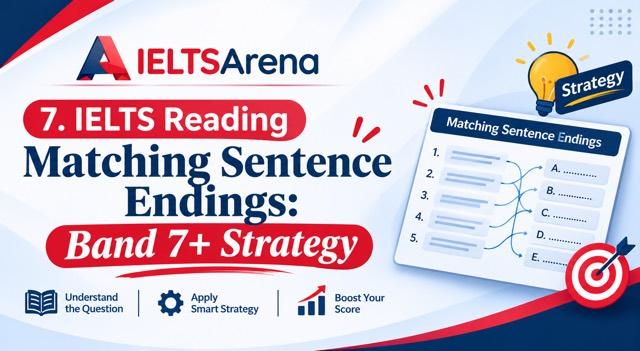
Matching Sentence Endings is the Reading question type most test-takers get wrong without realising it. The question gives you half-sentences and a list of endings, and you have to pick the ending that correctly completes each half-sentence according to the passage. On paper this sounds mechanical. In practice, a test-taker at Band 6.5 will often score 2 out of 5 on a Matching Sentence Endings set while scoring 11 out of 13 on the rest of the passage, because the ending options are designed to look plausible even when they are wrong.
The failure mode is specific. You find the right part of the passage, you find a half-sentence that matches, and you pick an ending that reads smoothly in English but does not actually come from the passage. The question is not testing grammar. It is testing whether the completed sentence matches what the passage actually says, not what sounds reasonable in general.
This guide gives you the four-step method that reliably produces Band 7 accuracy on Matching Sentence Endings, the three distractor patterns examiners build into every set, and a worked Band 6 vs Band 7 example on the same question. Practise timed Matching Sentence Endings sets at IELTSArena and get per-question explanations that show you exactly why each wrong ending is wrong.
Quick Answer: Matching Sentence Endings in IELTS Reading gives you 4 to 7 half-sentences and a longer list of endings (usually 7 to 10). Your job is to match each half-sentence to the ending that correctly completes it according to the passage. Answers follow passage order. More endings are provided than half-sentences, so some endings are unused. The four-step method: read the half-sentences first and underline the key noun, scan the passage in order to find each key noun, read the full sentence in the passage containing it, then pick the ending that matches the passage's meaning (not the ending that reads most smoothly). Target 1 to 1.5 minutes per question. Distractors use the same key noun as the correct answer but attach a wrong detail to it.
Who this is for: Academic and General Training Reading candidates at Band 5.5 to Band 7.5 who lose two or more marks per Matching Sentence Endings set because the wrong endings look plausible when read in isolation.
What Matching Sentence Endings Actually Tests
Matching Sentence Endings is listed by IELTS as question type 7 of the 14 Reading question types. It appears on both Academic and General Training Reading. A typical set has 4 to 7 half-sentences and 7 to 10 endings. More endings are always provided than half-sentences, so at least 2 to 4 endings are unused distractors.
The question tests three specific skills at once. First, scanning: you have to find the part of the passage each half-sentence refers to. Second, comprehension: you have to understand exactly what the passage says about that part. Third, paraphrase recognition: the half-sentence and the correct ending together express something the passage says, but the words are often reworded.
Answers follow the passage order. This is important because it tells you the first half-sentence refers to information near the start of the passage, the second half-sentence to information slightly later, and so on. You do not need to scan the whole passage for each question. You can move through it sequentially.
Matching Sentence Endings appears in roughly one out of every three IELTS Reading tests, usually on Passage 2 or Passage 3. When it does appear, it usually accounts for 5 of the 13 or 14 questions on that passage, which is why scoring well on it matters disproportionately for your overall band.
Why Most Test-Takers Get Matching Sentence Endings Wrong
Five failure patterns account for almost all the lost marks.
Picking the ending that reads smoothly in English. The distractor endings are designed to make grammatical, readable sentences when attached to any half-sentence. "The study revealed that the species was more adaptable than expected" is a readable sentence. It does not matter if the passage says the species was less adaptable. The question marks it wrong.
Not finding the exact passage sentence. You find the general part of the passage but not the specific sentence. You then guess based on paraphrasing you remember from reading the paragraph, which often matches a distractor better than the correct answer.
Matching keywords instead of meaning. Both the half-sentence and the wrong ending share a keyword from the passage. You pick the ending because of keyword overlap. The correct answer uses a paraphrase of the keyword.
Rushing without re-reading. You find the sentence in the passage, scan the endings, pick the first one that looks plausible, and move on. You never re-read the passage sentence to confirm the ending matches its meaning exactly.
Not using the unused endings as a check. More endings are provided than half-sentences, which means some endings are meant to be rejected. If you cannot see why two or three endings are wrong for every question you have answered, you have probably misread at least one.
Juliana's Story: Band 6.5 to Band 7.5 in Four Weeks
Juliana is a 28-year-old architecture graduate from Medellín applying for a TU Delft MSc in Architecture and the Built Environment. She needed IELTS Academic Band 7 overall with Reading at Band 6.5 minimum. Her first mock test came back at Band 6.5 on Reading, with one specific pattern: 11 out of 13 on Passage 1, 10 out of 14 on Passage 2, 7 out of 13 on Passage 3. The Passage 3 drop was mostly a 5-question Matching Sentence Endings set where she scored 2 out of 5.
Juliana read her wrong answers afterwards. Every single one was a smooth-sounding sentence that bore no relation to what the passage actually said. She had been picking endings that completed the half-sentence into a sensible English sentence, without checking whether the sentence matched the passage.
For four weeks, she drilled Matching Sentence Endings specifically. Three sets a day, 15 questions total, every answer checked against the passage sentence that produced it. She forced herself to copy out the exact passage sentence onto scratch paper before picking an ending. If she could not find the passage sentence, she skipped the question and moved on.
"The question looks like a grammar test and it is not. It is a test of whether you found the right sentence in the passage. Once I stopped guessing which ending sounded good and started requiring myself to find the passage sentence first, my accuracy went from 40 percent to 90 percent in three weeks."
Her next official test came back at Band 7.5 on Reading. The other question types did not change. Matching Sentence Endings went from 2 out of 5 to 5 out of 5 on test day, and the Passage 3 lift carried the whole band up.
The Four-Step Method for Band 7 Accuracy
Every Band 7 approach to Matching Sentence Endings follows the same four moves. Memorise them, drill them until they are automatic, and your accuracy will move from 40 percent to 80 percent in three weeks.
Step one: read all the half-sentences first. Before you look at the endings, read the 4 to 7 half-sentences and underline the key noun or name in each. The key noun is usually a specific thing (a person, a place, a study, a theory, a species, a method). This is what you will scan for in the passage.
Step two: scan the passage in order. Starting from the top of the passage, scan for the key noun from half-sentence 1. Stop when you find it. Then continue scanning for the key noun from half-sentence 2, starting from where you stopped. Because answers follow passage order, you never need to scan backward.
Step three: read the full passage sentence that contains the key noun. Not just the phrase, not just the clause. Read the whole sentence and the one after it if needed. Make sure you understand what the passage is saying about that key noun.
Step four: pick the ending that matches the passage sentence. Read the half-sentence plus each candidate ending as a complete sentence. The correct ending will produce a sentence whose meaning matches what the passage says. Reject any ending that produces a smooth but inaccurate sentence.
The method is slower than guessing but much more accurate. Budget 1 to 1.5 minutes per question. A 5-question Matching Sentence Endings set should take 6 to 8 minutes total.
The Three Distractor Patterns Examiners Build In
Examiners who write Matching Sentence Endings questions use three specific distractor patterns. Recognising the pattern makes the trap easier to spot.
Pattern one: the correct detail, wrong direction. The passage says "the species adapted faster than expected". The distractor ending says "adapted more slowly than expected". Both use the "adapted ... than expected" frame. The direction of the comparison is flipped. Band 6 candidates often miss the direction and pick the familiar frame.
Pattern two: the correct key noun, wrong attribute. The passage talks about Study A and Study B. Study A found X. Study B found Y. The distractor swaps the attributes: it attaches Study A to Y and Study B to X. Band 6 candidates often pick the ending that matches the key noun without checking which attribute goes with it.
Pattern three: the real-world truth, not the passage truth. The passage says "contrary to popular belief, the practice began in 1850". The distractor ending says "the practice began in 1750", which is the popular belief. A test-taker who remembers the general topic but not the specific passage will pick the ending that matches what they already knew, not what the passage actually said.
Spotting the pattern is faster than analysing the ending from scratch. Pattern one takes 10 seconds to identify. Pattern two takes 15 seconds. Pattern three takes 20 seconds. If you can name which distractor pattern each wrong ending uses, you can reject it quickly and lock in the correct answer.
Worked Example: Band 6 vs Band 7 on the Same Question
Short extract from a sample passage about bee colony collapse:
"Recent research at the University of Lund has challenged the long-standing view that neonicotinoid pesticides are the main cause of colony collapse disorder. The Lund team, led by Dr Eva Lundqvist, studied 240 commercial hives over four years and concluded that varroa mite infestation, not pesticide exposure, was the primary driver of colony failure in 72 percent of cases. However, Lundqvist cautioned that pesticide exposure may still play a significant indirect role by weakening bees' immune systems and making them more vulnerable to mite damage."
Question. Complete the sentence with the correct ending from options A-G.
The research led by Dr Lundqvist concluded that the primary cause of colony collapse in most cases was:
A. neonicotinoid pesticides. B. varroa mite infestation. C. a weakened bee immune system. D. the direct effect of pesticide exposure. E. a combination of environmental factors. F. an unknown pathogen. G. the decline in available nectar sources.
Band 6 approach. The candidate reads the passage quickly, notices the words "pesticides" and "mite" and "immune system", and picks option A because pesticides were mentioned prominently at the start of the extract. Wrong. Band 6 candidates often default to the first prominent keyword without checking the direction.
Band 7 approach. The candidate reads the half-sentence, underlines the key noun "Dr Lundqvist", scans the passage, finds "The Lund team, led by Dr Eva Lundqvist", reads the whole sentence carefully: "studied 240 commercial hives... and concluded that varroa mite infestation, not pesticide exposure, was the primary driver of colony failure in 72 percent of cases". Picks option B. Correct.
Notice the distractor patterns. Option A uses pattern three (the real-world assumption that pesticides cause colony collapse). Option C uses pattern two (the right topic, weakened immune systems, but applied to the wrong claim: the passage says this was an indirect effect, not the primary cause). Option D uses pattern one (the correct direction, pesticide exposure, flipped from indirect to direct). All three distractors sound plausible in isolation. Only option B matches the passage's actual meaning.
How Long Should Each Question Take
Target 1 to 1.5 minutes per Matching Sentence Endings question. A typical 5-question set should take 6 to 8 minutes total out of the 60 minutes you have for Reading. If a set is taking you 15 minutes, you are over-reading each candidate ending and probably still getting half of them wrong.
The time budget by step:
| Step | Time |
|---|---|
| Read all half-sentences, underline key nouns | 60 seconds (once for the full set) |
| Scan passage for key noun of question 1 | 30 seconds |
| Read the full passage sentence | 20 seconds |
| Compare candidate endings and pick | 30 seconds |
| Total per question (after initial reading) | 80 seconds |
If a question takes more than 2 minutes, mark it, guess your best answer, and come back at the end if time allows. Spending 4 minutes on one Matching Sentence Endings question costs you three questions elsewhere in the test.
Where IELTSArena Fits Into Your Matching Sentence Endings Practice
Matching Sentence Endings is a skill that improves fastest when you can see exactly why each wrong option is wrong. Most free online Reading practice tells you which option is correct. Few tell you which distractor pattern each wrong option uses and why the passage rules it out.
IELTSArena's Reading practice includes per-question explanations for every Matching Sentence Endings set. The explanations identify which passage sentence produced the correct answer, which distractor pattern each wrong option uses, and the specific words in the passage that make each wrong option rejectable. You can submit unlimited practice sets and get unlimited explanations.
For the two or three mock tests closest to your official exam, Expert Tutor Review by a trained IELTS examiner gives you a focused drill plan on Matching Sentence Endings if that is one of the question types still costing you marks. More than 10,000 learners have used IELTSArena's Reading tools to lift their band this way.
Start free, drill one 5-question Matching Sentence Endings set at IELTSArena, and you will see the four-step method in action with worked explanations on every answer.
Self-Diagnosis: Where Is Your Matching Sentence Endings Right Now
Take a 5-question Matching Sentence Endings set under timed conditions and answer honestly.
- Did you read all the half-sentences before looking at the endings, or did you move from question to question?
- Did you find the specific passage sentence that produced each correct answer, or did you guess from paragraph-level comprehension?
- For every wrong answer you chose, can you identify which of the three distractor patterns it used?
- Did any single question take more than 2 minutes?
- Did you leave any ending unused, even though more endings than half-sentences were provided?
If you answered no to question 1, 2, or 5, your method is incomplete and accuracy will stay below 60 percent. If you answered yes to question 4 without skipping, you are losing time you need for other questions. The four-step method fixes all five of these in three weeks of targeted practice.
Take Your First Matching Sentence Endings Drill Today
Drill one 5-question Matching Sentence Endings set on IELTSArena with per-question explanations and distractor pattern identification. You will know your current accuracy rate and your weakest distractor pattern in 15 minutes. Start free at IELTSArena. No credit card and no commitment.
Related Guides
These sit inside the Reading cluster on IELTSArena. Work through them in order to drill each question type.
- IELTS Reading: The Complete Guide
- Reading Sentence Completion
- Reading Short Answer Questions
- Reading Practice With Explanations
- IELTS Reading Matching Information
- IELTS Reading Matching Headings
- IELTS Reading Summary Completion
- IELTS Reading Yes / No / Not Given
- IELTS Reading True / False / Not Given
- IELTS Reading Multiple Choice Questions
- IELTS Reading Tips for 2026
FAQ
What is matching sentence endings in IELTS Reading? Matching Sentence Endings is one of the 14 IELTS Reading question types. It gives you 4 to 7 half-sentences and a longer list of endings (usually 7 to 10). Your job is to match each half-sentence to the ending that correctly completes it according to the passage. More endings are always provided than half-sentences, so at least 2 to 4 endings are unused distractors. Answers follow the passage order, which means question 1 refers to information near the start of the passage, question 2 to slightly later information, and so on. The question type appears on both Academic and General Training Reading, usually on Passage 2 or Passage 3, and typically accounts for 5 of the 13 or 14 questions on that passage when it appears.
How do I answer matching sentence endings questions? Use the four-step method. Step one: read all the half-sentences first and underline the key noun or name in each. Step two: scan the passage sequentially (from the top), looking for the key noun of each half-sentence in order. Step three: read the full passage sentence that contains the key noun, not just the phrase or clause. Step four: pick the ending that produces a complete sentence matching what the passage actually says, not the ending that sounds smoothest in English. Budget 1 to 1.5 minutes per question. A 5-question set should take 6 to 8 minutes out of your 60-minute Reading test. Practise with per-question explanations at IELTSArena that show you which distractor pattern each wrong ending uses.
Is there a trick for matching sentence endings IELTS? Not a trick, but a reliable method. The question type is designed so that wrong endings sound grammatically smooth and plausible when attached to the half-sentence. You cannot rely on how the completed sentence reads. You have to confirm that the completed sentence matches the specific passage sentence that produced it. The method: find the passage sentence first, then pick the ending. Candidates who pick the ending first and then try to justify it from the passage typically score 40 percent on Matching Sentence Endings. Candidates who find the passage sentence first and then pick the ending typically score 80 to 90 percent. The order of operations is the whole fix.
How many matching sentence endings questions are in IELTS Reading? Matching Sentence Endings does not appear on every IELTS Reading test. It appears in roughly one out of every three tests. When it does appear, it usually accounts for 5 of the 13 or 14 questions on one passage, most often Passage 2 or Passage 3 of Academic Reading or Section 3 of General Training Reading. A single test very rarely has two Matching Sentence Endings sets. If you see a 5-question set on your test, it will usually be the only one, and it typically represents 12 to 13 percent of your total 40 marks. Scoring well on it matters because in a test where it appears, missing 3 of the 5 questions drops your overall band by half a point for most candidates.
How do I spot distractors in matching sentence endings? There are three distractor patterns examiners build into every set. Pattern one: correct detail, wrong direction. The passage says "faster than expected", the distractor says "slower than expected". Pattern two: correct key noun, wrong attribute. The passage talks about Study A and Study B, the distractor swaps which attribute goes with which study. Pattern three: real-world truth, not passage truth. The passage says "contrary to popular belief, X happened in 1850", the distractor says "X happened in 1750" (the popular belief). Recognising which pattern a wrong ending uses takes 10 to 20 seconds and lets you reject it quickly without re-reading the passage. Practise spotting patterns with IELTSArena's per-question explanations that name the distractor pattern for every wrong option.