IELTS Listening is 40 minutes long, 4 sections, 40 questions, one chance to hear each answer. Miss the moment and the answer is gone. There is no rewinding, no pausing, no going back. The audio plays once, you listen, you write your answers, and the test moves on. 40 marks out of 40 is Band 9. Four wrong answers is Band 8.5. A dozen wrong answers is Band 6.
Most test-takers walk into Listening believing it is the easiest of the four skills because they already understand spoken English. That belief is why Band 6.5 is so common. The test does not reward general understanding. It rewards the ability to catch specific words, spellings, numbers, and dates at the exact moment they are spoken, while also reading the next question so you do not miss the next answer. The real skill is parallel processing under time pressure.
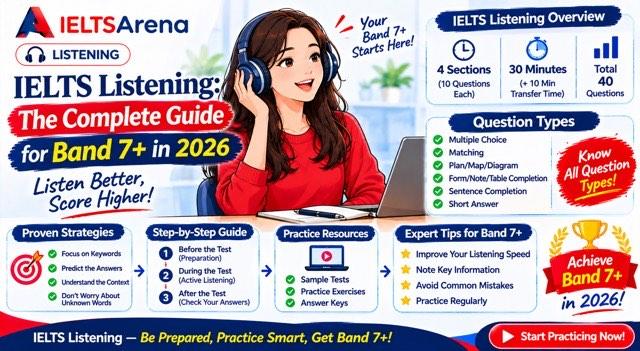
This is the complete guide to IELTS Listening in 2026. It covers the full test format, all four sections in detail, the 10 question types, the raw-to-band conversion tables, the real skills Listening tests, and a six-week preparation plan that lifts the band by half to one point for most test-takers. Practise every section at IELTSArena with real-exam audio, AI-marked answers, and full transcripts to review after each test.
Quick Answer: The IELTS Listening test is 40 minutes long: 30 minutes of audio across 4 sections, plus 10 minutes to transfer answers (on paper) or an automatic 2-minute review (on computer). You hear each recording once only. Section 1 is a 2-speaker conversation on everyday topics. Section 2 is a 1-speaker talk on a familiar social topic. Section 3 is a 2-to-4-speaker conversation in an academic setting. Section 4 is a 1-speaker academic lecture (10 minutes, with only one preview window and no mid-section break). The test uses 10 question types: multiple choice, matching, plan/map/diagram labelling, form completion, note completion, table completion, flow-chart completion, summary completion, sentence completion, and short-answer questions. Marked out of 40, converted to a band using a published table: Band 7 is 30 to 31 correct, Band 8 is 35 to 36 correct. From June 2026 the test is only available in computer-delivered format.
Who this is for: Anyone preparing for IELTS Listening, Academic or General Training (the Listening test is identical for both), from first-time test-takers learning the format to repeat test-takers trying to break past Band 6.5.
What IELTS Listening Actually Tests
IELTS Listening is not a test of whether you understand spoken English. It is a test of whether you can do four specific things under time pressure: catch exact words and numbers in real time, read the next question while the current answer is still being spoken, spell correctly under speed, and recognise paraphrase between the question wording and the audio wording.
The audio uses a mix of accents: British, Australian, North American, New Zealand, and occasionally South African, Irish, or Canadian. Each audio clip is spoken once, at natural speed, with no repetitions. Native English speakers who sit the test score around Band 8 to 8.5 on average, which tells you the test is harder than casual listening comprehension even for people who grew up with the language.
The question types are designed to make you make specific errors. Multiple choice forces you to track three competing options while the audio speaks. Map labelling makes you follow spatial descriptions ("to the left of the library, past the car park, you will see..."). Form completion requires exact spelling of names and addresses, which the speaker often spells out letter by letter and then changes a letter mid-sentence to test whether you were still listening.
Band 7 Listening is specifically about parallel processing: hearing one answer, writing it, and reading the next question at the same time. Most Band 6 candidates can hear and understand the audio, but they finish writing the previous answer just as the next question's audio starts, which means they miss the first few seconds of the next segment. The band drops because of timing, not comprehension.
Test Format: 40 Minutes, 4 Sections, 40 Questions
The full IELTS Listening structure:
| Section | Setting | Speakers | Length | Questions |
|---|---|---|---|---|
| Section 1 | Everyday (phone call, enrolment, booking) | 2 | ~5 min | 10 |
| Section 2 | Social (talk, tour, radio show) | 1 | ~5 min | 10 |
| Section 3 | Academic (tutorial, group project) | 2-4 | ~5 min | 10 |
| Section 4 | Academic (lecture, presentation) | 1 | ~10 min | 10 |
| Total | ~30 min audio | 40 questions |
On the paper test (now discontinued), candidates had 30 minutes of audio plus 10 extra minutes to transfer answers from the question booklet to the answer sheet. From June 2026, paper IELTS is gone globally. The computer-delivered test replaces this with an automatic 2-minute review window at the end, because you type your answers directly into the interface during the audio rather than copying them at the end.
Sections 1, 2, and 3 each have a short preview window (usually 20 to 45 seconds) before the audio starts, so you can read the questions and anticipate what to listen for. Section 4 has only one preview window, before the audio starts. Once the Section 4 lecture begins, it runs for the full 10 minutes without pause, which is why Section 4 is the hardest for most test-takers: no mid-section break means no recovery time if you lose your place.
In the computer-delivered format, answers are typed directly into the interface. For completion questions, the word limit is enforced by the question wording ("no more than two words and/or a number"), not by the interface itself. For multiple choice and matching, you click or select from a dropdown. The 2-minute review at the end lets you check your typed answers but does not replay the audio.
Section 1: Everyday Conversation (10 Questions)
Section 1 is a conversation between two people in an everyday context. Common scenarios include booking a taxi, enrolling in a gym, registering for a course, calling about a lost item, booking accommodation, or arranging an appointment. The topic is deliberately mundane because Section 1 is the easiest section and is designed to let candidates settle in.
The question types in Section 1 are almost always form completion, note completion, or table completion. You fill in blanks on a form or notes using words and numbers from the conversation. The information you need to catch includes: names (often spelled letter by letter), addresses, phone numbers, dates, prices, times, and simple preferences.
The most common Section 1 trap is the spelling change. The speaker says "My name is Johnson, J-O-H-N-S-O-N", then adds "sorry, it is actually Johnston, with a T at the end". If you wrote J-O-H-N-S-O-N after the first spelling and did not update it when the speaker corrected themselves, the answer is marked wrong. Section 1 tests whether you listen to the whole sentence, not just the first version.
Band 7 in Section 1 means 9 or 10 out of 10 correct. Section 1 is where you build your buffer for the harder sections ahead. A Band 7 candidate who scores 7 out of 10 on Section 1 is almost certainly below Band 7 overall, because Sections 2, 3, and 4 are harder and the gap can only widen from here.
Section 2: Social Talk (10 Questions)
Section 2 is a single speaker giving a talk, tour, or radio presentation on a familiar social topic. Common scenarios include a tour guide describing a historical site, a radio presenter introducing a local event, a hotel manager explaining facilities, or a community organiser describing a volunteer programme.
The question types in Section 2 often include multiple choice, matching, and plan or map labelling. Plan or map labelling is the hardest sub-type in this section. The speaker describes a layout ("as you walk through the main entrance, the reception is on your left, past the reception there is a corridor leading to the main hall..."), and you have to match labels (A, B, C, D) to locations on a diagram or map.
The map or plan labelling trap is directional language. "To your left as you enter" means something different from "to the left as you look at the map". Candidates who do not orient themselves to the speaker's position often match the wrong label. The fix is to find the entry point on the map before the audio starts and mentally walk through the map from there.
Band 7 in Section 2 means 8 or 9 out of 10 correct. The 1-point drop from Section 1 is normal because of the added map/plan complexity.
Section 3: Academic Discussion (10 Questions)
Section 3 is a conversation between 2 to 4 speakers in an academic setting. Common scenarios include a tutor advising two students on a research project, a group of students planning a presentation, a supervisor giving feedback on a dissertation, or a panel discussion between tutors.
The question types in Section 3 are usually multiple choice and matching. Matching requires you to track which speaker said what, or which research topic matched which student's interest, or which recommendation applied to which stage of the project. The complexity comes from the number of speakers: when three or four voices discuss a topic, it is easy to attribute a statement to the wrong person.
The most common Section 3 trap is agreement reversal. One speaker says "I think we should use quantitative data". Another responds "yes, that is a good idea, but actually qualitative data would be better for this topic". A candidate listening casually might write "quantitative" because it was the first idea proposed. The correct answer is "qualitative" because the second speaker reversed the agreement. The test rewards listening to the full exchange, not just the first statement.
Band 7 in Section 3 means 7 or 8 out of 10 correct. Section 3 is where the Band 7 vs Band 6.5 gap most often opens up, because the multi-speaker complexity rewards candidates who can hold several ideas in mind at once.
Section 4: Academic Lecture (10 Questions)
Section 4 is a single speaker giving an academic lecture, usually 10 minutes long. Common topics include scientific research (climate, biology, archaeology), social science (education, urban planning, migration), or historical overviews (industrial history, scientific discoveries, cultural movements). The content is academic but accessible to a general audience.
The question types in Section 4 are usually note completion, sentence completion, or summary completion. You fill in blanks in notes that summarise the lecture, using exact words from the audio. The word limit is strict (usually "no more than two words").
Section 4 is the hardest section for three specific reasons. First, it has no mid-section break: the audio runs for 10 minutes straight, so if you lose your place at minute 3, you have 7 minutes left with no recovery window. Second, the questions follow the lecture order strictly, so you have to keep pace with the speaker and read the next question while still writing the previous answer. Third, the academic vocabulary is denser than in the other sections, so unfamiliar terms can throw off comprehension.
Band 7 in Section 4 means 6 or 7 out of 10 correct. A candidate who scores 9 in Section 1 and 4 in Section 4 still averages Band 6.5 or 7, because the raw score adds across all four sections. Section 4 preparation is where most Band 6.5 candidates find the half-band to Band 7.
Raw Score to Band Conversion
The raw-to-band table for IELTS Listening in 2026 is approximately as follows. Exact thresholds vary by one or two marks between test versions because IELTS equates difficulty across versions.
| Raw score | Band |
|---|---|
| 39-40 | 9.0 |
| 37-38 | 8.5 |
| 35-36 | 8.0 |
| 32-34 | 7.5 |
| 30-31 | 7.0 |
| 26-29 | 6.5 |
| 23-25 | 6.0 |
| 18-22 | 5.5 |
| 16-17 | 5.0 |
| 13-15 | 4.5 |
| 10-12 | 4.0 |
Two practical implications. First, Listening is more forgiving at the low end than Reading: a raw of 23 is Band 6 on Listening but only Band 6 on Academic Reading too, so the two are broadly similar at the middle. Second, at Band 7 and above, every wrong answer costs something. Losing 5 marks drops you from Band 8 to Band 7.5, losing 10 drops you from Band 7 to Band 6.5.
The marking rules in 2026: spelling matters (misspellings mark the answer wrong, UK and US spellings both accepted), capitalisation does not matter, word limits are enforced strictly (4 words where 3 is the limit marks wrong), numbers in digit or word form are both accepted.
The 10 IELTS Listening Question Types
IELTS Listening uses 10 distinct question types across the four sections.
Multiple choice. Pick one of three options (A, B, C) or two of five options. Tests main-idea understanding and precise fact-checking. Common in Sections 2 and 3.
Matching. Match items from one list to items from another list (e.g. speakers to opinions, courses to features). Common in Sections 2 and 3.
Plan, map, or diagram labelling. Label locations on a map or parts of a diagram using options from a list. Tests ability to follow spatial descriptions. Most common in Section 2.
Form completion. Fill in blanks on a form using words and numbers from the audio. Tests ability to catch specific details. Most common in Section 1.
Note completion. Fill in blanks in notes using words from the audio. Tests ability to catch key terms while listening. Most common in Section 4.
Table completion. Fill in blanks in a table using words from the audio. Tests ability to track information in structured form. Common in Sections 1 and 2.
Flow-chart completion. Fill in blanks in a flow chart using words from the audio. Tests ability to follow a described process. Common in Section 4.
Summary completion. Fill in blanks in a short summary using words from the audio or from a word bank. Tests overall comprehension. Common in Section 4.
Sentence completion. Fill in blanks in sentences using words from the audio. Tests precise listening. Common in Sections 3 and 4.
Short-answer questions. Answer direct questions in a few words from the audio. Tests specific fact-catching. Less common than the completion types but appears occasionally in Sections 2 or 3.
A typical Listening test uses 5 to 7 different question types across the 4 sections. Form/note/summary/sentence completion together account for about 60 percent of all questions in a typical test.
Noor's Story: Band 6 to Band 7.5 in Six Weeks
Noor is a 29-year-old pharmacist from Tunis applying for UK NHS pharmacist registration via the Overseas Pharmacists Assessment Programme. She needed IELTS Academic Band 7 overall with no band below 6.5, including Listening at Band 7. Her first mock test came back at Band 6 on Listening. The breakdown showed Section 1 at 9 out of 10, Section 2 at 7 out of 10, Section 3 at 6 out of 10, and Section 4 at 4 out of 10.
Noor's problem was clear in the per-section split. She was strong on the easy sections and collapsed on Section 4. The reason was the no-break format: she lost her place at around minute 4 of the lecture and spent the remaining 6 minutes catching up on the wrong questions.
For six weeks, Noor practised Section 4 specifically. One Section 4 a day, five days a week. She drilled the habit of reading all 10 questions during the preview window and marking a short keyword next to each one. During the audio, she tracked the keywords in order rather than trying to catch every word. If she missed one, she made a quick note and moved to the next keyword rather than trying to recover the lost answer in the moment.
"I thought Listening was my best skill because I understand British accents. The problem was never understanding. The problem was that I was still writing the Section 4 answer to question 32 when the speaker reached question 34. The keyword method saved me."
Her next official test came back at Band 7.5 on Listening. Section 4 went from 4 out of 10 to 8 out of 10. Sections 1 to 3 improved by 1 mark each from the general practice volume. The 4-mark lift in Section 4 alone was worth a full band.
The Six Common Mistakes That Cap Listening at Band 6
Six habits that consistently stop otherwise strong candidates from reaching Band 7.
Reading too far ahead during the preview window. You read questions 1 to 10 during the Section 1 preview but forget what question 1 asked by the time the audio reaches it. Preview just the next 3 to 4 questions, not all 10.
Writing the previous answer while the next question is being spoken. You hear the answer to question 5, start writing it, and miss the audio for question 6. Train yourself to write minimally (just the key word) and look back at the question as soon as the answer is spoken.
Mishearing a spelling change. You write the first version of a name or address and do not update when the speaker corrects themselves. Listen for "sorry", "actually", "I mean" as signals that a correction is coming.
Confusing multiple-choice distractors. The speaker mentions all three options before confirming which one is the answer. Track all three during the audio and lock in the answer only when the speaker uses a confirmation signal ("decided", "chose", "went with").
Losing your place in Section 4. The 10-minute lecture has no break. Lose your place and you cannot recover without deliberate practice. The keyword-tracking method is the fix.
Guessing on blanks instead of leaving them empty and moving on. If you missed an answer, do not try to recover it during the audio. Mark it blank, keep pace with the speaker, and return to it during the 2-minute review window.
Where IELTSArena Fits Into Your Listening Preparation
Listening preparation needs three things: a volume of practice audio that matches real test difficulty, enforced one-time playback (no replays), and full transcripts available after the test so you can review what you missed. Most free online Listening practice gives you one or two of these. Few give you all three.
IELTSArena's Listening practice runs on the Real CBT Interface, which means every practice test uses the same timer, answer interface, and 2-minute review window as the actual computer-based test. The audio bank includes native British, Australian, North American, and New Zealand accents calibrated to real test difficulty. Each test includes a full transcript you can review after submission, with the specific audio timestamp for every question's answer marked.
After every practice test, you get per-question explanations: the exact word or phrase in the audio that produced the correct answer, which trap you fell for on wrong answers (spelling change, distractor confusion, keyword mismatch), and your accuracy by section. The per-section breakdown lets you see whether your weakness is Section 4 (most common), multi-speaker tracking in Section 3, map labelling in Section 2, or spelling discipline in Section 1.
For the two or three mock tests closest to your official exam, Expert Tutor Review by a trained IELTS examiner gives you a focused drill plan on the specific question type or section still costing you marks. More than 10,000 learners have used IELTSArena's Listening tools to lift their band this way.
Start free, take one full 40-minute Listening test at IELTSArena, and you will know your current band and your weakest section within 45 minutes of starting.
The Six-Week Listening Preparation Plan
A realistic plan for a test-taker currently at Band 6 to 6.5 aiming for Band 7. This assumes 30 to 45 minutes per day, five days a week.
Week 1: format and diagnosis. Learn the 4-section structure and the 10 question types. Take one full 40-minute test on IELTSArena. Review the per-section scores and identify your weakest section (usually Section 4 or Section 3).
Week 2: Section 4 drills. Five sessions. Each one a Section 4 only (10 questions, 10-minute audio) with transcript review after. Focus on the keyword-tracking method: read all 10 questions during the preview, mark a keyword next to each, track the keywords in order during the audio.
Week 3: Section 3 drills. Five sessions on Section 3. Focus on multi-speaker tracking and agreement-reversal signals.
Week 4: question-type weakness. From your mock tests, identify the one question type that costs you the most marks (usually multiple choice, map labelling, or sentence completion). Five sessions drilling that type across different sections.
Week 5: full mock tests. Three full 40-minute tests this week. Each one with transcript review. By end of week 5 your overall band should be at Band 6.5 to 7.
Week 6: pre-test polish. Two full mock tests, the second with Expert Tutor Review. Focus on any section or question type still showing weakness. Rest for two days before the official exam.
30 practice sessions across six weeks, half to one band of improvement for most Band 6 to 7 candidates. The improvement comes almost entirely from Section 4 strategy, multi-speaker tracking, and mechanical discipline on completion questions.
Self-Diagnosis: Where Is Your Listening Right Now
Take a full 40-minute Listening test under timed conditions and answer honestly.
- Did your Section 4 score drop by 3 or more marks compared to your Section 1 score?
- Did you lose your place at any point in Section 4 and fail to recover?
- On multi-speaker sections, did you attribute any statement to the wrong speaker?
- Did you miss any Section 1 answer because of a spelling correction you did not catch?
- Did you leave the 2-minute review window with any blank answers you had no time to guess at?
If you answered yes to question 1 or 2, Section 4 is your focus. If you answered yes to question 3, Section 3 tracking is your focus. If you answered yes to question 4, Section 1 attention is your focus. If you answered yes to question 5, pacing discipline is your focus.
Take Your First Listening Mock Test Today
40 minutes, 4 sections, 40 questions, full transcript review and per-question explanations within minutes. Start free at IELTSArena. No credit card and no commitment.
Related Guides
These sit inside the Listening cluster on IELTSArena. Drill each section and question type in turn.
- Listening Band 8 Strategy
- Listening Section 1
- Listening Section 2
- Listening Practice With Transcript
- IELTS Listening Section 3
- IELTS Listening Section 4
- IELTS Listening Form Completion
- IELTS Listening Map Questions
- IELTS Listening Multiple Choice
- IELTS Listening Note Completion
- IELTS Listening Spelling Mistakes
Also in this cluster:
FAQ
What is the IELTS Listening test? IELTS Listening is a 40-minute test with 4 sections, 40 questions, and recordings played once only. Section 1 is a 2-speaker everyday conversation (phone call, booking, enrolment). Section 2 is a 1-speaker social talk (tour, radio show, community event). Section 3 is a 2-to-4-speaker academic discussion (tutor and students, group project). Section 4 is a 1-speaker academic lecture (10 minutes, no mid-section break). The test uses 10 question types: multiple choice, matching, plan/map/diagram labelling, form completion, note completion, table completion, flow-chart completion, summary completion, sentence completion, and short-answer questions. Marked out of 40, converted to a band on the 9-point IELTS scale. The Listening test is identical for Academic and General Training candidates. From June 2026 the test is only available in computer-delivered format.
How long is the IELTS Listening test? The IELTS Listening test is 40 minutes long: approximately 30 minutes of audio across the 4 sections, plus a 2-minute review window at the end of the computer-delivered test (the old paper test gave 10 minutes for answer transfer; paper IELTS was discontinued globally in June 2026). You hear each recording once only. There is no pausing, no rewinding, no replaying. Sections 1, 2, and 3 each have a short preview window (20 to 45 seconds) before the audio starts to let you read the questions. Section 4 has only one preview window before the full 10-minute lecture begins, with no break mid-section, which is why Section 4 is the hardest section for most test-takers.
What are the four sections of IELTS Listening? The four sections progress from everyday to academic and from easiest to hardest. Section 1: an everyday conversation between two speakers (10 questions, around 5 minutes of audio). Section 2: a single-speaker social talk or presentation (10 questions, around 5 minutes). Section 3: an academic discussion between 2 to 4 speakers (10 questions, around 5 minutes). Section 4: a single-speaker academic lecture (10 questions, around 10 minutes of continuous audio with no break). Sections 1 and 2 cover everyday and social topics (booking accommodation, campus tours, community events). Sections 3 and 4 cover academic topics (research projects, scientific lectures, historical overviews). Band 7 candidates typically score 9-10 on Section 1, 8-9 on Section 2, 7-8 on Section 3, and 6-7 on Section 4.
How is IELTS Listening marked? IELTS Listening is marked objectively: each of the 40 questions is worth one mark, there is no partial credit, and the raw total out of 40 is converted to a band score using a published table. Band 7 is typically 30-31 correct, Band 8 is 35-36 correct, Band 9 is 39-40 correct. Spelling matters: misspellings mark the answer wrong, and both UK and US spellings are accepted when the word has two valid forms. Capitalisation does not matter. Word limits are enforced strictly ("no more than two words" means 3 words marks wrong). Numbers in digit form or letter form are both accepted. Hyphenated words count as one word. The 2026 marking standard has not changed from previous years.
How do I prepare for IELTS Listening in one month? Spend 30 to 45 minutes a day, five days a week, on structured practice with transcript review. Week 1 diagnose your current band with a full mock test and identify your weakest section (usually Section 4). Week 2 drill Section 4 specifically with the keyword-tracking method: read all 10 questions during the preview, mark a keyword next to each, track them in order during the audio. Week 3 drill Section 3 for multi-speaker tracking and agreement-reversal signals. Week 4 drill the one question type costing you the most marks (often multiple choice or map labelling). In the final week run three full mock tests with transcript review and Expert Tutor Review on the last one. 20 practice sessions with structured feedback typically produce half to one band of improvement for most Band 6 to 7 candidates.