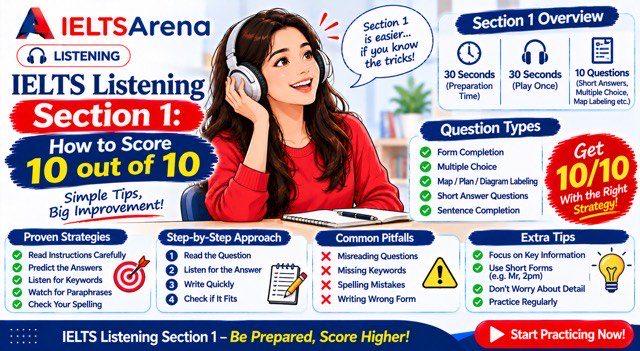
Section 1 is the section every IELTS Listening candidate should score 10 out of 10 on. It is the easiest section by design. The audio is a two-speaker everyday conversation. The question type is almost always form or note completion. The information you need to catch is concrete: names, addresses, phone numbers, dates, prices, times. There is no interpretation, no inference, no multi-speaker ambiguity. You hear the answer and you write it down.
Despite all this, most Band 6 candidates lose 2 to 3 marks on Section 1 and most Band 7 candidates lose 1. Those lost marks are almost never comprehension failures. They are mechanical failures: a spelling slip on "receive", a missed self-correction when the speaker changes a date, a four-word answer when the limit is three. Section 1 is a mechanical test disguised as a comprehension test, which is why Band 7 candidates who learn the mechanics score 10 out of 10 reliably.
This guide gives you the five specific sub-skills Section 1 tests, the six trap patterns that cost Band 7 candidates their marks, a worked Band 6 vs Band 7 example on a sample form, and a three-week drill that lifts most candidates from 7 or 8 out of 10 to a consistent 10 out of 10. Drill one Section 1 a day at IELTSArena with full transcripts and per-question error type identification.
Quick Answer: IELTS Listening Section 1 is a 5-minute, 10-question everyday conversation between two speakers, always the easiest section of the test. The audio is typically a phone call, enrolment, booking, or inquiry where one speaker takes information from the other. The questions are almost always form, note, or table completion with a strict word limit (usually "no more than two words and/or a number"). The information tested is concrete: names, addresses, phone numbers, dates, prices, times, email addresses. Band 7 candidates should score 9 or 10 out of 10 on Section 1. Band 8 candidates should score 10 reliably. The marks lost are almost never comprehension failures. They are spelling slips, missed self-corrections, or word-limit violations. Perfecting Section 1 is the fastest band lift available on the Listening test.
Who this is for: Any IELTS Listening candidate who is scoring less than 10 out of 10 on Section 1 and wants to lock in the easy marks before working on the harder sections. Especially useful for Band 6 to Band 7.5 candidates whose Section 1 performance has stalled at 7 or 8 out of 10.
Why Section 1 Marks Are the Easiest Ones to Keep
Section 1 marks are the cheapest marks on IELTS Listening. The audio is slow, the vocabulary is familiar, the speakers pause between information points, and the question structure (a form you fill in as the conversation progresses) matches the audio flow exactly. A Band 5.5 candidate with no special preparation can usually score 7 or 8 out of 10. A Band 7 candidate with no special preparation scores 8 or 9. The gap to 10 out of 10 is small and almost entirely mechanical.
The implication for your overall band is that Section 1 is your buffer. Band 7 overall requires 30 or 31 marks across all four sections. If you score 10 out of 10 on Section 1, you have 20 or 21 marks to find across the harder sections to reach Band 7. If you score 7 out of 10 on Section 1, you need 23 or 24 marks across Sections 2, 3, and 4, which is much harder. Perfecting Section 1 lowers the overall bar for the rest of the test.
The second implication is that Section 1 is the section where the Band 8 path starts. Band 8 requires 35 or 36 correct out of 40. A candidate scoring 10 on Section 1 has 25 or 26 marks to find across the harder sections. A candidate scoring 8 on Section 1 needs 27 or 28 marks, which for most Band 7 candidates is beyond reach even with full preparation on the other three sections.
The third implication is time efficiency. Three weeks of Section 1 drills (one Section 1 per day, five days a week) typically moves a candidate from 7 or 8 out of 10 to a consistent 10 out of 10. That is 2 or 3 marks gained for 15 practice sessions, which is the best marks-per-hour return on your Listening preparation.
The Five Sub-Skills Section 1 Tests
Section 1 tests five specific sub-skills that each account for a predictable share of the marks.
Sub-skill one: catching exact names and spellings. The speaker often spells out a name letter by letter ("my name is Johnston, J-O-H-N-S-T-O-N"). You have to catch every letter correctly and in the right order. This sub-skill accounts for about 1 to 2 of the 10 questions per Section 1.
Sub-skill two: catching exact numbers. Phone numbers, prices, dates, postal codes, times, quantities. All of these need exact copying. This sub-skill accounts for about 3 to 4 of the 10 questions.
Sub-skill three: catching short noun phrases. "Blue sports jacket", "extra-large pepperoni pizza", "double room with balcony". Short noun phrases usually fit within a 2 or 3 word limit. This sub-skill accounts for about 3 to 4 of the 10 questions.
Sub-skill four: catching self-corrections. The speaker says one thing, then corrects themselves ("the course starts at 7pm, sorry it is 6.30pm"). You have to catch the correction and update your answer. This sub-skill is tested in 2 to 3 of the 10 questions.
Sub-skill five: mechanical discipline. Writing answers within the word limit, with correct spelling, without unnecessary articles. This sub-skill is tested in every question, not as a separate category.
Perfecting all five sub-skills gets you to 10 out of 10. Most Band 7 candidates fail on sub-skill one (misspelling the letter sequence), sub-skill four (missing the self-correction), or sub-skill five (writing too many words). Band 8 candidates have reflex-level control on all five.
The Six Trap Patterns That Cost Section 1 Marks
Section 1 examiners build six specific trap patterns into every test. Recognising the pattern makes the trap easier to avoid.
Trap one: the mid-spelling change. The speaker spells "Johnson, J-O-H-N-S-O-N" and then says "sorry, with a T, Johnston, J-O-H-N-S-T-O-N". If you wrote J-O-H-N-S-O-N and did not update when the T was added, the answer is marked wrong. The signal is any "sorry" or "actually" or "I mean" during the letter-by-letter spelling.
Trap two: the number change. The speaker says "the course starts at 7pm, actually let me check, it is 6.30pm". If you wrote 7pm and did not update to 6.30pm, the answer is wrong. The signal is any "let me check" or "actually" or "wait" after a number is given.
Trap three: the distractor number. The speaker gives two numbers close together, only one of which is the answer. "The deposit is 50 pounds and the full course fee is 450 pounds. The deposit is non-refundable." If the question asks for the deposit, the answer is 50. If it asks for the course fee, the answer is 450. Candidates who write the first number they hear sometimes write 50 when the question asked for the course fee.
Trap four: the word-limit violation. The limit is "no more than two words". The speaker says "a double room with a balcony overlooking the garden". You write "double room with balcony" (4 words). Marked wrong. The correct answer is "double room" or "room with balcony" depending on what the question is asking for.
Trap five: the unnecessary article. The speaker says "bring a photo ID and a bank statement". You write "a photo ID" (3 words including the article). If the question field is grammatically expecting a noun phrase without the article, the article is unnecessary and may tip you over the word limit. Write "photo ID" (2 words) instead.
Trap six: the spelling slip on a common word. The speaker says "the deposit is non-refundable". You write "non-refundeble" or "non-refundable" with a typo. Marked wrong. The most common Section 1 spelling traps are receive, separate, necessary, accommodate, environment, immediately, business, equipment, library, restaurant.
Each trap takes 3 to 4 seconds of extra attention to avoid. Training all six trap patterns in 2 to 3 weeks of drills typically moves a candidate from 7 or 8 out of 10 to 10 out of 10 on Section 1.
Fatou's Story: Band 6.5 to Band 7.5 in Three Weeks
Fatou is a 27-year-old registered nurse from Dakar applying for Canadian Nurses Association registration to work in Ontario. She needed IELTS Academic Band 7 overall with Band 6.5 in each skill. Her first mock test came back at Band 6.5 on Listening. The per-section breakdown showed Section 1 at 7 out of 10, Section 2 at 7, Section 3 at 7, Section 4 at 5.
Fatou's Section 1 wrong answers were revealing. One was a phone number where she had written 0771234567 and the speaker had said 0771234576 (number change she missed). One was a name where she had written Johnson and the speaker had corrected to Johnston. One was a four-word answer where the limit was three. Three marks lost on Section 1 alone, all mechanical.
She realised Section 1 was the cheapest place to find marks. For three weeks she drilled Section 1 only: one Section 1 per day, five days a week, with the transcript open after each test. She focused specifically on the six trap patterns, starting with the mid-spelling change and the number change.
"I had been treating Section 1 as the easy warmup section. The examiner was treating it as a trap-filled gift to candidates who were paying attention. Once I started looking for the traps instead of rushing through the easy section, I stopped losing marks on it."
Her next official test came back at Band 7.5 on Listening. Section 1 went from 7 to 10. Section 2 held at 8. Section 3 moved to 8. Section 4 held at 6. Total 32, Band 7.5. The Section 1 lift alone was worth a full band.
The Four-Step Method for a Perfect Section 1
Every Band 7 approach to Section 1 follows the same four moves.
Step one: read all 10 questions during the preview window. Section 1 has a 20 to 30 second preview before the audio starts. Use it to read every question on the form. Underline the key noun or category for each blank (name, address, date, amount, time, choice).
Step two: predict the grammatical category for each blank. If the blank is next to "Name:", you are expecting a name (letter sequence). Next to "Address:", a street name and number. Next to "Fee:", a currency amount. Predicting the category means you know exactly what kind of information to listen for when the speaker reaches that part of the form.
Step three: listen for the signal that each answer is coming. The signal is usually a direct question from one speaker to the other ("so, what is your date of birth?"). As soon as the signal appears, lock your attention on the next 5 to 10 seconds of audio for the answer.
Step four: write the answer the moment you hear it, then update if the speaker self-corrects. Write the first version you hear. If the speaker says "sorry", "actually", "I mean", "let me check", or similar correction signals in the next sentence, cross out your first answer and write the corrected version.
Budget 30 seconds per question across the 5-minute Section 1 audio, which is faster than later sections. The speed is possible because Section 1 answers are concrete and the audio paces itself around the form.
Worked Example: Band 6 vs Band 7 on a Section 1 Form
Sample Section 1 extract. The scenario: a prospective student (Kasia) calls a language school to enrol in a French course.
Form fields (what the test gives you): Student name: ______ Course: ______ French Start date: ______ Course fee: £______ Book title: ______
Audio transcript extract: "Receptionist: Could I take your name please? / Caller: Yes, it is Kasia Zielinski, that is Z-I-E-L-I-N-S-K-I. / Receptionist: Lovely, so Kasia Zielinski. And which course were you interested in? / Caller: The advanced French course. / Receptionist: Lovely. That starts on the fifteenth of January, actually sorry, let me check, yes it is the twentieth of January. / Caller: The twentieth. / Receptionist: The course fee is 495 pounds, which includes the required textbook. / Caller: What is the textbook? / Receptionist: It is called French for Professionals."
Word limit: NO MORE THAN TWO WORDS AND/OR A NUMBER.
Band 6 answers. Student name: Kasia Zielinsky (misspelled, Band 6 lost mark) Course: Advanced (correct but potentially incomplete depending on question wording) Start date: 15 January (missed the self-correction, wrong) Course fee: £495 (correct) Book title: French for Professionals (3 words, over limit if 2 words is the rule, wrong)
Three marks lost on the first form of the test.
Band 7 answers. Student name: Kasia Zielinski (correct spelling, caught the letter-by-letter) Course: Advanced (correct, 1 word) Start date: 20 January (caught the self-correction) Course fee: £495 (correct) Book title: French for Professionals (if limit is 2 words, this is 3 words and wrong; if limit is "no more than two words and/or a number", this is a book title with 3 content words; the safer answer is a shorter version that fits, perhaps "French for Professionals" counted as a proper noun phrase; in practice IELTS marks proper noun titles as single lexical items, so this often marks correct, but the safer strategy is to avoid testing the ambiguity and copy only the essential title words).
Even on the Band 7 answer, the book title question shows where the Band 8 candidate wins: they recognise the ambiguity, re-read the word limit, and write the answer in the shortest form that the limit unambiguously allows.
Notice the trap density. In 6 seconds of audio (the dates section), the speaker gave two different dates and signalled the correction with "actually sorry, let me check". Band 6 candidates caught the first date and moved on. Band 7 and above caught the correction. One listening reflex worth 1 mark.
The 20 Most Commonly Misspelled Section 1 Answers
Drill these until they are automatic. The 20 most common Section 1 spelling traps in 2026:
receive, separate, necessary, accommodate, accommodation, environment, immediately, occasionally, government, beginning, business, definitely, equipment, library, restaurant, embarrassed, recommend, independent, maintenance, address
Half of these show up on at least one Section 1 test in ten. Zero spelling errors on this list is the baseline for Band 8 Section 1 performance.
The drill: take a Section 1 practice test, note any answer that uses one of the 20 trap words, and if you misspelled it, re-write it 5 times correctly. Over 2 weeks, your spelling error rate on these words drops from 1 or 2 per test to zero.
Names, Numbers, Dates, and Addresses: Specific Rules
Each concrete information type in Section 1 has its own rule.
Names. When spelled letter by letter, write the letters exactly as spoken. If the speaker says "Johnson, J-O-H-N-S-O-N", write Johnson, not any other variant. If the speaker self-corrects ("sorry, with a T, Johnston"), update to Johnston. Capitalisation does not matter, but spelling does.
Phone numbers. Write the digits as spoken, without spaces or dashes unless the speaker clearly separates them. The computer-delivered test accepts 0771234567, 077-123-4567, and 077 123 4567 as equivalent. If the number is a "double" or "triple" ("double seven, triple three"), expand to 7733 or 333 directly.
Dates. Write in the format spoken. "The twentieth of January" is "20 January" or "January 20" or "20/01" or "20th January", all accepted. Year, if given, is written as 4 digits: "twenty-twenty-six" is 2026. Do not add a year the speaker did not say.
Prices. Include the currency symbol if the question field shows one (£, $, €). The answer "495" fills "£______" fields as "£495". If the question field is blank, write the amount with the currency word ("495 pounds") up to the word limit.
Addresses. Street name plus number. The speaker says "fourteen Hill Street". The answer is "14 Hill Street" if the word limit allows 3 words and a number. Postcodes are copied as spoken, usually in blocks of letters and numbers (SW1A 1AA).
Email addresses. Write the full address including the @ and the domain. The speaker says "it is kasia dot zielinski at gmail dot com". The answer is "kasia.zielinski@gmail.com" or "kasia zielinski at gmail com" depending on how the interface handles special characters. In the 2026 computer-delivered format, special characters can be typed directly.
Where IELTSArena Fits Into Your Section 1 Practice
Section 1 is the section where per-question error identification pays off fastest. Most free Listening practice tells you which answers were wrong but not whether they were wrong because of misspelling, missed self-correction, word-limit violation, or distractor confusion. Without that breakdown, your drilling is unfocused.
IELTSArena's Listening practice includes per-question explanations that identify the specific error type on every wrong answer. If you wrote "Johnson" when the speaker corrected to "Johnston", the feedback tells you the self-correction signal you missed and the exact audio timestamp. If you wrote a 4-word answer when the limit was 2, the feedback shows you the shorter correct version.
Each practice test also includes the full transcript, so you can read the exact words the speaker used for every answer and see which trap pattern each wrong answer triggered. The full transcript review is the single most useful feature for perfecting Section 1 because you can see exactly what the audio said versus what you wrote.
For your final two or three mock tests before the official exam, Expert Tutor Review by a trained IELTS examiner catches subtle Section 1 errors that AI sometimes misses (edge-case word-limit interpretations, obscure spelling variants). More than 10,000 learners have used IELTSArena's Listening tools to perfect their Section 1 performance.
Start free, drill one Section 1 today at IELTSArena, and you will see your exact error patterns in 15 minutes.
The Three-Week Section 1 Perfection Plan
A tested plan for most Band 6.5 to Band 7 candidates whose Section 1 is scoring 7 or 8 out of 10.
Week 1: trap identification. Five sessions. One Section 1 per day. After each, review the transcript and identify which of the six trap patterns caused each wrong answer. By end of week 1 you should be able to name your most common trap pattern.
Week 2: spelling discipline. Five sessions. Drill the 20 common misspellings until your spelling error rate drops to zero on the drill list. Each Section 1 practice also focuses on exact-copy spelling with the transcript open to catch any slips.
Week 3: self-correction and word-limit discipline. Five sessions. Focus on catching every self-correction signal and on counting every answer against the word limit before moving on. By end of week 3, your Section 1 score should be at 9 or 10 out of 10 consistently.
15 drills across three weeks, 2 or 3 marks gained on Section 1 alone, which is worth half a band on your overall Listening score for most candidates.
Self-Diagnosis: Where Is Your Section 1 Right Now
Take a Section 1 under timed conditions and answer honestly.
- Did you score 9 or 10 out of 10?
- Did you catch every self-correction the speakers made?
- Did you write any answer that exceeded the word limit?
- Did you misspell any answer?
- Did you miss a number because you wrote the first one you heard instead of the corrected one?
If you answered no to question 1, Section 1 is still a mark source for you. If you answered no to question 2 or yes to question 5, self-correction catching is your focus. If you answered yes to question 3, word-limit discipline is your focus. If you answered yes to question 4, the 20-word spelling drill is your focus.
Take Your First Section 1 Drill Today
Drill one Section 1 on IELTSArena with the full transcript and per-question error type identification. You will know your exact error pattern in 15 minutes. Start free at IELTSArena. No credit card and no commitment.
Related Guides
These sit inside the Listening cluster on IELTSArena. Drill each section in turn.
- IELTS Listening: The Complete Guide
- Listening Band 8 Strategy
- Listening Section 2
- Listening Practice With Transcript
- IELTS Listening Section 3
- IELTS Listening Section 4
- IELTS Listening Form Completion
- IELTS Listening Multiple Choice
- IELTS Listening Map Questions
- IELTS Listening Note Completion
- IELTS Listening Spelling Mistakes
FAQ
What is Section 1 in IELTS Listening? Section 1 is the first of the four IELTS Listening sections and always the easiest. It is a 5-minute everyday conversation between two speakers, typically a phone call, enrolment, booking, or inquiry where one speaker takes information from the other (name, address, dates, preferences). You answer 10 questions about the information given in the audio. The question type is almost always form, note, or table completion with a strict word limit, usually "no more than two words and/or a number". Section 1 tests five specific sub-skills: catching exact names and spellings, catching exact numbers (phone, price, date, time), catching short noun phrases, catching self-corrections, and mechanical discipline (word limits, correct spelling). Band 7 candidates should score 9 or 10 out of 10 on Section 1. Band 8 candidates should score 10 reliably.
How do I get 10 out of 10 on Section 1 Listening? Perfect Section 1 by eliminating the six trap patterns that cost most candidates their marks: mid-spelling changes (speaker spells a name and then corrects a letter), number changes (speaker gives a time or date and corrects it), distractor numbers (two numbers close together, only one is the answer), word-limit violations (writing 4 words when 2 is the limit), unnecessary articles (writing "a photo ID" when "photo ID" is enough), and spelling slips on common traps (receive, separate, necessary, accommodate, environment). Follow the four-step method: read all 10 questions during the preview, predict the grammatical category for each blank, listen for the signal that each answer is coming, write the answer immediately and update if the speaker self-corrects. Three weeks of daily Section 1 drills with transcript review typically takes a candidate from 7-8 out of 10 to a consistent 10 out of 10.
What question types appear in IELTS Listening Section 1? Section 1 almost always uses form completion, note completion, or table completion. The structure presents an incomplete form, notes, or table that you fill in as the two speakers exchange information in the audio. A single Section 1 test typically uses one of these three types across all 10 questions, though occasionally a test will combine two types (6 questions of form completion followed by 4 of table completion, for example). The word limit is usually "no more than two words and/or a number" and is stated at the top of the Section 1 instructions. Multiple choice, matching, and map labelling almost never appear in Section 1; they are reserved for Sections 2, 3, and 4. The completion-only format is why Section 1 is the easiest section for most candidates.
Why do I lose marks on Section 1 Listening? The marks lost on Section 1 are almost never comprehension failures. They are mechanical failures. The five most common causes: misspelling a word (receive, separate, necessary are the most frequent offenders), missing a self-correction (the speaker says "7pm, sorry it is 6.30pm" and you wrote 7pm), writing more words than the limit allows (4 words when 2 is the maximum), writing an unnecessary article ("a photo ID" when "photo ID" is enough), and writing the first number you heard instead of the corrected one (two numbers close together, only the second is the answer). Each of these errors costs 1 mark. Fixing all five mechanical patterns is the fastest marks-per-hour gain on IELTS Listening preparation because Section 1 marks are the easiest to lock in with targeted drilling.
How do I avoid spelling mistakes on Section 1 IELTS? Drill the 20 most commonly misspelled Section 1 words until they are automatic: receive, separate, necessary, accommodate, accommodation, environment, immediately, occasionally, government, beginning, business, definitely, equipment, library, restaurant, embarrassed, recommend, independent, maintenance, address. If you misspell any of these in practice, re-write the correct spelling 5 times immediately. Over 2 weeks, your error rate on these words drops from 1-2 per test to zero. For answers that are names or addresses spelled out letter by letter, write the letters in the order they are spoken and update immediately if the speaker self-corrects a letter (signalled by "sorry", "actually", "with a T", or "no wait"). UK and US spellings are both accepted. Capitalisation does not matter in the computer-delivered test. Hyphenated words count as one word for the word-limit rule.