Section 2 is where IELTS Listening stops being a note-taking exercise and starts being a comprehension test. The single speaker talks for 5 minutes, often takes you on a mental tour of a building or a park or a festival venue, asks you to track which option goes with which description, and gives you three multiple-choice options spread across a single sentence of fast speech. Section 1 forgave hesitation. Section 2 does not.
Most Band 6.5 candidates lose 2 or 3 marks on Section 2, and almost all of them lose at least 1 mark on a map or plan labelling question. The map questions are the headline difficulty: candidates get the direction wrong ("to your left" vs "to the left as you look at the map"), they lose their mental position on the layout, they mistake a landmark for the destination. The multiple-choice questions cost marks differently: the speaker mentions all three options in one sentence, and candidates lock in the first option before the confirmation signal arrives.
This guide gives you the three question types that dominate Section 2, the map-labelling method that keeps you oriented, the three-option tracking rule for multiple choice, the matching strategy for Section 2 lists, a worked example, and a three-week plan that lifts most candidates from 7 or 8 out of 10 to a consistent 9 or 10. Drill one Section 2 a day at IELTSArena with full transcripts and per-question error type identification.
Quick Answer: IELTS Listening Section 2 is a 5-minute monologue by a single speaker on a familiar social topic (tour guide, radio presenter, community organiser, event host). 10 questions, usually a mix of 3 to 4 question types: multiple choice, matching, and plan/map/diagram labelling are the three most common. The single-speaker format means no multi-voice tracking, but the faster pace and the map labelling challenge make Section 2 harder than Section 1. Band 7 candidates should score 8 or 9 out of 10. Band 8 candidates should score 9 or 10. The three dominant failure modes are getting lost on a map (orientation confusion), locking in the wrong multiple choice option before the speaker confirms, and matching the wrong item in a matching set because the speaker described items out of list order.
Who this is for: IELTS Listening candidates at Band 5.5 to Band 8 whose Section 2 score has stalled at 7 or 8 out of 10, especially those losing marks on map labelling or on multiple choice three-option confusion.
Why Section 2 Is Harder Than Section 1
Section 2 feels easier than Section 1 to many first-time candidates because there is only one speaker, no conversation back-and-forth, and no letter-by-letter spelling of names. The reality is the opposite. Section 2 is harder for three specific reasons.
Reason one: faster pace with no conversational pauses. In Section 1, the two speakers naturally pause between information points because they are taking turns. In Section 2, the single speaker delivers a continuous monologue, so the information is denser per second and there are fewer natural pauses where you can catch up.
Reason two: harder question types. Section 1 is almost exclusively completion questions (fill in blanks on a form). Section 2 introduces multiple choice, matching, and map or plan labelling. Each of these three types requires more decision-making per question than completion does. Multiple choice means tracking three options at once. Matching means tracking a list of options against a list of items. Map labelling means tracking spatial orientation while the speaker describes a layout.
Reason three: map labelling has no second chance. If you lose your position on a map during a Section 1 form question, you still hear the next question's information and can catch up. If you lose your position on a map during Section 2, you miss the next 3 or 4 answers because the speaker is still walking through the layout from the point you lost, and every subsequent location description builds on the previous one. One moment of orientation confusion can cost 3 or 4 marks.
The practical implication for your overall band is that Section 2 preparation is specifically about mastering the three new question types that did not appear in Section 1. Generic listening practice does not fix Section 2 the way it does Section 1. Targeted drills on map labelling, three-option tracking, and matching list management are what move the Section 2 score.
The Three Question Types That Dominate Section 2
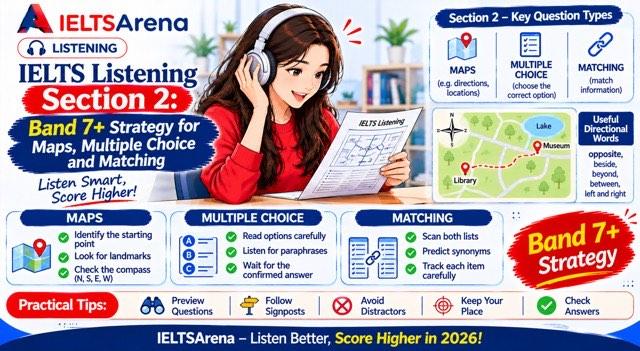
Section 2 almost always uses a mix of three question types. A typical Section 2 might have 4 questions of multiple choice, 4 of map labelling, and 2 of matching. Or 5 of matching and 5 of multiple choice. The mix varies, but these three types appear in Section 2 more often than in any other section.
Multiple choice. You get a question and three options (A, B, C) or occasionally five options where you pick two. The speaker mentions some or all of the options during the audio, often in one sentence, and only one option is correct. The confirmation of which option is correct usually comes after all options have been mentioned, which is why tracking all three is essential.
Matching. You get a list of items (usually 5 or 6) on one side and a list of options (usually 3 to 5) on the other. You match each item to the correct option. In Section 2, the items are often facilities or activities, and the options are often features or audience types. The speaker describes the items one by one, but not always in list order.
Plan, map, or diagram labelling. You get a visual (a map of a park, a plan of a building, a diagram of a device) with 5 to 7 labelled locations (A, B, C, D, E, F, G). You get a list of 5 to 7 items (reception, main hall, cafe, car park, etc.) and match each item to the correct location. The speaker walks through the layout and describes each item's position relative to landmarks or to other items.
Short-answer questions, note completion, and sentence completion sometimes appear in Section 2 but less often than the three above. Form completion and table completion almost never appear in Section 2; they are the signature of Section 1.
The Six Common Failures That Cost Section 2 Marks
Six specific failure modes account for almost all the marks Band 7 candidates lose on Section 2.
Failure one: map orientation confusion. The speaker says "to your left as you enter". You interpret "left" as the viewer's left looking at the map, which is the speaker's right. One wrong interpretation at the start of a map set cascades through every subsequent answer.
Failure two: losing your mental position on the map. The speaker says "walk past the reception, through the corridor, turn right at the main hall, and you will see". If you lose track of where "you" currently are on the map, every subsequent landmark description becomes ambiguous.
Failure three: multiple-choice lock-in. The speaker mentions option A first and you tick A. The speaker then mentions B and C in the same sentence and confirms C as the actual choice. You never update your answer because you had already moved on.
Failure four: matching from the list in the wrong order. You assume the speaker will describe items in the same order as the list on your page. The speaker describes item 3 first, then item 1, then item 2. You try to match in your assumed order and end up assigning item 3's description to item 1.
Failure five: confusing "the" with "a" in matching. The speaker says "one of the activities was the pottery workshop". You match the pottery workshop to the first activity in your list. But the speaker was describing one of several activities, not the first activity specifically. The confirmation came later, in a sentence starting with "another activity we offered was".
Failure six: tracking only the speaker's current landmark, not the destination. On map questions, the speaker often names several landmarks on the way to the final location. Candidates who tick a letter at each landmark mention instead of the final destination end up with the wrong answer.
Each failure mode has a specific fix. Training all six in three weeks of drills typically moves a candidate from 7 or 8 out of 10 to 9 or 10 on Section 2.
Amaka's Story: Band 6.5 to Band 7.5 in Four Weeks
Amaka is a 31-year-old architect from Lagos applying for registration with the Architects Registration Board in the UK. She needed IELTS Academic Band 7 overall with Band 6.5 in each skill. Her first mock test came back at Band 6.5 on Listening. The per-section split was 9, 6, 7, 6, total 28.
Amaka's Section 2 breakdown was revealing. 4 out of 5 map labelling questions wrong. 2 out of 3 multiple choice correct. 1 out of 2 matching correct. The map labelling was the clear bottleneck. She had lost her position on the map at the third question and spent the rest of the audio guessing.
The AI breakdown identified the specific failure: she was interpreting "left" and "right" from the viewer's perspective rather than the speaker's walking direction. Every map description from that point on had been mis-oriented. The fix was to mark her mental position on the map at each landmark description, not at the start of the walk.
For four weeks, Amaka drilled Section 2 map labelling specifically. One map question set per day, five days a week, with the transcript open afterwards. She trained the habit of putting a dot or arrow on the map at every landmark the speaker mentioned, so she always knew where "you" currently were.
"I thought maps were about following directions. They are about not getting lost. The dot-on-the-map trick kept me oriented for the whole 5 minutes instead of for the first 30 seconds. Once I stopped losing my position, the map answers started arriving automatically."
Her next official test came back at Band 7.5 on Listening. Section 2 went from 6 to 9. Section 3 moved to 8 from general drill volume. Section 4 held at 6. Total 32, Band 7.5. The 3-mark lift on Section 2 alone was worth half a band.
The Map Labelling Method for Band 7 Accuracy
Every Band 7 approach to Section 2 map labelling follows the same four moves.
Step one: orient yourself to the speaker's perspective during the preview window. Find the entry point on the map (usually marked "entrance" or "you are here" or the obvious start of the walk). From that point, work out which direction the speaker will be facing as they describe the walk. All "left" and "right" references from the speaker will be from that perspective.
Step two: mark your mental position on the map at every landmark. When the speaker says "walk past the reception", put a dot or arrow on the map at the reception. When they say "turn right at the main hall", put a dot at the main hall and draw a small right-turn arrow. The dots are not notes; they are position markers that keep you oriented.
Step three: distinguish landmarks from destinations. Landmarks are places the speaker walks past. Destinations are the places you need to label. Only lock in an answer when the speaker uses destination language ("you will find", "that is where you will see", "the X is located"). Walking past a landmark does not mean the landmark is the answer.
Step four: write the answer the moment the destination language appears. Do not wait for the next sentence to confirm. If the speaker says "and that is the cafe", lock in "cafe" immediately. Waiting costs you the first few seconds of the next question.
Budget 40 seconds per map question. A 5-question map set should take 3 to 4 minutes of the 5-minute Section 2 audio.
The Three-Option Rule for Section 2 Multiple Choice
Every Band 7 approach to Section 2 multiple choice follows the same three moves.
Step one: during the preview, write A, B, C in your notepad for each multiple-choice question. This forces you to engage with the three options before the audio starts rather than scanning them for the first time during the audio.
Step two: as each option is mentioned in the audio, tick it or add a note next to it. Do not pick yet. The speaker often mentions all three options in one sentence or two consecutive sentences. Your job during this phase is to track which options have been mentioned, not to pick the answer.
Step three: lock in the answer only when the confirmation signal arrives. The confirmation signals are: "decided", "chose", "went with", "will be", "has been", "is the correct", "the final choice". Any of these signal that the speaker is now naming the correct option. Underline that option in your notepad and move on to the next question.
The three-option rule prevents the single most common Section 2 multiple-choice error: locking in the first option mentioned before the confirmation has happened. Training the rule takes 2 to 3 weeks of focused drills.
The List-Order Rule for Section 2 Matching
Matching questions in Section 2 give you a list of items on one side and a list of options on the other. The speaker describes the items, but not always in list order. The list-order rule protects against the assumption that the speaker will follow your list.
Rule one: during the preview, read all items in the list and underline a keyword for each. The keyword is what you will recognise when the speaker reaches that item in the audio.
Rule two: do not assume list order. The speaker might describe item 3 first, then item 1, then item 2. Track by keyword, not by list position.
Rule three: wait for the confirmation phrase before matching. The speaker often describes an item and then gives the matching feature. Do not match on the item description alone. Wait for the feature. "The pottery workshop is ideal for" signals the feature is coming next.
Rule four: cross off each option from the options list as you use it. This prevents double-matching the same option to two different items.
The four rules together cover almost every Section 2 matching failure mode. Three weeks of matching drills typically lifts matching accuracy from 50 percent to 85 percent.
Worked Example: Band 6 vs Band 7 on a Section 2 Map Question
Sample Section 2 extract. The scenario: a community centre manager gives a radio tour of a newly refurbished centre.
Map description (what the test gives you): The map shows the community centre with 7 labelled locations (A to G). You need to match the following items to locations on the map: reception, main hall, cafe, car park, children's playroom, library, washrooms.
Audio transcript extract: "As you enter through the main doors, you will immediately see the reception on your left. Walk straight past the reception and down the corridor, and you will come to a junction. Turn right at the junction, and the first door on your right is the children's playroom. If instead you had turned left at the junction, the cafe would be on your right, with a view onto the courtyard. Returning to reception, if you take the stairs up, the library is on the first floor, directly above the reception."
Band 6 approach. Reads the options list quickly, sees "reception" as the first item, ticks location A (the first letter on the map near the entrance). Then hears "turn right at the junction" and ticks a right-side location for the children's playroom without actually tracking the position on the map. By the time the cafe is described, they have lost their orientation and are guessing. The library is the easiest ("directly above the reception") but even that requires knowing which letter the reception already was.
Band 7 approach. During the preview, finds the entrance on the map, orients to the speaker's walking perspective. When the audio starts, puts a dot at the reception when "on your left" is said (not the first letter on the map, but the one actually on the speaker's left from the entrance). Puts a dot at the junction. Draws a right-turn arrow at the junction. Puts the children's playroom at "first door on your right" after the turn. Returns to the junction mentally for the cafe, which is "on your right" after turning left. Ticks the library at "first floor, directly above the reception".
Notice the pattern. The Band 6 candidate matches by description keywords. The Band 7 candidate tracks their mental position and uses the speaker's directional language to work out which labelled letter each item corresponds to. One method gives you up to 50 percent accuracy; the other gives you 90 percent.
Section 2 Band Targets
The per-question accuracy targets for Section 2 at each band level:
| Band | Section 2 target |
|---|---|
| Band 6 | 6 out of 10 |
| Band 6.5 | 7 out of 10 |
| Band 7 | 8 out of 10 |
| Band 7.5 | 8 or 9 out of 10 |
| Band 8 | 9 or 10 out of 10 |
| Band 9 | 10 out of 10 |
A candidate scoring 6 out of 10 on Section 2 is likely sitting at Band 6 to 6.5 overall. A candidate scoring 8 out of 10 is likely at Band 7. A candidate scoring 10 is likely at Band 8 or higher.
Section 2 is the section where Band 7 candidates most often lose the single mark that drops them from Band 7.5 to Band 7. If you score 10 on Section 1 and 9 on Section 2, you are 19 marks in with 11 or 12 more to find across Sections 3 and 4 to reach Band 7. If you score 10 on Section 1 and 7 on Section 2, you are 17 marks in with 13 or 14 more to find, which requires near-perfect Sections 3 and 4.
Where IELTSArena Fits Into Your Section 2 Practice
Section 2 is the section where per-question error type identification pays off fastest after Section 1. Most free Listening practice tells you which answers were wrong but not whether they were wrong because of map orientation, multiple choice lock-in, matching list order, or landmark confusion. Without that breakdown, your drilling is unfocused.
IELTSArena's Listening practice includes per-question explanations that identify the specific error type on every wrong Section 2 answer. If you labelled the wrong location on a map, the feedback tells you whether the error was orientation (left vs right) or position tracking (you lost your mental place on the walk). If you picked the wrong multiple choice option, the feedback tells you whether you locked in before the confirmation signal or misheard the confirmation.
Each practice test also includes the full transcript, so you can read the exact spatial description the speaker used for every map question and see which landmark cue you missed. The full transcript review is the single most useful feature for map labelling practice.
For your final two or three mock tests before the official exam, Expert Tutor Review by a trained IELTS examiner catches subtle Section 2 errors that AI sometimes misses (unusual map orientation conventions, edge-case matching ambiguities). More than 10,000 learners have used IELTSArena's Listening tools to lift their Section 2 performance.
Start free, drill one Section 2 today at IELTSArena, and you will see your exact error patterns in 15 minutes.
The Three-Week Section 2 Plan
A tested plan for most Band 6.5 to Band 7 candidates whose Section 2 is scoring 7 or 8 out of 10.
Week 1: map labelling. Five sessions. One Section 2 per day focused on map labelling questions. After each, review the transcript and identify whether your errors were orientation (left vs right), position tracking (lost your place), or landmark vs destination confusion. By end of week 1 you should be marking dots on every map during the audio as a reflex.
Week 2: multiple choice three-option tracking. Five sessions. Focus on multiple choice questions in Section 2. Write A, B, C in the notepad for every question, track all three during the audio, lock in only on the confirmation signal. By end of week 2 your multiple choice accuracy should be at 90 percent.
Week 3: matching list order. Five sessions. Focus on matching questions. Underline keywords in the list during the preview, track by keyword rather than list order, wait for the confirmation phrase before matching. By end of week 3 your matching accuracy should be at 85 percent.
15 drills across three weeks, 2 or 3 marks gained on Section 2, which is worth half a band on your overall Listening score for most Band 6.5 to 7 candidates.
Self-Diagnosis: Where Is Your Section 2 Right Now
Take a Section 2 under timed conditions and answer honestly.
- Did you score 8 or more out of 10?
- On the map question, did you keep track of your mental position throughout the walk?
- On multiple choice, did you lock in any option before the speaker confirmed it?
- On matching, did you assume the speaker would describe items in list order?
- Did you confuse any landmark on the map with the actual destination?
If you answered no to question 1, Section 2 is still a mark source. If you answered no to question 2 or yes to question 5, map labelling is your focus. If you answered yes to question 3, three-option tracking is your focus. If you answered yes to question 4, matching list order is your focus.
Take Your First Section 2 Drill Today
Drill one Section 2 on IELTSArena with the full transcript and per-question error type identification. You will know your exact error pattern in 15 minutes. Start free at IELTSArena. No credit card and no commitment.
Related Guides
These sit inside the Listening cluster on IELTSArena. Drill each section in turn.
- IELTS Listening: The Complete Guide
- Listening Band 8 Strategy
- Listening Section 1
- Listening Practice With Transcript
- IELTS Listening Section 3
- IELTS Listening Section 4
- IELTS Listening Form Completion
- IELTS Listening Multiple Choice
- IELTS Listening Map Questions
- IELTS Listening Note Completion
- IELTS Listening Spelling Mistakes
FAQ
What is Section 2 in IELTS Listening? Section 2 is the second of the four IELTS Listening sections. It is a 5-minute monologue by a single speaker on a familiar social topic: a tour guide describing a historical site, a radio presenter introducing a community event, a hotel manager explaining facilities, or a community organiser describing a volunteer programme. You answer 10 questions about the information given in the audio. The question types are usually a mix of multiple choice, matching, and plan or map or diagram labelling. Section 2 is harder than Section 1 because of the faster pace with no conversational pauses, the harder question types that require more decision-making than form completion, and the map labelling challenge where losing your orientation can cost 3 or 4 consecutive marks.
How do I answer map questions in IELTS Listening? Use the four-step method. Step one: during the preview window, orient yourself to the speaker's walking perspective by finding the entrance on the map. All "left" and "right" references will be from that perspective, not from your view of the page. Step two: mark your mental position on the map at every landmark the speaker mentions by putting a dot or arrow. Step three: distinguish landmarks (places the speaker walks past) from destinations (places you need to label). Only lock in an answer when the speaker uses destination language ("you will find", "that is where you will see"). Step four: write the answer the moment the destination language appears, do not wait for confirmation in the next sentence. Budget 40 seconds per map question. A 5-question map set should take 3 to 4 minutes of the 5-minute Section 2 audio.
How do I avoid distractors in Section 2 multiple choice? Use the three-option rule. During the preview, write A, B, C in your notepad for each multiple choice question. As each option is mentioned in the audio, tick it or add a brief note, but do not pick yet. The speaker often mentions all three options in one sentence or two consecutive sentences, and the confirmation of which option is correct comes after all options have been mentioned. Lock in the answer only when the confirmation signal arrives: "decided", "chose", "went with", "will be", "has been", "is the correct", "the final choice". The three-option rule prevents the single most common Section 2 multiple choice error: locking in the first option mentioned before the confirmation has happened.
What question types appear in IELTS Listening Section 2? Section 2 almost always uses a mix of three question types: multiple choice (3 options or occasionally 5 options with 2 answers), matching (list of items matched to a list of options), and plan or map or diagram labelling (match labels to locations on a visual). A typical Section 2 might have 4 multiple choice, 4 map labelling, and 2 matching, or 5 matching and 5 multiple choice. Short-answer questions, note completion, and sentence completion sometimes appear but are less common than the three dominant types. Form completion and table completion almost never appear in Section 2; they are the signature of Section 1. The mix of three different question types in one section is part of what makes Section 2 harder than Section 1.
How long is IELTS Listening Section 2? Section 2 is approximately 5 minutes of audio with 10 questions. You have a short preview window (20 to 30 seconds) before the audio starts to read the questions, and sometimes a brief pause in the middle of Section 2 to read the second half of the questions. The 5-minute audio length is identical to Sections 1 and 3, with Section 4 being the longer section at 10 minutes. The overall Listening test is 40 minutes: about 30 minutes of audio across the four sections plus a 2-minute review window at the end in the computer-delivered format. Sections 1, 2, and 3 all have mid-section pause points for reading the next set of questions; Section 4 does not.