Listening practice without transcripts is listening practice that does not move your band. You take a mock test, score 28 out of 40, feel the shape of a Band 6.5 result, and move on to the next test. Three mock tests later your score is still 28 out of 40 and you have no idea why. You know you missed questions. You do not know whether you missed them because of spelling, because of a self-correction you did not catch, because you lost your place on a map, or because you locked in a multiple-choice answer before the speaker confirmed it.
The transcript is what breaks the loop. With the transcript open, every wrong answer becomes a specific diagnosable error with an exact audio timestamp. You can see the word the speaker actually said versus the word you wrote. You can see the moment the self-correction happened. You can see the confirmation signal you missed. Three transcript reviews teach you more than 20 untracked mock tests.
This guide covers what Listening practice with transcripts should include, how to use the transcript to identify your three or four recurring error types, how IELTSArena's free Listening practice works, and the four-week practice schedule that most Band 6 to Band 7 candidates follow. Take your first full 40-minute Listening test today at IELTSArena with the full transcript included, and you will know your current band and the three specific error types costing you the most marks within 50 minutes of starting.
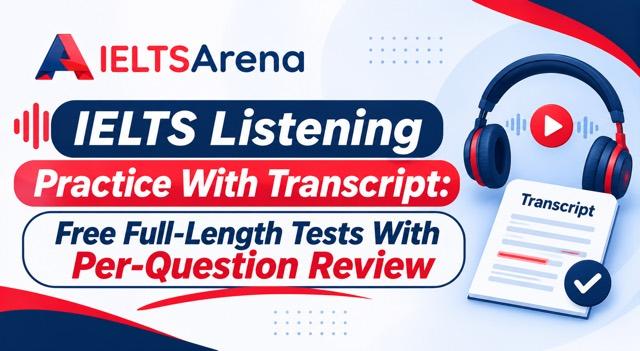
Quick Answer: IELTS Listening practice with transcript means taking a full 40-minute timed mock test with 4 sections and 40 questions, then receiving the complete audio transcript plus per-question explanations that identify the exact word, phrase, or signal you missed on every wrong answer. Useful practice also maps your wrong answers to specific error types (spelling slip, missed self-correction, multiple-choice lock-in, map orientation confusion, matching list order) so you can see which pattern is costing you the most marks. IELTSArena offers free AI-marked full Listening tests with transcripts and per-question explanations in minutes, plus Expert Tutor Review on request for final mock tests. Most Band 7 candidates take three to five full practice tests across the four to six weeks before their official exam, with targeted section and question-type drills between tests.
Who this is for: Test-takers in the final four to six weeks before their official IELTS, test-takers whose Listening band has stalled despite regular practice, and test-takers whose previous official Listening score was lower than their practice scores suggested.
Why Listening Practice Without Transcripts Does Not Move the Band
Listening practice works through a feedback loop: take a test, identify the specific errors, drill the error types, retest. Without transcripts, the "identify the specific errors" step cannot happen, so the loop breaks. You can take 20 practice tests without any band movement because you are measuring your current state over and over without knowing what to change.
The specific failure mode is error type blindness. You know you missed question 6 of Section 1, but you do not know whether you missed it because you misspelled "receive", because you wrote the wrong date (missed the self-correction), or because you wrote four words when two was the limit. The three error types have three different fixes. Without the transcript, you cannot tell which fix applies.
The second failure mode is signal blindness. Many Listening errors come from missing a signal word in the audio: "actually" before a self-correction, "decided" before a multiple-choice confirmation, "another activity" before a matching item. If you cannot see the exact audio transcript, you cannot see which signal word you failed to catch. Without that signal recognition, the error repeats on the next test.
The third failure mode is timestamp blindness. Even if you know the error type, you do not know where in the audio the information was given. On Section 4, this matters most. A missed answer at minute 7 of the 10-minute lecture is a different problem (sustained attention) from a missed answer at minute 2 (preview-window reading). The transcript with timestamps tells you which minute of the audio is your weak point.
What Useful Listening Transcripts Should Include
Not all "practice with transcripts" is useful. Four specific requirements separate useful transcripts from basic ones.
Complete transcript of every spoken word. The transcript should include every word the speakers said, including fillers, false starts, and self-corrections. A cleaned-up transcript that omits the "sorry, actually" or the "um, no wait" hides exactly the moments where most errors happen.
Timestamps linking transcript to audio. Each paragraph or question in the transcript should have a timestamp showing when in the audio the answer was given. This lets you replay the exact audio segment if you want to re-hear the signal you missed.
Highlighted or marked answer locations. The specific phrase in the transcript that contains each answer should be highlighted or marked, so you can see without searching where the answer came from.
Per-question error type identification. For every wrong answer, the review should identify the specific error type: spelling, missed self-correction, missed signal word, map orientation, word-limit violation, multiple-choice lock-in, or matching list order. Error type identification is what makes the transcript actionable rather than just informative.
If the practice tool gives you only the correct answers and a basic transcript without these four layers, it is a scoring tool, not a learning tool. Band movement requires the learning layer.
Priya's Story: Band 6 to Band 7 in Four Weeks
Priya is a 33-year-old registered nurse from Kochi applying for Nursing and Midwifery Board of Australia registration for a role in Melbourne. She needed IELTS Academic Band 7 overall with Band 7 minimum in each skill. Her first mock test came back at Band 6 on Listening. The per-section split was 8, 7, 6, 4, total 25.
Priya had been practising Listening for two months on a free site that gave her her score but not transcripts. Her mock test scores had plateaued at Band 6 for the last four weeks. She did not know why her Listening was not moving.
She switched to IELTSArena and took her first full-length test with transcripts and per-question explanations. The breakdown showed her 15 wrong answers clustered in three specific patterns: 4 Section 1 wrong answers were all spelling slips on common traps (receive, necessary, accommodate), 3 Section 2 wrong answers were all map labelling where she had misoriented left vs right, 4 Section 4 wrong answers were all in the last 3 minutes of the lecture when her attention had dropped. The remaining 4 errors were spread across question types.
For four weeks, Priya drilled only those three patterns. Week one she drilled the 20 common misspellings with the transcript open to catch any slip. Week two she drilled Section 2 map labelling with the position-dot method. Week three she drilled the last 3 minutes of Section 4 lectures specifically. Week four she ran three full mock tests to confirm the gains.
"I thought I just needed more practice. I needed to see the exact words the speakers said versus the exact words I wrote. Once the transcript showed me the signal I missed, the error stopped repeating. Four weeks of targeted drilling with transcripts moved me more than two months of mock tests without them."
Her next official test came back at Band 7 on Listening. Section 1 went from 8 to 10. Section 2 from 7 to 9. Section 4 from 4 to 7. Total 32, Band 7. The lift came entirely from three targeted drills that would never have been visible without transcripts and per-question error identification.
The Four Error Types the Transcript Makes Visible
Four error types account for almost all the marks Band 6 to Band 7.5 candidates lose on IELTS Listening. The transcript is the only practical way to identify which of the four is costing you the most marks on a given test.
Error type one: spelling slips on common words. The transcript shows the exact word the speaker said. You compare to what you wrote. If you wrote "recieve" when the transcript says "receive", you have a spelling slip on a common trap word. Band 7 candidates have 1 or 2 per test. Band 8 candidates have zero. The 20-word common misspelling drill eliminates this error type in 2 weeks.
Error type two: missed signals for self-correction, confirmation, or paraphrase. The transcript shows the signal word you failed to catch. "Actually", "sorry", "I mean", "let me check", "decided", "went with", "another activity", "the final choice". Each of these signals a change or confirmation that affects the answer. Band 7 candidates miss 2 or 3 per test. Band 8 candidates miss 0 or 1.
Error type three: map orientation and position tracking errors. The transcript shows every directional word ("to your left", "past the reception", "turn right at the junction"). You can trace your mental position against the actual spatial description and see the moment you lost orientation. Section 2 map errors are almost always visible in the first 30 seconds of audio after the preview window.
Error type four: mechanical discipline (word limits, articles, word form). The transcript shows the exact phrase the speaker used. You compare to what you wrote and see whether you added unnecessary articles, exceeded the word limit, or changed a plural to a singular because it sounded better. These mechanical errors are the easiest to fix because the transcript makes them obvious in seconds.
Each error type can be drilled in 1 week of focused practice. Fixing all four takes 4 to 6 weeks and typically moves a Band 6.5 candidate to Band 7.5 for the majority of test-takers who complete the plan.
The Three Signs You Need Practice With Transcripts Now
Specific signals that transcript-driven practice should be the next thing you do.
Your Listening score has plateaued despite regular practice. You have been practising for four weeks or more and your mock test scores are flat. The flatness means your practice is not reaching your specific weaknesses because you cannot see your specific weaknesses.
You cannot name your three most common error types. If you had to list the three error types that cost you the most Listening marks, you would guess. Without transcripts, the guess is uninformed. You are drilling blindly.
You took a previous IELTS and the official Listening score was lower than your practice scores suggested. The gap often comes from a specific error type (usually Section 4 fatigue or spelling slips) that you underperformed on in the exam that you had never identified in practice.
If any of these three is true, the next full-length Listening test you take should include the full transcript and per-question error identification.
How IELTSArena's Listening Practice With Transcript Works
IELTSArena's Listening practice runs on the Real CBT Interface, which means every full-length test uses the same answer interface, 2-minute review window, and one-time audio playback as the actual computer-delivered test. The audio bank includes native British, Australian, North American, and New Zealand accents calibrated to real test difficulty. The 40-minute timer is enforced strictly.
Complete transcript within minutes. After every practice test, you get the full transcript of all four sections. Every word the speakers said is included, including fillers, false starts, and self-corrections. Each question's answer phrase is highlighted in the transcript so you can see without searching where the answer came from.
Per-question error type identification. For every wrong answer, the AI identifies the specific error type: spelling slip, missed self-correction, missed signal word, map orientation, word-limit violation, multiple-choice lock-in, matching list order. The feedback tells you which pattern is costing you the most marks across the test.
Audio timestamps. Each question's answer phrase has a timestamp linking back to the exact moment in the audio. You can replay any 10-second segment to re-hear the signal you missed, which is the fastest way to build signal-recognition reflexes.
Per-section accuracy tracking across tests. The system tracks your accuracy by section and by question type across every test you submit. Section 1 moving from 7 to 10 over three weeks is visible. Section 4 stalling at 5 is visible. The tracking lets you confirm that your targeted drills are working.
Unlimited free submissions. You can take unlimited practice tests and get unlimited transcripts and explanations for free. No credit card required.
Expert Tutor Review for final mock tests. For the two or three mock tests closest to your official exam, Expert Tutor Review by a trained IELTS examiner catches subtle errors that AI sometimes misses (unusual accent variants, edge-case word-limit interpretations, ambiguous self-corrections). Returned within 24 to 48 hours.
More than 10,000 learners have used IELTSArena's Listening tools to lift their band. Take your first full-length Listening practice test today at IELTSArena, and within 50 minutes you will know your current band and the three error types costing you the most marks.
How to Read Your Listening Transcript
A practice test with transcript is only useful if you review the transcript correctly. Four reading rules.
Rule one: start with the error type summary before the transcript itself. The error type summary tells you where to focus. If 6 of your 15 wrong answers were spelling slips and 4 were missed self-corrections, those are your drill plan for the next week. If your 15 wrong answers are spread evenly across types, you have a broader timing or attention issue instead.
Rule two: on every wrong answer, read the exact transcript phrase that produced the correct answer. Do not just read the answer. Read the surrounding 2 or 3 sentences so you see the signal that marked the answer and the context the answer sat in. This builds pattern recognition for the same signal type on future tests.
Rule three: on Section 4 wrong answers, note the timestamp. A wrong answer at minute 3 of the Section 4 lecture is different from a wrong answer at minute 8. The first is preview-window reading, the second is sustained attention. Different fixes.
Rule four: track your wrong-answer patterns in writing between tests. Keep a short list (3 to 5 entries) of the specific signals you keep missing. "I missed the 'actually' before a date change" or "I locked in option A before the confirmation" or "I lost position on the map at the junction". The list should shrink week by week.
A good Listening transcript review takes 30 to 40 minutes: 10 minutes reading the error type summary, 20 minutes working through each wrong answer in the transcript, 10 minutes updating your wrong-answer pattern list. This is where the band movement actually happens.
The Four-Week Listening Practice Schedule That Works
A tested schedule for most Band 6 to Band 7 candidates with four to six weeks until the official exam.
Week 1: diagnosis. One full-length Listening test on IELTSArena with AI transcript and explanations. Read the error type summary carefully. Identify the three error types costing you the most marks. Do not take a second mock test this week; the point is to let the diagnosis sink in.
Week 2: drill the biggest error type. Five sessions. If spelling is the biggest, drill the 20 common misspellings with transcript review every day. If map labelling is the biggest, drill Section 2 maps with the position-dot method. If Section 4 attention is the biggest, drill the last 3 minutes of Section 4 lectures.
Week 3: drill the second biggest error type and re-test. Three days of drilling the second error type. End of the week: a second full-length mock test with transcript. Compare the per-error-type counts against week 1.
Week 4: integrated practice and timing. Three full mock tests this week. Each one with transcript review. The third with Expert Tutor Review for band-level accuracy. Rest for two days before the official exam.
Three to four mock tests, 10 to 15 targeted drill sessions, half to one band of improvement for most Band 6 to Band 7 candidates. The drilling is where the band moves. The mock tests measure the movement.
Self-Diagnosis: Is Your Listening Practice Working
Answer honestly about your Listening practice over the last four weeks.
- Have you received full transcripts on any of the mock tests you have taken?
- Can you name the three error types costing you the most marks?
- Has your Listening band moved in the last four weeks?
- Did you drill specific error types between mock tests, or did you move straight to the next mock test?
- Do you keep a running list of the signals you repeatedly miss across tests?
If you answered no to question 1, your practice is a scoring loop without a learning layer, and the next mock test should include the full transcript. If you answered no to question 2, you have no diagnosis to drive your drilling. If you answered no to question 3 and yes to question 1, your drilling is not targeted enough. If you answered no to question 4, you are measuring without improving. If you answered no to question 5, you are losing the same marks you lost last week.
If you answered no to two or more, the next full-length test you take should include transcripts, per-question error identification, and a dedicated 30 minutes afterwards for transcript review.
Take Your First Listening Practice Test Today
Full 40-minute Listening test on IELTSArena. 4 sections, 40 questions, complete transcript and per-question explanations within minutes, per-section accuracy tracking across tests, Expert Tutor Review on request for your final mock tests. Start free at IELTSArena. No credit card and no commitment.
Related Guides
These sit inside the Listening cluster on IELTSArena. Use them to drill the specific section or error type the transcript review flagged.
- IELTS Listening: The Complete Guide
- Listening Band 8 Strategy
- Listening Section 1
- Listening Section 2
- IELTS Listening Section 3
- IELTS Listening Section 4
- IELTS Listening Form Completion
- IELTS Listening Multiple Choice
- IELTS Listening Map Questions
- IELTS Listening Note Completion
- IELTS Listening Spelling Mistakes
FAQ
Where can I get IELTS Listening practice with transcripts? IELTSArena provides free full-length IELTS Listening practice tests with complete transcripts and per-question explanations within minutes of submission. Each test is a 40-minute, 4-section, 40-question simulation run on the Real CBT Interface, which matches the format and interface of the official computer-delivered test. After each test, you receive the full transcript of all four sections with every spoken word included (including fillers and self-corrections), each question's answer phrase highlighted in the transcript, audio timestamps linking back to the exact moment each answer was given, and per-question error type identification (spelling, missed self-correction, missed signal word, map orientation, word-limit violation, multiple-choice lock-in, matching list order). You can submit unlimited practice tests and get unlimited transcripts for free. For band-level accuracy on your final two or three mock tests, Expert Tutor Review by a trained IELTS examiner is available on request within 24 to 48 hours.
How do I use transcripts to improve IELTS Listening? Follow the four-rule review method. Rule one: start with the error type summary before the transcript itself, so you know where to focus. Rule two: on every wrong answer, read the surrounding 2 or 3 sentences in the transcript, not just the answer, so you see the signal that marked the answer. Rule three: on Section 4 wrong answers, note the timestamp, because a wrong answer at minute 3 is a different problem (preview-window reading) from a wrong answer at minute 8 (sustained attention). Rule four: track your wrong-answer patterns in writing between tests, keeping a short list of the specific signals you keep missing. A good transcript review takes 30 to 40 minutes. 10 to 15 transcript reviews over four weeks typically moves a candidate from Band 6 to Band 7.
Is free IELTS Listening practice accurate? Free IELTS Listening practice is accurate when the audio bank is calibrated against real IELTS difficulty with the correct mix of British, Australian, North American, and New Zealand accents, when the mark scheme follows official 2026 marking rules strictly (spelling matters, word limits are enforced, UK and US spellings both accepted), and when the test enforces one-time audio playback as the official test does. IELTSArena's free Listening practice uses passages at official 2026 difficulty, applies the official raw-to-band conversion, enforces the 40-minute timer and the one-time playback rule. AI-marked free practice correlates above 0.85 with official exam scores for most test-takers, which is accurate enough to drive preparation decisions and identify weak error types. For band-level accuracy on your final mock tests, Expert Tutor Review by a trained IELTS examiner adds a layer of precision that AI alone does not provide.
How many practice tests should I take before IELTS Listening? Three to five full-length Listening practice tests across the four to six weeks before your official exam, with targeted drilling between tests. The first mock test, four to six weeks out, diagnoses your three most common error types. The second, two to three weeks out, confirms whether your drilling moved those types. The third, one week out, with Expert Tutor Review, gives you band-level accuracy and a final drill plan. Taking more than five mock tests usually means skipping the targeted drilling between tests, which breaks the measurement-drill-remeasurement loop. The drilling is where the band moves. The mock tests only measure the movement.
Why am I not improving on IELTS Listening despite practice? The most common cause is practice without transcripts. Without the transcript, you cannot identify the specific error type on each wrong answer, so your next week of practice is unfocused. The second most common cause is practice without targeted drilling between tests. Taking mock test after mock test with no drill phase between them is measuring without improving. The third most common cause is spending the drill phase on the wrong error type. If spelling is your biggest error source but you spend four weeks drilling Section 4 attention, Section 4 might improve by a mark while spelling stays flat, and your overall band does not move. The fix: take one full-length test with transcript, identify the three biggest error types, drill the biggest one for a focused week, re-test, drill the next one. IELTSArena provides unlimited free tests with transcripts so you can run this loop without any paid subscription.