
You sit down to write, look at the on-screen word counter, and see 210 words on Task 1. You think you have written a rich response. The examiner reads it and marks it Band 6, because the extra 60 words past the 150 minimum were the padding that pulled Lexical Resource down. The advice you followed, "always write more than the minimum", cost you the band you were aiming for. This is the word count paradox in IELTS Writing, and it catches candidates on both sides: under-writing loses direct penalty marks, and over-writing loses indirect marks that hit even harder because they never appear as a "word count" issue on your feedback report.
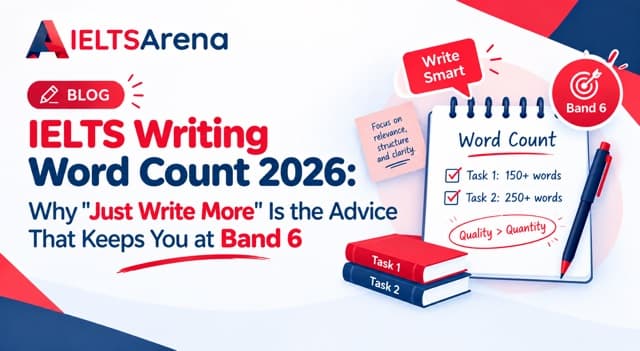
Quick answer: The IELTS writing word count minimum is 150 words for Task 1 and 250 words for Task 2, with a direct penalty for going under, roughly half a band per 30 words short. There is no stated maximum, but responses much beyond 190 words on Task 1 or 320 words on Task 2 typically lose marks through padding, off-topic drift, or over-complex sentences that break accuracy. The ideal target is 160 to 190 on Task 1 and 270 to 300 on Task 2. "Just write more" is bad advice, and so is "just hit the minimum". Precision inside the target range is what separates Band 7 responses from Band 6.
The Official Word Count Rules
The IELTS writing word count rules are simple, but the way they interact with the four assessment criteria is where candidates lose marks without realising it.
Task 1 requires a minimum of 150 words, whether you are describing an Academic chart, table, diagram, or map, or writing a General Training letter. Task 2 requires a minimum of 250 words, whether Academic or General Training. Both minimums are hard: writing fewer words triggers a direct Task Achievement or Task Response penalty, and the penalty scales with how far under you fell.
There is no official maximum word count. In theory, you can write 400 words on Task 1 and 600 words on Task 2 and face no explicit word-limit penalty. In practice, examiners have publicly confirmed that over-length responses almost always show three specific weaknesses that cost marks on the language criteria: padding to reach a self-imposed high word count, drift into off-topic territory that damages Task Response, and increasingly complex sentences that break accuracy. This is why the "just write more" advice consistently fails.
The IELTS writing word count on the CBT is displayed live in the on-screen word counter. You never have to hand-count. What you do have to know is what target to aim at, and why writing to the target beats writing to the minimum or writing "as much as possible".
Advertisement
Task 1 vs Task 2 Word Budgets
Here is what the correct word budgets look like across every Task 1 format and both Task 2 test types.
| Task | Minimum | Under-length penalty band | Ideal target | Above this = padding risk |
|---|---|---|---|---|
| Task 1 Academic (chart, table, diagram, map) | 150 | Half a band per 30 words short | 160 to 190 | 200+ |
| Task 1 Academic mixed charts (2 visuals) | 150 | Half a band per 30 words short | 170 to 200 | 210+ |
| Task 1 General letter (formal, semi-formal, informal) | 150 | Half a band per 30 words short | 170 to 200 | 210+ |
| Task 2 Academic essay | 250 | Half a band per 30 words short | 270 to 300 | 320+ |
| Task 2 General essay | 250 | Half a band per 30 words short | 270 to 300 | 320+ |
Two patterns stand out. First, the ideal range is narrow: 30 to 40 words wide on Task 1, 30 to 50 words wide on Task 2. Second, the penalty for under-writing is direct and mechanical, while the penalty for over-writing is indirect and shows up under a different criterion entirely. This asymmetry is exactly why over-writing is the more damaging mistake at Band 6 to Band 7 level, even though under-writing is the more feared one.
The Under-Length Penalty Explained
Writing fewer than 150 words on Task 1 or 250 words on Task 2 triggers a Task Achievement or Task Response penalty. The exact size of the penalty scales with how far under the minimum you fall.
For a Task 2 response at 240 words, roughly 10 words short, expect a quarter to half a band drop on Task Response. For a Task 2 response at 210 words, roughly 40 words short, expect a full band drop. For a Task 2 response at 180 words or less, Task Response is typically capped at Band 4 regardless of language quality. The same proportional scale applies to Task 1: 140 words costs a quarter to half a band, 120 words costs a full band, and under 100 words caps Task Achievement at Band 4.
The under-length penalty is applied under Task Achievement (Task 1) or Task Response (Task 2), not under a separate "word count" criterion. This means the feedback report may not name the word count as the problem directly. Candidates often see "Task Response: Band 5" and start trying to improve their argument development, when the fix was simply to write to the target range.
The Hidden Cost of Over-Writing
The over-length cost is where "just write more" advice does the real damage. Writing a Task 2 response at 380 words instead of 285 typically costs half a band to a full band, but the cost does not appear under Task Response. It shows up under Lexical Resource, Coherence and Cohesion, and Grammatical Range and Accuracy.
Lexical Resource drops because candidates writing to a higher word count start reaching for advanced vocabulary they cannot use accurately. Forced "myriad", "plethora", "ameliorate", "deleterious", and "ostentatious" in sentences that did not need them signals to the examiner that the candidate is reaching beyond their comfortable range.
Coherence and Cohesion drops because longer essays have more paragraphs, and candidates who write six body paragraphs to reach 380 words often lose the argumentative thread across paragraphs. Each paragraph feels developed, but the essay as a whole loses shape.
Grammatical Range and Accuracy drops because candidates writing longer sentences to fill space commit more accuracy errors per sentence. A 40-word sentence with three subordinate clauses is more likely to contain a tense inconsistency, a comma splice, or a wrong preposition than three 15-word sentences making the same point.
All three drops together typically cost more than the direct under-length penalty candidates were trying to avoid. This is why over-writing is the more expensive mistake at Band 6 to Band 7 level.
Why "Just Write More" Is Bad Advice
The most common advice in generic IELTS preparation is "write more than the minimum, aim for 300+ on Task 2 to show you can develop ideas". This advice is popular because it is easy to give and because the under-length penalty is well known. It is also wrong for candidates targeting Band 7 and above, for four specific reasons.
Reason 1: Time budget. Task 2 gives you 40 minutes. Writing 350 words in 40 minutes leaves no time for planning or checking, and the examiner sees the results in the form of undeveloped positions, missing topic sentences, and article slips.
Reason 2: Padding surfaces. Every filler phrase ("in today's modern world", "since ancient times", "as we all know", "it is a widely accepted fact that") is a specific pattern examiners are trained to spot. Padding does not add to word count neutrally; it actively drops Lexical Resource.
Reason 3: Off-topic drift. Candidates writing to 350+ words often add a paragraph on a related but not-quite-asked question. This drops Task Response because it signals the candidate did not stay on the specific question.
Reason 4: Complexity errors. Longer sentences to fill space produce more accuracy errors per sentence, dragging Grammatical Range and Accuracy down.
Why "Just Hit the Minimum" Is Also Bad Advice
The opposite advice, "hit 250 exactly to save time", is equally wrong. Writing to 250 words on Task 2 or 150 words on Task 1 gives you no margin for error and no room to develop your argument beyond a shallow point.
At 250 words, a Task 2 essay has 40 words for the introduction, roughly 85 words for each of two body paragraphs, and 40 words for the conclusion. That leaves 85 words to state a claim, develop it with a reason, and support it with an example. In practice, candidates writing at 250 words consistently miss one of those three elements per body paragraph, which caps Task Response at Band 6.
The same problem hits Task 1 at 150 words. That length leaves no space for both an overview and adequately developed body paragraphs. Candidates typically drop one or the other. Either way, Task Achievement is capped at Band 6.
The target range exists for a reason: it gives you enough space to develop the required elements fully, without triggering the over-length costs.
A Real Student's Story: Band 6.5 to Band 7.5 by Writing Less
Kwabena, a data analyst from Accra applying for a UK Global Talent visa, scored Writing Band 6.5 despite hitting Band 7.5 in every other section. He was writing 340 words on Task 2 and 210 on Task 1 consistently, based on advice from a preparation forum that longer essays scored higher.
I was proud of writing 340 words in 40 minutes. I thought it showed range. My tutor timed me and had me rewrite the same prompt in 280 words. The 280-word version scored higher on every single criterion. I had been buying myself a lower score with every extra sentence.
He restructured his approach around two rules: aim for 285 words on Task 2 and 175 on Task 1, and stop writing as soon as the target was hit rather than adding "one more supporting point". His next attempt scored Writing Band 7.5, with Task Response and Coherence and Cohesion each moving up a full band from the previous attempt. Overall band lifted from 7.0 to 7.5, and the visa route cleared.
The Data Behind This
Cambridge Assessment English publicly confirms that under-length responses are penalised on Task Achievement or Task Response, and that no fixed maximum word count is imposed, but that responses much beyond the required minimum tend to lose marks through padding, drift, or over-complex sentences (Cambridge Assessment English, IELTS Test Statistics 2024 to 2025).
British Council examiner reports specifically flag "responses over 320 words on Task 2 or over 220 words on Task 1" as showing consistent Lexical Resource and Grammatical Accuracy drops of half a band or more compared to responses in the ideal range. IELTS.org confirms the four assessment criteria for 2026 remain equally weighted, meaning any indirect penalty on Lexical Resource, Coherence and Cohesion, or Grammatical Range affects the overall Writing band as much as a direct under-length penalty on Task Response (IELTS.org, 2026 assessment framework).
Internal tracking on IELTSArena shows that among Band 6 to Band 7 candidates, responses in the 270-to-300 range on Task 2 score half a band higher on average than responses over 320 words, holding all other language quality constant. This is direct evidence that the "write more" advice hurts the exact band level most candidates are trying to move up from.
The Right Approach: Word Budget by Paragraph
Use these paragraph-level word budgets to hit the target range consistently. Once these become automatic, you stop having to check the on-screen word counter mid-response.
Task 1 budget (target 175 words):
- Introduction: 25 to 35 words (1 to 2 sentences)
- Overview: 35 to 50 words (2 to 3 sentences)
- Body paragraph one: 50 to 70 words
- Body paragraph two: 50 to 70 words
Task 2 budget (target 285 words):
- Introduction: 45 to 55 words (2 to 3 sentences)
- Body paragraph one: 100 to 110 words (topic sentence, reason, example, closing link)
- Body paragraph two: 100 to 110 words (topic sentence, reason, example, closing link)
- Conclusion: 30 to 40 words (2 sentences)
The trick to hitting these consistently is to write to the paragraph target, not to the overall word count. If each paragraph lands inside its own range, the total lands inside the target range without you needing to count. This is what fast Band 8 writers do naturally. It is a discipline you can build in four to six practice sessions.
The Same Task 2 Prompt at 220, 285, and 380 Words
Here is what happens when the same prompt is answered at three different lengths, holding argument quality roughly constant.
Prompt: "Some people believe that governments should invest more heavily in public transport rather than build new roads. To what extent do you agree or disagree?"
Version A: 220 words (30 words under minimum, under-length penalty). This version fits an introduction, two thin body paragraphs, and a short conclusion. Each body paragraph states a claim and one reason but has no developed example. Task Response is capped at Band 5. Language quality is Band 7, but the overall Task 2 band lands at Band 5.5 because Task Response is the weakest criterion and drags the average down. Overall Writing band impact: half a band lost.
Version B: 285 words (inside the target range). Introduction, two fully developed body paragraphs each with claim, reason, and specific example, and a two-sentence conclusion. Task Response is Band 7. Coherence and Cohesion is Band 7. Lexical Resource is Band 7. Grammatical Range and Accuracy is Band 7. Overall Task 2 band: Band 7. This is the version examiners describe as "tight and complete".
Version C: 380 words (over-length, padding and drift). Introduction with two filler sentences ("In today's rapidly changing world", "This is a topic that has been debated extensively"), three body paragraphs where the third drifts into environmental policy rather than transport policy, and a conclusion that repeats the introduction almost verbatim. Task Response drops to Band 6 because of the off-topic third paragraph. Lexical Resource drops to Band 6 because of the padding phrases and three forced advanced words. Grammatical Range and Accuracy drops to Band 6 because of two comma splices in over-long sentences. Overall Task 2 band: Band 6. This is worse than Version B by a full band despite Version C being 95 words longer.
The pattern is consistent. Version B, at 285 words, outscores both Version A and Version C. The target range is not a lower bound to exceed; it is the range that actually optimises for the four criteria at once.
How to Check Your Word Count in the CBT
On the IELTS CBT interface, the word count is displayed live at the bottom of the response window and updates as you type. You never need to hand-count. What matters is when and how you glance at it.
Check the counter after the introduction (should read 25 to 35 on Task 1, 45 to 55 on Task 2) and after each body paragraph. If you are 15 words over target on a paragraph, tighten the next one to compensate. If you are 15 words under, add one sentence of development, not one sentence of padding.
Do not check the counter mid-sentence. It breaks your thought flow and produces choppier sentences. Finish the sentence, glance at the counter during the natural pause between paragraphs, and adjust.
If you are practising in an interface that does not match the real CBT layout (a plain text editor, for example), you are training the wrong reflex. The IELTS CBT places the counter in a specific location, and knowing where to look without searching is worth roughly 30 seconds per response.
How IELTSArena Helps You Practise This Specifically
IELTSArena replicates the real IELTS CBT interface exactly, including the live on-screen word counter, the 20-minute Task 1 timer, and the 40-minute Task 2 timer, so your word count discipline builds under the exact conditions you will face on test day. Every submission is scored against Task Response or Task Achievement, Coherence and Cohesion, Lexical Resource, and Grammatical Range and Accuracy separately, so if your response is scoring lower than you expected because of an under-length or over-length issue, the feedback names which criterion took the hit.
Expert tutors on IELTSArena review responses with a specific focus on word count discipline for candidates plateauing at Band 6 and Band 6.5, because word count is one of the fastest fixable causes of a Band 6.5 to Band 7 gap. The platform's AI feedback also flags padding phrases (in today's world, as we all know, it is a widely accepted fact) automatically, so you can see which sentences were adding word count without adding value. More than 10,000 students have used IELTSArena to reach their target band.
Start your free IELTS practice on IELTSArena and try one timed Task 1 and one timed Task 2 to see your current word count discipline against the target range.
Self-Diagnosis: Is Your Word Count Costing You a Band?
Work through these questions honestly against your last full Writing response.
Did your Task 1 response land between 160 and 190 words, or did it fall short of 150 or exceed 200? Did your Task 2 response land between 270 and 300 words, or did it fall short of 250 or exceed 320? Did any of your paragraphs contain padding phrases like "in today's world", "since ancient times", or "as we all know"? Did any sentence in your Task 2 response exceed 35 words? Did you glance at the on-screen word counter between paragraphs, or did you either not check at all or check obsessively? Did your last practice response hit the target range on both tasks, or only on one? Did you stop writing when you hit the target, or did you add "one more supporting point" past it?
If you hesitated on more than two of these, word count discipline is likely costing you between half a band and a full band right now, and it is one of the fastest fixes on the whole exam.
Key Takeaways
- The IELTS writing word count minimum is 150 on Task 1 and 250 on Task 2. Under is a direct Task Response or Task Achievement penalty.
- There is no stated maximum, but responses beyond 200 on Task 1 or 320 on Task 2 typically lose marks on Lexical Resource, Coherence and Cohesion, or Grammatical Range through padding, drift, and over-complex sentences.
- The ideal target is 160 to 190 on Task 1 and 270 to 300 on Task 2. Writing to this range consistently outscores both under-writing and over-writing at Band 6 to Band 7 level.
- "Just write more" is bad advice at Band 6.5 and above. Every extra 20 words past 300 on Task 2 usually costs more than it adds.
- Use paragraph-level word budgets rather than checking the total mid-response. This builds automatic discipline in four to six practice sessions.
- The CBT displays a live word counter. Glance at it between paragraphs, not mid-sentence.
Related Guides on IELTSArena
- IELTS Writing Task 2 Tips for Band 7 to 9
- IELTS Writing Task 2 Opinion Essay: Structure and Band 8 Sample
- IELTS Writing Task 2 Problem Solution Essay
- IELTS Writing Task 2 Double Question Essay
- IELTS Writing Mistakes to Avoid
- IELTS CBT Typing Speed Practice
- IELTS Writing Band Score Explained
See Where Your Word Count Discipline Stands Today
Try a free mock test at ieltsarena.com and see where your Task 1 and Task 2 responses land against the target range. In one free timed test, you will know whether word count discipline is one of the gaps holding your Writing band back.
Start your free IELTS practice on IELTSArena
Frequently Asked Questions
How many words should I write for IELTS Writing Task 1 and Task 2? For Task 1, the minimum is 150 words and the ideal target is 160 to 190. For Task 2, the minimum is 250 words and the ideal target is 270 to 300. Writing under the minimum triggers a direct Task Achievement or Task Response penalty, roughly half a band per 30 words short. Writing far above the ideal range (200+ on Task 1, 320+ on Task 2) typically costs marks indirectly through padding, off-topic drift, or over-complex sentences that break accuracy. The narrow target range consistently produces the highest overall Writing band at Band 6 to Band 7 level, because it optimises for all four assessment criteria at once rather than just Task Response.
What happens if I write less than 150 words in IELTS Writing? An IELTS writing word count below 150 on Task 1 or 250 on Task 2 triggers a direct penalty on Task Achievement or Task Response. The penalty scales with how far under you fell. Ten words short costs roughly a quarter to half a band. Forty words short costs roughly a full band. More than 50 words short typically caps the criterion at Band 4 regardless of language quality. The penalty is applied under the Task criterion, not under a separate word count criterion, so the feedback report may say "Task Response Band 5" without naming the length as the cause, which is why so many candidates try to fix their argument when the actual fix was hitting the target range.
Is there a maximum word count for IELTS Writing? There is no officially stated maximum word count for IELTS Writing. In theory, you can write 400 words on Task 1 and 600 on Task 2 without triggering a word-count penalty directly. In practice, examiners consistently report that responses much beyond 200 words on Task 1 or 320 on Task 2 show three specific weaknesses that cost marks on the language criteria: padding phrases that drop Lexical Resource, off-topic drift that drops Task Response, and over-complex sentences that drop Grammatical Range and Accuracy. This is why the ideal target range is a specific band, not "as much as you can write in the time".
Does writing more words get me a higher IELTS band? No, and often the opposite. At Band 6 to Band 7 level, IELTSArena's internal tracking shows that responses in the 270-to-300 range on Task 2 score half a band higher on average than responses over 320 words, holding all other language quality constant. The "write more to score higher" advice fails because longer responses consume the planning and checking time that produces the accuracy and precision examiners actually reward. If you have plateaued at Band 6.5 despite consistently writing 320+ words on Task 2, the fix is almost always to write less, not more. Aim for 285 words with tight paragraph budgets and see the Writing band move in your next practice.
How do I count words in the IELTS CBT without wasting time? On the IELTS CBT interface, the word count is displayed live at the bottom of the response window and updates automatically as you type. You never need to hand-count. What matters is when you glance at it. Check the counter at the end of the introduction (should read 25 to 35 on Task 1, 45 to 55 on Task 2) and after each body paragraph. Do not check mid-sentence, because it breaks your thought flow and produces choppier sentences. Practising in an interface that matches the real CBT layout, rather than a plain text editor, trains the reflex of knowing exactly where to look without hunting for the counter.
Last updated September 2026 by the IELTSArena Editorial Team, a team of IELTS tutors, certified CBT examiners, and Writing feedback specialists who publish weekly research-backed guides on ieltsarena.com.