
Your introduction is 40 to 50 words. Two of those sentences carry your whole essay: the paraphrased question and the thesis statement. If the thesis is weak, the examiner spends the rest of the essay waiting for a position that never fully arrives, and your Task Response mark gets stuck at Band 6 no matter how good your body paragraphs are.
Most Band 5.5 to Band 6.5 essays either skip the thesis statement, bury it halfway through the introduction, or hedge so much that the examiner cannot tell what the writer actually thinks. The fix is a two-sentence formula you can learn in one sitting and apply to every Task 2 question type you will ever see on test day.
This guide gives you the formula, the five question-type variations, and side-by-side Band 6 and Band 7 and Band 8 examples. Practise writing timed introductions on real Task 2 prompts at IELTSArena and get your thesis sentence scored on the four official criteria so you know whether yours is doing its job.
Quick Answer: A Band 7+ thesis statement in IELTS Writing Task 2 is one or two sentences at the end of your introduction that state your position clearly and preview your two main ideas. The formula is: state your overall opinion, then name the two reasons or two views you will develop in the body. It appears in sentence two or three of a 40 to 50 word introduction. Every Task 2 question type needs a thesis, including discuss-both-views and advantages-and-disadvantages questions, because the examiner marks you on a "clear position throughout the response" under Task Response.
Who this is for: Test-takers at Band 5.5 to Band 7.5 whose introductions do not clearly signal a position, and who want a repeatable thesis formula that works on every Task 2 question type in 2026.
Why the Thesis Statement Carries Your Introduction
The IELTS Writing Task 2 introduction has one job: tell the examiner what the essay is about and what your position is. It has two moving parts to do that job.
The first part is the paraphrase. You restate the question in your own words to show the examiner you understood it. The second part is the thesis statement. You tell the examiner what you think and what the body paragraphs are going to argue.
If you skip the thesis, the examiner has to read the first body paragraph to find out your position. That triggers a lower Task Response mark because the band descriptor at Band 7 requires a "clear position throughout the response." Position that arrives late is not position throughout.
A thesis statement is not the same as an opinion statement. Opinion-only is "I agree with this statement." A thesis adds the roadmap: "I agree with this statement because of two main reasons: it saves money for governments and it reduces inequality for citizens." The second version does the Task Response work the first one is missing.
Advertisement
Why Most Thesis Statements Lose Marks
Five habits sink thesis statements across every nationality and every target band. If your introductions have been scoring Band 6 or 6.5 on Task Response, at least one of these is in play.
Thesis is missing entirely. The introduction has two sentences that both paraphrase the question. There is no position. The examiner reaches the end of the introduction and still does not know what you think.
Thesis hedges with "it depends." "Both sides have good points and the answer depends on the situation" is not a thesis. It tells the examiner you did not decide. Task Response wants a decision, even on discuss-both-views questions.
Thesis is memorised and does not fit the question. Templated thesis sentences like "This essay will argue that the advantages outweigh the disadvantages" cause two problems: the examiner has seen them a thousand times, and they often do not match the specific question in front of you.
Thesis contradicts the body paragraphs. You state one position in the introduction and then argue the opposite in the body. This happens most on discuss-both-views questions when the writer runs out of time to steer back to the stated opinion.
Thesis forgets to preview the main ideas. The position is clear but the examiner has no idea what is coming next. The reader has to guess the structure of the essay instead of being guided through it, which drops Coherence and Cohesion as well as Task Response.
Zarina's Story: Band 6 to Band 7 in Four Weeks
Zarina is a 29-year-old doctor from Tashkent applying for Australian Medical Council registration. She needed Band 7 on each of the four skills, with Writing the only one still below. Her mock test came back at Band 6.5 on Writing with the feedback "position not fully developed in the introduction."
She looked at her last five essays. Every introduction had the same shape: two sentences, both paraphrasing the question, no clear thesis. Her position was always buried in the first body paragraph, which meant the examiner had already marked her introduction down before they got to the strong content.
For four weeks, she wrote only introductions. 10 minutes a day, five different Task 2 prompts, forcing herself to end every introduction with a two-part thesis: her opinion plus the two reasons she would develop. She stopped writing complete essays until the thesis habit was automatic.
"I was writing Band 7 body paragraphs the whole time. The examiner just never knew it was coming because my introduction gave away nothing. One sentence fixed my whole essay."
Her next official test came back at Band 7 on Writing. She did not change her vocabulary, her grammar, or her body paragraph structure. She added one thesis sentence at the end of every introduction and the band came.
The Data Behind Thesis Statements
Cambridge Assessment English publishes the Writing Task 2 band descriptors publicly. Band 7 Task Response reads "addresses all parts of the task" and "presents a clear position throughout the response." Band 6 Task Response reads "position may become unclear" and "overview may be unclear."
The gap between those two descriptors is almost entirely closed by the thesis statement. A clear position in sentence two of the introduction gives you "clear position throughout the response" because the examiner now reads every body paragraph against the position you stated up front. No thesis means the examiner is forming their own guess, which is almost never generous.
British Council guidance on Writing Task 2 tells test-takers to state their opinion in the introduction and support it with specific examples in the body. IELTS trainers consistently report that students who move the thesis from the end of the first body paragraph to the end of the introduction gain half a band on Task Response on average, with no other changes to the essay.
In the 2026 marking approach, examiners have become stricter on memorised templates. A thesis that reads "This essay will discuss both views and then give my own opinion" is treated as a filler sentence, not a thesis, because it tells the examiner nothing about what the writer actually thinks. The thesis must contain real content specific to the question in front of you.
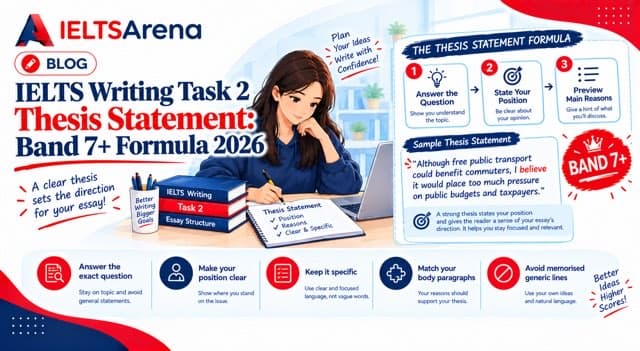
The Two-Sentence Thesis Formula
Every Band 7+ thesis in IELTS Writing Task 2 does two moves. Learn these two moves and you can write a thesis for any question type in 20 seconds.
Move one: state your position. One sentence. Plain language. No hedging. If the question asks for your opinion, give an opinion. If it asks you to discuss both views, say which view you lean toward and why. If it asks for advantages and disadvantages, say whether the advantages outweigh the disadvantages or the other way round.
Move two: preview your two main ideas. One sentence or a continuation of sentence one. Name the two reasons or two angles you will develop in the two body paragraphs. This is your roadmap, and it is what separates a Band 6 opinion from a Band 7 thesis.
Combined example for the prompt Some people think governments should fund public transport, while others think private companies should run it. Discuss both views and give your own opinion:
"While private operators can bring efficiency and investment, I believe public transport should be mainly funded by governments, because it reduces road congestion in cities and keeps fares affordable for low-income commuters."
One sentence. Position stated. Two reasons previewed. The examiner now knows exactly what the two body paragraphs will cover and can mark you against that promise. That is the whole formula.
Thesis Statement for Every Task 2 Question Type
The two-move formula adapts to all five Task 2 question types. The position move changes shape; the preview move stays the same.
Opinion (agree or disagree). State how far you agree or disagree. The position is a single stance. Example: "I strongly agree that governments should prioritise renewable energy funding, because fossil fuel dependence damages public health and renewable technology creates long-term employment."
Discuss both views and give your own opinion. Acknowledge the other view in one clause, state the view you support, and preview your two reasons. Example: "Although some argue that online learning cannot replace classroom instruction, I believe hybrid models produce the best outcomes, as they combine flexible access for working students with the structured peer interaction that pure online formats lack."
Advantages and disadvantages (do the advantages outweigh the disadvantages). State which side outweighs. Preview the two main points you will cover across both paragraphs. Example: "The advantages of a global common language clearly outweigh the disadvantages, because easier international trade and faster scientific exchange matter more than the gradual loss of regional languages that would also occur."
Problem and solution (or cause and solution). Name the main cause or problem, then the main solution. Two moves still fit. Example: "The main driver of youth unemployment is a mismatch between university training and employer demand, and the most practical solution is a national apprenticeship scheme co-designed with industry."
Two-part question (direct question with two parts). Answer both parts in one sentence each, or combine into one sentence that previews both answers. Example: "The rise in single-person households is driven mainly by delayed marriage and longer life expectancy, and it is largely a positive development because it reflects greater personal choice and economic independence."
Memorise the shape of each type, not the words. Shape travels across every question you will ever see; wording changes every time.
Band 6 vs Band 7 vs Band 8 Thesis: Side by Side
Same question, same position, three different executions. The question: Some people think that the government should ban dangerous sports, while others think people should be free to do any sport. Discuss both views and give your own opinion.
Band 6 thesis: "In my opinion, there are good points on both sides and I think it depends on the sport. Some sports are more dangerous than others."
No position, no preview, generic phrasing. The examiner cannot tell which side the writer leans toward or what the body paragraphs will cover.
Band 7 thesis: "While some dangerous sports do cause serious injuries, I believe adults should be free to choose their own activities, because personal freedom is a core right and most dangerous sports can be made much safer with proper training and safety rules."
Position stated. Two reasons previewed. Clear and specific to the question.
Band 8 thesis: "Although the state has a legitimate interest in reducing avoidable injuries, I would argue against blanket bans on dangerous sports, because individual autonomy over physical risk is a fundamental liberty and most dangerous sports become relatively safe once governed by trained instructors and standardised safety protocols."
Same position, same two reasons, but tighter vocabulary (blanket bans, individual autonomy, standardised safety protocols), more complex grammar (concessive clause, conditional structure), and no wasted words.
Notice all three thesis sentences take the same shape: one concessive clause acknowledging the other side, one main clause stating the position, two "because" reasons previewing the body. The shape is identical; only the vocabulary and grammar lift the band.
Where the Thesis Goes in the Introduction
The thesis statement is the last sentence of your introduction, after the paraphrase. Introduction structure for a 40 to 50 word opening:
Sentence 1 (10 to 15 words): General statement that paraphrases the topic in your own words. Sentence 2 (10 to 15 words): Paraphrase the specific question or claim. Sentence 3 (20 to 25 words): Your thesis. Position plus preview of two reasons.
If you prefer a two-sentence introduction, combine the general statement and the question paraphrase into sentence one and put the thesis in sentence two. Either structure scores at Band 7 as long as the thesis is clearly the final move.
Never bury the thesis in sentence one. Never save it for the body paragraphs. The examiner reads the introduction once, forms their opening impression of your Task Response, and then confirms or revises that impression as they read the body. A visible thesis in the last sentence of the introduction locks in the highest possible opening impression.
Where IELTSArena Fits Into Your Thesis Statement Practice
Writing a thesis is a two-sentence skill, but you cannot tell whether yours is working without a trained reader. Most test-takers think their thesis is clear because they know what they meant. The examiner only knows what you wrote.
IELTSArena's AI Writing Feedback scores the introduction of your essay separately from the body, so you can see immediately whether your thesis is being read as a Band 7 position or a Band 6 hedge. The feedback flags vague position language, missing previews, and template phrases that no longer score in 2026.
For human-level accuracy, IELTSArena's Expert Tutor Review marks your essay the way the real examiner will on test day. The tutor writes a replacement thesis at the band above yours so you can see the exact wording lift you need. More than 10,000 learners have used IELTSArena to move their Writing band up, with the Real CBT Interface giving you the same keyboard, timer, highlighter, and word counter as the actual computer-based test.
Write one 40-word introduction right now, submit it for scoring at IELTSArena, and you will know within minutes whether your thesis is doing its job.
Self-Diagnosis: Is Your Thesis at Band 7 Yet?
Open the last Task 2 essay you wrote and answer honestly:
- Is there a clearly identifiable sentence in your introduction that states your position?
- Does that same sentence preview the two main ideas you develop in the body paragraphs?
- If a stranger read only your introduction, would they be able to predict both body paragraphs?
- Did you avoid "it depends" and "both sides have valid points" as your final position?
- Is your thesis specific to the question in front of you, or could it be pasted into any Task 2 essay with minimal changes?
If you answered no to two or more, your thesis is likely holding your Task Response at Band 6 or 6.5 even if your body paragraphs are already at Band 7.
See Your Current Band Today
Write one Task 2 introduction under exam conditions, submit it on IELTSArena, and get a Task Response read on your thesis in minutes. Start your free practice at IELTSArena. No credit card and no commitment.
Related Guides
These sit inside the same Task 2 essay-building-blocks cluster on IELTSArena. Work through them in order to build a complete Band 7+ essay.
- Writing Task 2 Body Paragraphs (the PEEL structure for Band 7+)
- Writing Task 2 Introduction (the full 40 to 50 word opening)
- Writing Task 2 Conclusion (what to say in the last 30 to 40 words)
- Writing Task 2 Paraphrasing the Question (the one sentence most people get wrong)
- Writing Task 2 Practice With Feedback (free scored essays on IELTSArena)
- IELTS Writing Band Descriptors Explained
- IELTS Writing Task 2 Tips for 2026
- Coherence and Cohesion for IELTS Writing
- Task 2 Sample Essays Band 9
- How to Improve Your IELTS Writing Score
FAQ
Do I need a thesis statement in IELTS Writing Task 2? Yes, every Task 2 essay needs a thesis statement, including discuss-both-views and advantages-and-disadvantages questions. The Cambridge Writing band descriptors require a "clear position throughout the response" to reach Band 7 on Task Response, and the thesis is where that position is stated. Without it, the examiner cannot mark you against a position because you have not given them one. The thesis sits at the end of your introduction, usually as sentence two or three of a 40 to 50 word opening, and does two moves: it states your overall opinion and previews the two main ideas you will develop in the body paragraphs.
How do I write a thesis statement for IELTS Task 2? Use the two-move formula. Move one: state your position in plain language, with no hedging. Move two: preview the two main reasons or two views you will develop in the body paragraphs. Combine both moves into one sentence of 20 to 25 words. Example for a discuss-both-views question: "While some argue that online learning cannot replace classrooms, I believe hybrid models work best, because they combine flexible access for working students with the structured peer interaction pure online formats lack." Memorise the shape, not the words. The same shape adapts to opinion, discuss, advantages-disadvantages, problem-solution, and two-part questions.
Where should the thesis statement go in an IELTS Task 2 essay? The thesis statement goes at the end of your introduction, as sentence two or three of a 40 to 50 word opening. It comes after you paraphrase the question. The examiner reads the introduction once and forms their first impression of your Task Response, so the thesis has to be the last thing they read before entering the body paragraphs. Never put the thesis in the first body paragraph. Never save it for the conclusion. A late thesis signals an unclear position, which caps your Task Response at Band 6 or 6.5 even when the rest of your essay is at Band 7.
Is a thesis statement the same as an opinion sentence in IELTS? No. An opinion sentence states what you think. A thesis statement states what you think plus what you will argue to prove it. "I agree with this statement" is an opinion. "I agree with this statement, because it saves governments money and reduces inequality for citizens" is a thesis. The difference is the preview of your two main ideas, which gives the examiner the roadmap for your body paragraphs. Band 7 Task Response specifically rewards a clear position supported by main ideas, so the thesis version always outscores the opinion version even when both say the same thing.
What is the difference between opinion and thesis in IELTS Writing Task 2? The opinion is the position you take. The thesis is the opinion plus a preview of the reasons you will develop in the body. On an opinion-type question like "To what extent do you agree or disagree", the opinion is your stance (strongly agree, partly agree, disagree). The thesis bundles that stance with the two reasons that will structure your two body paragraphs. On a discuss-both-views question, you need both a thesis (overall position plus previewed reasons) and an opinion (which view you support). The examiner marks you on both the clarity of the position and the extent to which your body paragraphs deliver on the preview, so a complete thesis is always safer than a bare opinion.