
You have 40 minutes, you have written an introduction, two body paragraphs, and the clock says 36:30. You have three and a half minutes left and no idea what to put in your conclusion that you have not already said. So you either skip it entirely, which caps your essay at Band 6, or you rush out a vague sentence that repeats your introduction word for word, which also caps your essay at Band 6.
The IELTS Writing Task 2 conclusion is the shortest and simplest paragraph in the whole essay. It is 30 to 40 words, it has a fixed job, and it can be written in under three minutes once you know the formula. Most test-takers do not know the formula, which is why conclusions quietly pull Band 7 essays back down to Band 6.5.
This guide gives you the formula, the exact phrases that score and the ones examiners now treat as filler in 2026, and Band 6 vs Band 7 vs Band 8 comparisons on the same question. Practise timed conclusions on real Task 2 prompts at IELTSArena and get your closing paragraph scored on Task Response and Coherence and Cohesion so you know whether yours is doing its job.
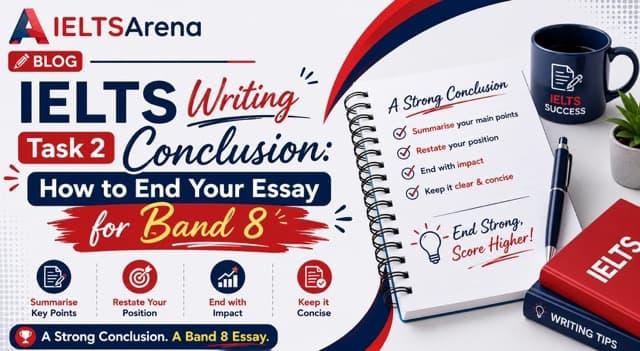
Quick Answer: A Band 7+ conclusion in IELTS Writing Task 2 is 30 to 40 words at the end of your essay. It does two things: restates your overall position in different words and briefly summarises the two main reasons from your body paragraphs. It never introduces new ideas, never contradicts the introduction, and never uses the memorised filler "In conclusion, I would like to say that". Write it in 3 to 4 minutes after your two body paragraphs. A missing or weak conclusion is the single most common reason a Band 7 essay drops to Band 6.5.
Who this is for: Test-takers at Band 5.5 to Band 7.5 whose essays either skip the conclusion or close with a filler sentence that repeats the introduction. Equally useful for Academic and General Training Task 2.
Why the Conclusion Decides Whether Your Essay Holds Band 7
Writing Task 2 is marked on four criteria of equal weight: Task Response, Coherence and Cohesion, Lexical Resource, and Grammatical Range and Accuracy. The conclusion sits inside two of them.
Task Response at Band 7 requires "a clear position throughout the response." Throughout means from the introduction to the conclusion. If your conclusion contradicts your introduction, trails off, or never arrives, you have broken the throughout rule and your Task Response drops.
Coherence and Cohesion at Band 7 requires "a clear overall progression." Progression needs a destination. A conclusion is the destination. Without it, the essay reads as if the writer ran out of time, which the examiner correctly interprets as poor time management and marks accordingly.
A missing conclusion also triggers a word-count problem. If your two body paragraphs plus your introduction come to 230 words and you skip the conclusion, you are under 250. Falling below 250 words on Task 2 is an automatic penalty on Task Response regardless of how good the rest of the essay is.
Advertisement
Why Most Task 2 Conclusions Lose Marks
Five habits sink conclusions across every band and every nationality. If your essays close weakly, at least one of these is the cause.
The conclusion is missing entirely. You ran out of time on the second body paragraph and the essay just stops. Easy fix: cut 20 words from body paragraph two so you have 3 minutes free at the end.
The conclusion repeats the introduction word for word. The examiner has already read those exact words 10 minutes ago. Lexical Resource drops because you have shown no range, and Task Response drops because you have added nothing.
The conclusion introduces a new argument. You suddenly remember a third reason and stuff it into the last 20 words. The reason is undeveloped, the paragraph breaks shape, and the examiner reads it as a loss of control.
The conclusion contradicts the thesis. You hedged in the body ("there are good points on both sides") and now the conclusion lands somewhere different from your opening position. Task Response caps at Band 6 because the position is not clear throughout.
The conclusion is pure filler. "In conclusion, I would like to say that this is a very important topic in today's modern world." The examiner has seen this sentence a thousand times. It is marked as a sentence that says nothing, which is worse than no sentence at all.
Mikael's Story: Band 6.5 to Band 7.5 in Three Weeks
Mikael is a software developer from Yerevan applying for the UK Global Talent visa. He needed Band 7 across the board. His first mock test came back at Band 6.5 on Writing. The feedback highlighted one thing: "introduction and body paragraphs at Band 7, conclusion at Band 5.5."
He went back and read his last 10 essays. The pattern was obvious. He always ended with the same sentence: "In conclusion, both sides of this issue have good points, and governments should think carefully about the best way forward." Every single essay. The sentence was pure filler and the examiner knew it.
For three weeks, Mikael practised only conclusions. He would write a Task 2 introduction and two body paragraphs on paper, then switch to a timer and give himself exactly three minutes to write the conclusion. He forced himself to use the position-plus-summary formula every time.
"I used to think the conclusion was the least important part. It is the shortest part, so I treated it as less important. It turned out to be the sentence that was holding my whole essay back."
His next official test came back at Band 7.5 on Writing. Nothing changed in his introduction, body paragraphs, vocabulary, or grammar. The conclusion stopped being a filler sentence and became a 35-word restatement with specific references to his two body paragraph points. Half a band gained from three weeks of conclusion-only practice.
The Data Behind Conclusion Marks
Cambridge Assessment English band descriptors for Writing Task 2 are publicly available. Band 7 Task Response reads "presents a clear position throughout the response" and "main ideas extended and supported". Band 6 reads "position may become unclear" and "main ideas may be insufficiently developed".
The word "throughout" in the Band 7 descriptor is what the conclusion holds up. A conclusion that restates your position and briefly recaps your two reasons closes the throughout loop. A conclusion that drifts, hedges, or disappears breaks the loop, and the examiner has no choice but to drop Task Response to Band 6 or Band 6.5.
British Council Writing Task 2 guidance recommends 40 minutes total: 5 minutes planning, 30 minutes writing, 5 minutes checking. Of the 30 writing minutes, around 3 to 4 go to the conclusion. IELTS trainers consistently report that students who allocate zero time to the conclusion typically lose half a band on Task Response that they could have kept with 90 seconds of planning before they started writing.
In the 2026 marking approach, examiners have become more consistent in flagging memorised closing phrases. "In conclusion, I would like to say that in today's modern world" is treated as filler and does not count toward Task Response. The conclusion still has to contain real content specific to the question in front of you, even if it is only 30 words long.
The Three-Move Conclusion Formula
Every Band 7+ Task 2 conclusion does three moves. The first two are mandatory. The third is optional but adds polish when you have the time.
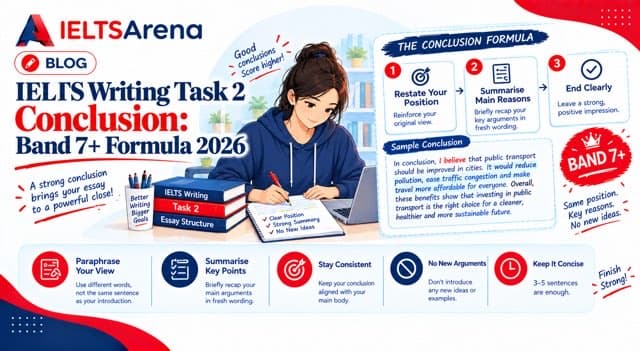
Move one: restate your position in different words. One short sentence. Do not copy your thesis. Change the key verbs and noun phrases so the examiner sees your Lexical Resource range. If your thesis started with "I strongly agree", your conclusion can start with "The case for X is therefore clear" or "The evidence above supports the view that".
Move two: briefly recap your two main reasons. One short sentence. Name both reasons from your body paragraphs in one compound sentence. This is what closes the Task Response loop. The examiner reads this sentence and confirms you did what you promised in your thesis.
Move three (optional): add a prediction, recommendation, or implication. One short sentence. Only use this move if you have the time and the content is natural to the topic. On a problem-and-solution essay, close with the main solution. On a discuss-both-views essay, add a recommendation for which approach governments or individuals should take. Skip this move if you cannot do it in one tight sentence.
Combined example for the prompt Some people think governments should fund public transport, while others think private companies should run it. Discuss both views and give your own opinion:
"The case for public funding of transport is therefore stronger than the case for private operation, as state-funded systems reduce road congestion and keep fares affordable for commuters on low incomes. Governments should treat public transport as a core service, not a commercial enterprise."
Three sentences, 42 words, three moves. The first sentence restates the position in different words. The second recaps both reasons from the body. The third adds a recommendation. The conclusion is now doing the work the examiner needs it to do.
Phrases That Score in 2026, and Phrases That Do Not
Opening phrases for Task 2 conclusions have become a sorting mechanism for examiners. Some phrases now actively drag your Lexical Resource mark down because they signal a memorised template. Others still read as natural and controlled.
Opening phrases that still score at Band 7+ in 2026:
- "In summary,"
- "To sum up,"
- "On balance,"
- "The evidence above supports the view that..."
- "The case for X is therefore stronger than the case for Y."
- "Taking the arguments above together,"
- "Weighing both sides,"
Opening phrases to avoid:
- "In conclusion, I would like to say that..."
- "In conclusion, I would like to conclude..."
- "It is a well-known fact that in today's modern world..."
- "To conclude, both sides have good points and it depends."
- "In my humble opinion,"
- "Last but not least,"
The difference is specificity. "In summary" is a plain transition that signals the end of the essay and nothing more. "In conclusion, I would like to say that" is three empty words before the content starts, which tells the examiner you are padding to reach word count.
Pick one opening phrase, use it consistently in practice, and never deviate on test day. One rehearsed opener saves you 20 seconds of thinking time at a point in the essay where you have almost none to spare.
Band 6 vs Band 7 vs Band 8 Conclusion: Side by Side
Same question, same thesis position, three different executions. The question: Some people think the government should fund space exploration, while others think the money should be spent on more urgent problems on Earth. Discuss both views and give your own opinion.
Band 6 conclusion: "In conclusion, I would like to say that both space exploration and Earth problems are very important. The government should think carefully and spend money in the best way. In my opinion, this is a difficult issue."
40 words, three sentences, zero content. Opens with filler, hedges on position, closes with a generic sentence. The examiner has learned nothing from the three sentences they just read.
Band 7 conclusion: "On balance, government funding should prioritise urgent problems on Earth over space exploration, because immediate humanitarian needs are more pressing and the economic returns from poverty reduction are better established. Space research can continue through international collaborations and private investment."
42 words, two sentences, three moves. Clear position, two reasons named from the body paragraphs, closing recommendation. The examiner can mark this conclusion against the thesis and confirm Task Response is "clear throughout".
Band 8 conclusion: "Weighing both sides, the stronger case lies with directing public funds toward urgent domestic priorities rather than space exploration, as the opportunity cost of unmet humanitarian needs outweighs the longer-term scientific gains, which can increasingly be met through private and international partnerships."
43 words, one sentence, same three moves compressed. The vocabulary (opportunity cost, humanitarian needs, international partnerships) and the grammar (participial opener, relative clause with modal verb) lift the band to 8. Same ideas, tighter execution.
Notice the Band 7 and Band 8 conclusions follow the same shape as each other. The only difference is lexical and grammatical range. The three moves are identical, which means you can rehearse the shape in practice and let the vocabulary rise naturally as your preparation deepens.
How Long Should the Conclusion Be
Target 30 to 40 words for the conclusion in a 250 to 290 word essay. The maths of a Band 7+ Task 2:
| Section | Word count | Time |
|---|---|---|
| Planning | 0 | 4 to 5 min |
| Introduction | 40 to 50 | 5 min |
| Body paragraph 1 | 90 to 130 | 11 to 13 min |
| Body paragraph 2 | 90 to 130 | 11 to 13 min |
| Conclusion | 30 to 40 | 3 to 4 min |
| Check | 0 | 3 to 4 min |
| Total | 260 to 310 | 40 min |
Writing a conclusion longer than 40 words usually means you are repeating content from the body or adding a new argument. Both drag the band down. A 50-word conclusion is almost always worse than a 35-word conclusion because it has more surface area for mistakes.
Writing a conclusion shorter than 25 words usually means the three moves are not all present. Shorter is not better. You need enough words to restate the position in different language and recap both body paragraph reasons.
Three sentences at 10 to 15 words each, or two sentences at 15 to 20 words each. Either shape works.
Where IELTSArena Fits Into Your Conclusion Practice
Writing a conclusion is a 90-second skill once you know the formula. The hard part is building the muscle memory under exam-time pressure, when you have already written for 35 minutes and your judgement is tired. Most test-takers lose their conclusion marks on test day, not in practice, because they never trained the move at minute 36.
IELTSArena's AI Writing Feedback scores every paragraph of your Task 2 essay separately, so you see whether your conclusion is being read as a Band 7 close or a Band 5.5 filler. The feedback flags memorised opening phrases, missing position restatement, and conclusions that contradict the thesis.
For deeper correction, IELTSArena's Expert Tutor Review marks your conclusion the way the real examiner will on test day and rewrites it at the band above yours so you can see what a Band 7 close looks like when yours is still at Band 6.5. More than 10,000 learners have used IELTSArena to tighten their Writing band this way. The Real CBT Interface gives you the same timer, highlighter, and word counter as the actual computer-based test, so your conclusion is written under the same pressure as test day.
Write one full Task 2 essay on IELTSArena, including the conclusion, and you will know within minutes which part of your closing paragraph is costing you band marks.
Self-Diagnosis: Is Your Conclusion at Band 7 Yet?
Open the last Task 2 essay you wrote and answer honestly:
- Does your conclusion restate your position in different words than your thesis, or is it a near copy?
- Does it name both main reasons you developed in the two body paragraphs?
- Did you avoid "In conclusion, I would like to say that" and other filler openers?
- Is the conclusion between 30 and 40 words, with no new argument introduced?
- Does the position in your conclusion match the position in your introduction, or did you drift during the body paragraphs?
If you answered no to two or more of these, your conclusion is holding your Writing band back by half a band.
See Your Current Band Today
Write one full Task 2 essay under exam conditions, submit it on IELTSArena, and get a paragraph-by-paragraph breakdown that includes a dedicated Task Response read on your conclusion. Start your free practice at IELTSArena. No credit card and no commitment.
Related Guides
These sit inside the same Task 2 essay-building-blocks cluster on IELTSArena. Work through them in order to build a complete Band 7+ essay.
- Writing Task 2 Body Paragraphs (the PEEL structure for Band 7+)
- Writing Task 2 Thesis Statement (the two-move formula)
- Writing Task 2 Introduction (the full 40 to 50 word opening)
- Writing Task 2 Paraphrasing the Question (the one sentence most people get wrong)
- Writing Task 2 Practice With Feedback (free scored essays on IELTSArena)
- IELTS Writing Band Descriptors Explained
- IELTS Writing Task 2 Tips for 2026
- Coherence and Cohesion for IELTS Writing
- Task 2 Sample Essays Band 9
- How to Improve Your IELTS Writing Score
FAQ
How do I write a conclusion for IELTS Writing Task 2? Use the three-move formula. Move one: restate your position in different words than your thesis. Move two: briefly recap the two main reasons from your body paragraphs. Move three (optional): add a prediction, recommendation, or implication specific to the topic. Keep the whole conclusion to 30 to 40 words, written in 3 to 4 minutes after the two body paragraphs. Never introduce a new argument. Never copy your introduction. Open with a clean transition like "In summary", "On balance", or "The evidence above supports the view that". Practise this formula on timed Task 2 prompts at IELTSArena and get your conclusion scored on Task Response and Coherence and Cohesion.
Is a conclusion necessary in IELTS Writing Task 2? Yes. A conclusion is mandatory for Band 7 and above on Task 2. The Cambridge band descriptors require a "clear position throughout the response" at Band 7 Task Response, and the conclusion is where that position is closed. An essay without a conclusion caps at Band 6 or 6.5 on Task Response regardless of how strong the body paragraphs are. A missing conclusion also often drops you below the 250-word minimum, which triggers an automatic word-count penalty. If you are running out of time, cut 20 words from your second body paragraph rather than skip the conclusion. A short conclusion always scores higher than no conclusion.
How long should an IELTS Task 2 conclusion be? Target 30 to 40 words for the conclusion, written in 3 to 4 minutes. Two sentences at 15 to 20 words each, or three sentences at 10 to 15 words each, both work. Conclusions longer than 40 words usually repeat content from the body or add a new argument, both of which drag the band down. Conclusions shorter than 25 words usually miss either the position restatement or the recap of main reasons, which breaks the Task Response "clear position throughout" requirement at Band 7. Keep the conclusion short, tight, and self-contained. A 35-word conclusion is almost always better than a 50-word one.
Can I introduce new ideas in my IELTS Task 2 conclusion? No. The conclusion is only for restating your position and recapping the two reasons you already developed in the body paragraphs. New ideas in the conclusion drop your Coherence and Cohesion mark because they break the "clear overall progression" requirement at Band 7. They also break your Task Response because an undeveloped new idea signals you ran out of time or lost control of the essay structure. The one exception is adding a prediction, recommendation, or implication that logically follows from the body paragraphs. That is a closing move, not a new argument, and only use it if you can do it in one tight sentence.
What phrases should I avoid in an IELTS Task 2 conclusion? Avoid memorised fillers that signal a template to the examiner: "In conclusion, I would like to say that", "In conclusion, I would like to conclude", "In my humble opinion", "Last but not least", "It is a well-known fact that in today's modern world", and "both sides have good points and it depends". These phrases have been flagged in examiner training as pure filler and now actively lower your Lexical Resource mark. Replace them with "In summary", "On balance", "To sum up", "The evidence above supports the view that", or "Weighing both sides,". Pick one and rehearse it in practice so it is automatic on test day.