
The first sentence of your IELTS Writing Task 2 essay is a sorting mechanism. Before the examiner has read a single word of your position, they already know whether your opening paraphrase is Band 6 or Band 7. Three or four words copied straight from the question drop the opening below Band 7 on Lexical Resource. A paraphrase that changes the meaning of the question drops the whole essay below Band 7 on Task Response.
The one sentence most Band 5.5 to Band 6.5 test-takers get wrong is the question paraphrase. They either copy the question with one noun swap, or they over-paraphrase with strange synonyms that change what the question actually said. Both failures are visible in the first 15 seconds the examiner spends on your essay.
This guide gives you the four techniques that produce a Band 7+ paraphrase in one sentence, the words you must never change, side-by-side Band 6 and 7 and 8 examples, and the four most common paraphrasing failures that cost marks. Practise timed paraphrases on real Task 2 prompts at IELTSArena and get your opening sentence scored on Lexical Resource and Task Response.
Quick Answer: Paraphrasing the question in IELTS Writing Task 2 means rewriting the prompt in your own words as the first sentence of your introduction. A Band 7+ paraphrase uses four techniques: swap non-essential words for accurate synonyms, change the word form (noun to verb, adjective to noun), change the grammar structure (active to passive, two clauses to one), and reorder the ideas. Keep proper nouns, technical terms, and numbers exactly as the question gives them. The paraphrase is one sentence of 15 to 20 words, written in the first two minutes of your 40-minute Task 2, and must preserve the full meaning of the original question.
Who this is for: Test-takers at Band 5.5 to Band 7.5 whose first sentence copies too much from the question or distorts its meaning. Equally useful for Academic and General Training Task 2.
Why the Paraphrase Sentence Decides Your Opening
Your introduction has two moving parts. The first is the paraphrase of the question. The second is your thesis statement. Together they take 40 to 50 words and set the ceiling for your Lexical Resource and Task Response marks in the first 30 seconds the examiner spends on your essay.
The paraphrase sentence has three jobs. It shows the examiner you understood the question. It demonstrates vocabulary range by replacing non-essential words with accurate synonyms. It introduces the topic in a natural, controlled sentence that leads into your thesis.
If your paraphrase copies three or more words in a row from the question, examiners now treat that as unparaphrased language. Lexical Resource drops because you have shown no range. If your paraphrase changes the meaning of the question, Task Response drops because the examiner now believes you are answering a different question than the one in front of you. Both failures happen in sentence one of the essay and both are hard to recover from.
Advertisement
Why Most Task 2 Paraphrases Lose Marks
Four habits sink paraphrase sentences across every target band. If your opening has been scoring at Band 6 or 6.5 on Lexical Resource, at least one of these is in play.
Direct copy of the question. The question says "Some people believe that governments should fund public transport" and your paraphrase says "There are some people who believe that governments should fund public transport". Six consecutive words copied. The examiner marks this as unparaphrased and your Lexical Resource opens at Band 5.5.
Over-paraphrasing with unnatural synonyms. The question says "public transport" and you write "communal commuting systems". The synonym is technically accurate but no native speaker would use it, and the examiner marks this as inappropriate vocabulary. Lexical Resource drops because unnatural word choice counts against you at Band 7 and above.
Changing the meaning of the question. The question says "while others think private companies should run it" and you write "while others want public transport to be fully privatised". Running something and fully privatising it are two different things. Task Response drops because you are now answering a question that is not on the page.
Paraphrasing the words you should keep exactly. The question says "the government" and you write "the authorities" or "the state". Fine. The question says "COVID-19 pandemic" and you write "the recent health crisis". Not fine. Proper nouns, technical terms, specific events, and numbers must stay exactly as the question gives them. Changing them signals carelessness.
Chidinma's Story: Band 6.5 to Band 7.5 in Four Weeks
Chidinma is a 32-year-old lawyer from Lagos preparing to re-qualify for Canadian law practice through the National Committee on Accreditation. She needed Band 7 across the board and her mock test came back at Band 6.5 on Writing. The feedback flagged one thing: "opening sentence copies too much from the question and limits Lexical Resource range in the introduction."
She looked at her last six essays. Every single opening started with the exact same four-word phrase from the question, then swapped out one noun. Her introductions were doing nothing for her vocabulary range because her first sentence was giving nothing away.
For four weeks, she practised only paraphrase sentences. She would take a Task 2 prompt and give herself two minutes to write a 15-word paraphrase that preserved the meaning but copied no more than two consecutive words from the question. She built a personal synonym bank for the ten most common Task 2 topics: environment, education, technology, health, work, government, cities, media, family, culture.
"I thought my vocabulary was weak. It was not weak. I just never used it, because I was spending the first sentence of every essay copying the question instead of showing the examiner what I actually knew."
Her next official test came back at Band 7.5 on Writing. The body paragraphs were the same quality they had always been. The opening sentence stopped copying the question and started demonstrating her vocabulary range in the first 15 words. The examiner's first impression lifted and the whole essay lifted with it.
The Data Behind Paraphrasing Marks
Cambridge Assessment English band descriptors are publicly available. Band 7 Lexical Resource reads "uses a sufficient range of vocabulary to allow some flexibility and precision" and "uses less common lexical items with some awareness of style and collocation". Band 6 reads "the range of vocabulary is sufficient to discuss the topic" and "attempts to use less common vocabulary but with some inaccuracy".
Band 7 Task Response reads "addresses all parts of the task" and "presents a clear position throughout the response". The paraphrase sentence is where the examiner first checks that you have addressed all parts. If your paraphrase skips a key phrase or misstates the question, you have failed to address all parts in your opening move and the examiner marks accordingly.
British Council Writing Task 2 guidance tells test-takers to rephrase the question in their own words to begin the introduction. IELTS trainers consistently report that students who build a topic-specific synonym bank for the ten most common Task 2 topics gain half a band on Lexical Resource within four to six weeks, with no other preparation changes.
In the 2026 marking approach, examiners have been given clearer instructions on what counts as copying versus natural overlap. Three or more consecutive words lifted from the question are now treated as unparaphrased. One or two words that are part of a natural phrase (such as "the government" or "young people") are allowed. The paraphrase sentence must contain at least four substantive synonym substitutions to pass the Band 7 Lexical Resource threshold.
The Four Paraphrase Techniques for Band 7+
Every Band 7+ paraphrase uses at least two of these four techniques in combination. Learn the four, practise them on three different question types, and the technique will carry you through every Task 2 opening you ever write.
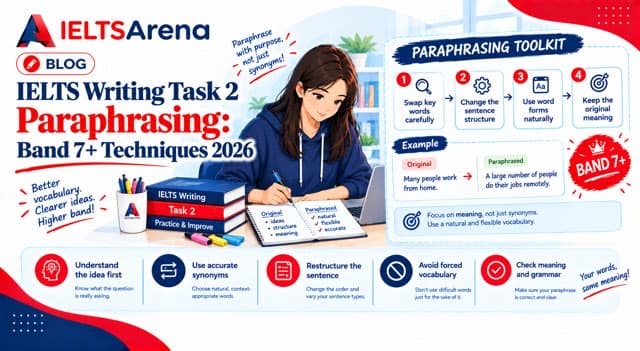
Technique one: swap non-essential words for accurate synonyms. The simplest technique and the one most students start with. Replace nouns, verbs, and adjectives with equivalent words that mean the same thing in the same register. Examples: "important" becomes "essential", "young people" becomes "the younger generation", "a lot of" becomes "many", "think" becomes "believe", "problem" becomes "issue". Do not replace proper nouns, technical terms, numbers, or specific events.
Technique two: change the word form. Shift a word from one grammatical class to another while keeping the meaning. Noun becomes verb, verb becomes noun, adjective becomes noun. Examples: "the pollution of cities" becomes "cities are polluted", "to educate children" becomes "the education of children", "a dangerous activity" becomes "the danger of this activity". Word-form changes count as a lexical range marker for the examiner because they require more control than straight synonym swaps.
Technique three: change the grammar structure. Shift the sentence from active to passive, from two clauses to one, from a conditional to a direct statement, or from a question to a statement. Examples: "Governments should fund public transport" becomes "Public transport should be funded by governments", "If children spend too much time online, they will not develop social skills" becomes "Excessive time online hinders children's social development". Grammar structure changes count as Grammatical Range range at Band 7.
Technique four: reorder the ideas. Flip the order of two clauses, bring the subordinate idea forward, or move the comparison before the main point. Examples: "Some people think X while others think Y" becomes "While some argue Y, others maintain X". Reordering is often the most natural technique and the one that produces the most readable paraphrase.
Combined example. The question: Some people think the government should fund public transport, while others think private companies should run it.
Paraphrase using all four techniques: "Public transport funding is a contested issue, with some arguing it should fall under state responsibility and others preferring private sector operation."
Four techniques in one sentence. "The government should fund" becomes "state responsibility" (synonym swap plus word form change: verb to noun). "Private companies should run it" becomes "private sector operation" (synonym swap plus word form change: verb to noun). The two views are flipped in order. The sentence is reorganised from two clauses to one. 20 words, no three-word strings copied, meaning fully preserved.
Words You Must Keep Exactly as the Question Gives Them
Not everything in the question should be paraphrased. Changing these items either distorts the meaning or signals carelessness.
Proper nouns. Names of countries, cities, companies, organisations, and people stay as written. "The United Kingdom" is not "the UK's territory". "COVID-19" is not "the recent health crisis".
Technical terms. If the question uses a specific term with a defined meaning, keep it. "Carbon dioxide emissions" is not "polluted air". "Mental health" is not "psychological state".
Numbers and statistics. If the question says "by 2050" or "under 18 years old" or "50 percent", keep them exactly. Changing a number changes the question.
Specific events, policies, or categories. "Zero-hour contracts" stays as "zero-hour contracts". "The gig economy" stays as "the gig economy".
Short, common words that have no good synonym. "The", "a", "and", "but", "in", "of". No one expects you to replace these.
If you are not sure whether to paraphrase a word, apply the meaning test: if the synonym changes what the question is asking, keep the original. If the synonym preserves the meaning exactly, swap it.
Band 6 vs Band 7 vs Band 8 Paraphrase: Side by Side
Same question, three different executions. The question: Some people believe that unpaid community service should be a compulsory part of high school programmes, while others disagree. Discuss both views and give your own opinion.
Band 6 paraphrase: "Some people believe that unpaid community service should be a compulsory part of high school programmes, but others do not agree with this view."
19 words. The paraphrase copies 11 consecutive words from the question. The only change is "disagree" to "do not agree with this view". Lexical Resource opens at Band 5.5 to Band 6.
Band 7 paraphrase: "There is ongoing debate over whether high school students should be required to carry out unpaid work in their communities as part of the curriculum, with opinions divided on both sides."
30 words. Zero three-word strings copied. Four substantive changes: "unpaid community service" becomes "unpaid work in their communities", "compulsory" becomes "required to", "programmes" becomes "the curriculum", "some people believe... others disagree" becomes "opinions divided on both sides". Meaning fully preserved. Lexical Resource opens at Band 7.
Band 8 paraphrase: "Whether unpaid community work should form a mandatory component of secondary school education has become a divisive question, with persuasive arguments on both sides."
24 words. Same four techniques used but with tighter vocabulary (mandatory component, divisive question, persuasive arguments) and more compressed grammar (gerund opener, single main clause). Lexical Resource opens at Band 8.
Notice that all three paraphrases preserve the exact meaning of the original question. The jump from Band 6 to Band 7 is not about saying something cleverer. It is about saying the same thing in different words that demonstrate range. The jump from Band 7 to Band 8 is about compression and natural phrasing.
How Long Should the Paraphrase Sentence Be
Target 15 to 25 words for the paraphrase sentence in your introduction, written in the first 60 to 90 seconds of your Task 2. The introduction maths:
| Sentence | Word count | Time |
|---|---|---|
| Paraphrase of the question | 15 to 25 | 60 to 90 sec |
| Optional general context sentence | 0 to 15 | 30 to 60 sec |
| Thesis statement | 20 to 30 | 60 to 90 sec |
| Introduction total | 40 to 55 | 4 to 5 min |
A paraphrase longer than 30 words almost always carries unnecessary filler and risks grammar slips. A paraphrase shorter than 12 words usually misses some element of the original question, which drops Task Response.
Two short sentences are allowed if the question is complex. For a two-part question like "What are the causes of X and how can it be addressed", a two-sentence paraphrase can work: one sentence for the first part, one for the second. Do not stretch to three sentences. Three paraphrase sentences signal that you are padding to reach the word count.
Where IELTSArena Fits Into Your Paraphrase Practice
Paraphrasing is a sentence-level skill that needs sentence-level feedback. A full essay review tells you your Lexical Resource is at Band 6.5 but does not tell you which specific sentence pulled it down. Most test-takers assume the problem is in the body paragraphs when it is actually in the opening paraphrase.
IELTSArena's AI Writing Feedback scores every sentence of your Task 2 essay separately, so you can see immediately whether your paraphrase is being read as Band 7 or Band 6. The feedback flags consecutive copied words, inaccurate synonyms, and meaning changes within the first sentence of the essay.
For human-level correction, IELTSArena's Expert Tutor Review marks your paraphrase the way the real examiner will on test day and rewrites it at the band above yours so you can see the exact vocabulary and structure moves you are missing. More than 10,000 learners have used IELTSArena to tighten their Writing band this way. The Real CBT Interface gives you the same keyboard, timer, and word counter as the actual computer-based test, so your paraphrase is written under the same pressure as test day.
Write one Task 2 introduction right now on IELTSArena, including just the paraphrase and the thesis, and you will know within minutes whether your opening sentence is costing you half a band.
Self-Diagnosis: Is Your Paraphrase at Band 7 Yet?
Open the last Task 2 essay you wrote and answer honestly:
- Does your paraphrase sentence copy three or more consecutive words from the question?
- Did you preserve the full meaning of the question, or did you accidentally change what it was asking?
- Did you keep proper nouns, technical terms, and numbers exactly as the question gave them?
- Did you use at least two of the four paraphrasing techniques (synonym swap, word form change, grammar structure change, reorder)?
- Is your paraphrase between 15 and 25 words, or is it either too short (misses a part of the question) or too long (padded with filler)?
If you answered no to two or more, your paraphrase is capping your Lexical Resource at Band 6 or 6.5 no matter how strong the rest of the essay is.
See Your Current Band Today
Write one Task 2 introduction under exam conditions, submit it on IELTSArena, and get a sentence-by-sentence read on your paraphrase in minutes. Start your free practice at IELTSArena. No credit card and no commitment.
Related Guides
These sit inside the same Task 2 essay-building-blocks cluster on IELTSArena. Work through them in order to build a complete Band 7+ essay.
- Writing Task 2 Body Paragraphs (the PEEL structure for Band 7+)
- Writing Task 2 Thesis Statement (the two-move formula)
- Writing Task 2 Conclusion (the three-move formula)
- Writing Task 2 Introduction (the full 40 to 50 word opening)
- Writing Task 2 Practice With Feedback (free scored essays on IELTSArena)
- IELTS Writing Band Descriptors Explained
- IELTS Writing Task 2 Tips for 2026
- Coherence and Cohesion for IELTS Writing
- Task 2 Sample Essays Band 9
- How to Improve Your IELTS Writing Score
FAQ
How do I paraphrase the question in IELTS Writing Task 2? Use the four-technique framework. First, swap non-essential words for accurate synonyms (important becomes essential, young people becomes the younger generation). Second, change word forms (verb to noun, adjective to noun). Third, change the grammar structure (active to passive, two clauses to one). Fourth, reorder the ideas (bring the subordinate clause forward, flip the comparison). Use at least two of the four techniques in one 15 to 25 word sentence that preserves the full meaning of the original question. Never copy three or more consecutive words from the question. Keep proper nouns, technical terms, and numbers exactly as given. Practise this on real Task 2 prompts at IELTSArena.
Why is paraphrasing important in IELTS Writing? Paraphrasing the question is the first move in your essay and it is where the examiner forms their opening read on your Lexical Resource and Task Response. A paraphrase that copies the question tells the examiner you cannot generate your own vocabulary range, which caps Lexical Resource at Band 5.5 to 6. A paraphrase that changes the meaning of the question tells the examiner you are answering a different question than the one in front of you, which caps Task Response at Band 6. A good paraphrase lifts your opening read before the examiner has read a single word of your thesis or body paragraphs, which raises the ceiling for the whole essay.
What techniques work for paraphrasing IELTS questions? Four techniques work across every Task 2 question type. Synonym substitution replaces non-essential words with equivalent vocabulary. Word form changes shift a word between grammatical classes (noun to verb, adjective to noun). Grammar structure changes convert active to passive, combine two clauses into one, or shift from conditional to direct statement. Reordering flips the sequence of ideas or brings the subordinate clause forward. A Band 7+ paraphrase uses at least two of these four techniques in combination within one 15 to 25 word sentence. Pure synonym substitution alone is Band 6. Two techniques combined is Band 7. Three or four techniques combined with natural phrasing is Band 8.
Can I use the exact words from the question in my IELTS essay? You can keep some exact words and must keep others. Proper nouns, technical terms, numbers, and specific events must stay exactly as the question gives them. Common function words like the, a, and, but, in, of are expected to appear and do not count as copying. Content words like nouns, verbs, and adjectives should be replaced wherever a natural synonym exists. The 2026 marking standard treats three or more consecutive words copied from the question as unparaphrased language, which drops Lexical Resource. Two consecutive words that are part of a natural phrase like the government or young people are allowed. The test is whether your paraphrase shows your vocabulary range, not whether every single word is new.
How long should the paraphrase sentence be in IELTS Task 2? Target 15 to 25 words for the paraphrase sentence, written in the first 60 to 90 seconds of your 40-minute Task 2. A paraphrase shorter than 12 words usually misses part of the original question, which drops Task Response for not addressing all parts of the task. A paraphrase longer than 30 words usually carries filler phrases and risks grammar slips. For a complex two-part question, you can split the paraphrase into two sentences of 12 to 15 words each. Never stretch to three sentences, as that signals padding. The paraphrase is one of three sentences in a 40 to 50 word introduction, so it needs to be tight enough to leave room for the thesis statement.