
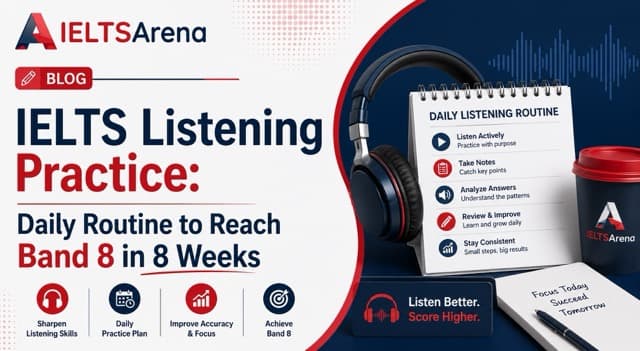
You have taken the IELTS Listening test twice. Both times you scored Band 6.5. You know the accents, you know the question types, and you still lose four or five marks every time on Section 3 and Section 4.
The frustrating part is that you have been practicing. You do a full test on Sunday, feel motivated, then touch nothing until the following weekend. That gap is exactly why your score has not moved.
Reaching Band 8 in Listening is not about doing more tests. It is about doing IELTS listening practice daily, in short focused blocks, so your ear stays trained and your accuracy climbs week after week.
This is the eight-week routine that moves students from Band 6 to Band 8, broken down day by day.
The Real Problem With How You Practice Listening
Most test-takers treat Listening as the easy section. They assume that because they watch English shows and understand most conversations, they will be fine on exam day.
The IELTS Listening test does not measure whether you understand English. It measures whether you can catch specific details under pressure, spell them correctly, and track a conversation while writing at the same time.
The test has four sections, 40 questions, and runs for about 30 minutes with 10 extra minutes to transfer answers on the paper version. On the computer-based test, you get two minutes at the end instead.
Section 1 is a social conversation. Section 2 is a monologue. Section 3 is an academic discussion between two to four speakers. Section 4 is a university lecture with no breaks.
Band 8 requires roughly 35 to 36 correct answers out of 40. That means you can afford four or five mistakes across the entire test. To hit that number consistently, your listening accuracy has to become automatic, and automation only comes from daily repetition.
Advertisement
Why Weekend-Only Practice Keeps You Stuck
When you practice once a week, your brain treats each session as a fresh start. You spend the first ten minutes re-adjusting to the speed and the accents. By the time you are properly tuned in, the test is half over.
Listening skill decays quickly without exposure. A study habit that appears three days apart is not enough to build the pattern recognition Band 8 demands.
The second problem is fatigue. A full test is 30 minutes of intense concentration. If you only ever practice in one long block, you train your stamina but never isolate your weaknesses.
You keep repeating the same mistakes because you never slow down to analyze them. You finish the test, check the score, feel disappointed, and move on.
Real improvement happens in the review, not the test. And review is exactly what gets skipped when you only practice once a week and run out of time.
Doing IELTS listening practice daily fixes both problems at once. Short sessions keep your ear tuned, and they leave room for the analysis that actually raises your band.
How Priya Moved From Band 6 to Band 8 in Eight Weeks
Priya, a pharmacy graduate from the Philippines, needed Band 7 in Listening for her registration pathway. She had been stuck at Band 6 for three months.
Her mistake was familiar. She did one full mock test every Saturday, scored around 26 out of 40, and could not understand why she was not improving.
"I thought more tests meant more progress," she said. "But I was just repeating the same errors every week and never learning from them."
She switched to a daily routine. Twenty-five minutes each morning: one section, full review of every wrong answer, and five minutes of transcript reading.
By week four, her Section 1 and Section 2 accuracy was near perfect. By week seven, she was catching the detail traps in Section 3 that used to cost her marks.
Her final result was Band 8. The change was not talent. It was the shift from one long weekly session to focused IELTS listening practice daily.
What The Data Says About Consistency
Score improvement in Listening follows a clear pattern. According to score analysis published by IELTS test preparation researchers, candidates who practice in short daily blocks improve measurably faster than those who cram in long weekly sessions.
Listening and Reading are the two sections where scores rise most predictably with structured practice, because they test recognition skills that respond directly to repetition.
The British Council notes that Listening is often the section where candidates see the quickest gains, provided practice is regular and paired with active review.
The numbers around the band boundary matter too. Moving from Band 6.5 to Band 8 usually means going from around 30 correct answers to 35 or more. That is only five extra questions, but those five are almost always the same recurring error types: spelling slips, plural mistakes, and losing focus in Section 4.
Fixing recurring errors requires seeing them repeatedly, which only daily practice provides. One weekly test simply does not surface your patterns often enough to correct them.
The 8-Week Daily IELTS Listening Practice Plan
Here is the full routine. Each day takes 25 to 40 minutes. The structure changes across the eight weeks so you build accuracy first, then speed, then stamina.
Weeks 1 to 2: Build accuracy on Sections 1 and 2
- Do one Section 1 exercise each day, focusing only on getting every answer correct.
- Check every answer, then re-listen to the parts you missed while reading the transcript.
- Note the exact word you misheard. Spelling and plurals matter here.
- Twice a week, do a Section 2 monologue to add variety.
Weeks 3 to 4: Add Section 3 and train prediction
- Alternate Section 1 and Section 3 across the week.
- Before each recording, read the questions and predict the answer type: is it a number, a name, a date, or a noun?
- Practice writing answers while still listening, not after.
- Review the distractors. Section 3 loves to give you an answer, then correct it.
Weeks 5 to 6: Master Section 4 and note completion
- Do one Section 4 lecture every day. This is the hardest section and needs the most exposure.
- Practice tracking signpost words like "however", "finally", and "the main reason".
- Work on note completion where you must fit the exact word into a summary.
- Add one full mock test at the end of week six to measure progress.
Weeks 7 to 8: Full tests and stamina
- Do three to four full tests across each week under timed conditions.
- On non-test days, review only. Go back to your error log and re-listen to your weakest sections.
- Practice the answer transfer step if you are taking the paper test.
- Simulate exam conditions on the computer-based interface so nothing feels new on test day.
To answer a common question directly: doing sections separately is better in the early weeks because it lets you isolate and fix weaknesses, while full tests matter most in the final two weeks when you need stamina and timing. A blend of both is the fastest route to Band 8.
Where IELTSArena Fits Into Your Daily Routine
The hardest part of daily practice is not motivation. It is having fresh, exam-accurate material every single day and knowing exactly which answers you got wrong and why.
IELTSArena solves both. The platform gives you real IELTS Listening tests split into sections, so you can do focused daily blocks instead of only full tests.
Every question comes with the correct answer and a transcript, so your five-minute review step is built in. You see your exact mistake immediately instead of guessing.
IELTSArena replicates the real IELTS computer-based test interface, including the on-screen timer and navigation panel. When you practice IELTS listening daily on the same interface you will face in the exam, test-day anxiety drops sharply.
The progress analytics track every mock test you take, so you can see your Section 3 and Section 4 accuracy climbing week by week. You know if your routine is working instead of hoping it is.
More than 10,000 learners have used IELTSArena to build the daily habit that moves their band score. The Daily Goals feature gives you a target for each session, which keeps a two-month plan from falling apart in week three.
For students who want a human eye on their weaknesses, expert tutors on IELTSArena can review where you keep losing marks and adjust your routine. That combination of real CBT simulation, instant answers, and progress tracking is what turns IELTS listening practice daily into a real Band 8 result.
The test does not reward how much you listen. It rewards how consistently and how accurately you listen, day after day.
Self-Diagnosis: Is Your Listening Routine Working?
Answer these honestly before your next practice session.
- Do you practice Listening at least five days a week, or only on weekends?
- After each test, do you review every wrong answer and identify the exact word you missed?
- Can you consistently score 35 or more out of 40 on Section 4, the hardest section?
- Do you keep an error log that shows your recurring mistake patterns?
- Have you practiced on the real computer-based test interface, or only on paper and audio files?
If you answered no to two or more of these, your routine has a gap that is keeping you below Band 8. The fix is structure and daily repetition, not more weekend marathons.
Start Your Free IELTS Listening Practice Today
You do not need another three months to reach Band 8 in Listening. You need eight weeks of focused daily practice on real exam material with instant review.
Take a free Listening test on IELTSArena and see exactly where your band score stands today. In one test, you will know which sections are costing you marks and where your daily routine should begin.
Take a Free Listening Test on IELTSArena →
Frequently Asked Questions
What should my daily IELTS listening practice routine look like?
A strong daily routine takes 25 to 40 minutes and combines one focused listening section with full review. Start each session by predicting the answer types from the questions. Then listen once under exam conditions and write your answers. Check every answer, re-listen to the parts you missed while reading the transcript, and log your exact errors. In the first weeks, focus on single sections to isolate weaknesses. In the final two weeks, shift to full timed tests to build stamina. Practicing on a real computer-based interface like IELTSArena makes the routine match your actual exam experience.
How many hours of IELTS listening practice per day is enough to improve?
You do not need hours. Thirty to forty focused minutes a day is enough to move your band score if you review properly. Quality matters far more than volume in Listening. A short session with full error analysis beats a two-hour session where you only check the final score. The key is consistency. Students who practice 30 minutes daily for eight weeks improve faster than those who do one three-hour session per week, because daily exposure keeps the ear tuned and surfaces recurring mistakes often enough to fix them.
What listening exercises should I do every day to prepare for IELTS?
Rotate through the four section types across the week rather than repeating the same one. Section 1 and Section 2 build accuracy on names, numbers, and spelling. Section 3 trains you to follow multiple speakers and spot distractors. Section 4 builds stamina for a long uninterrupted lecture. Add transcript reading and note completion drills. Prediction practice, where you guess the answer type before listening, is one of the highest-value daily exercises. IELTSArena provides all four section types as separate exercises, so you can target a different skill each day.
How do I stay focused during long IELTS listening practice sessions?
Break long sessions into single sections in the early weeks so your concentration stays sharp. Section 4 is where focus usually breaks, so train it deliberately by practicing one lecture at a time and tracking signpost words like "however" and "finally". Remove distractions and use headphones to mirror exam conditions. Build stamina gradually. Do not attempt full 30-minute tests every day from the start. Reserve full tests for the final two weeks once your accuracy is already strong, so fatigue does not undo your progress.
Is it better to do one full IELTS listening test daily or practice sections separately?
In the early weeks, practicing sections separately is better because it lets you isolate and fix specific weaknesses like Section 4 accuracy or spelling errors. Full tests too early only confirm your score without teaching you why you are losing marks. In the final two weeks before your exam, switch to full timed tests to build stamina and timing under real conditions. The best plan blends both: sections first for accuracy, full tests later for endurance. IELTSArena lets you do both on the same real exam interface.