
Your IELTS essay band score is the average of four criterion scores, calculated separately by a certified IELTS examiner using the public band descriptors, and combined using a specific weighting formula that most preparation materials skip entirely. Task 2 counts twice as much as Task 1, and the final Writing band is rounded using rules that always work in the candidate's favor.
This guide covers every step of the actual marking process, from the four criteria and their weightings to the exact rounding rules that decide whether your 6.75 becomes a 7 or stays a 6.5.
The Four Criteria That Make Up Every IELTS Essay Band Score
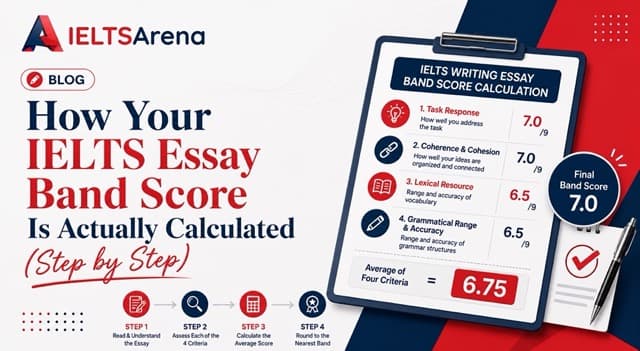
Every IELTS essay is scored on four criteria, each worth 25% of that essay's band score. These are the same for both Task 1 and Task 2, but what each criterion measures differs slightly between the two.
Task Response (Task 2) / Task Achievement (Task 1) measures how well you addressed the specific question asked. For Task 2, this is whether you developed a clear position and covered every part of the prompt. For Task 1, it is whether you identified key features of a chart (Academic) or addressed all bullet points with appropriate tone (General Training).
Coherence and Cohesion evaluates how logically your paragraphs flow, whether your linking devices work naturally, and whether your ideas progress in a clear order.
Lexical Resource measures the range and precision of your vocabulary, including collocations, less common lexical items, and topic-appropriate word choice.
Grammatical Range and Accuracy measures both the variety of grammatical structures you use and how consistently you get them right.
Each is scored on the 0-to-9 IELTS band scale, in half-band increments. The essay band is the average of the four, then rounded.
Advertisement
Are the Four Criteria in Your IELTS Essay Band Score Weighted Equally
Yes, within a single essay. Each of the four contributes 25% of that essay's band score. There is no criterion that quietly matters more than the others at the essay level.
Between Task 1 and Task 2, however, the weighting is very different. Task 2 counts twice as much as Task 1 in the final Writing band calculation. This is one of the most consequential facts in IELTS preparation, and it is missing from most generic guides.
The formula is: (Task 1 band + 2 × Task 2 band) ÷ 3. A Band 7 on Task 2 combined with a Band 6 on Task 1 gives a Writing band of (6 + 14) ÷ 3 = 6.67, which rounds to 6.5. Swap those, and a Band 7 on Task 1 with Band 6 on Task 2 gives (7 + 12) ÷ 3 = 6.33, which rounds to 6.5 too, but only just.
This is why every hour spent improving Task 2 is worth twice what the same hour on Task 1 would return, which is exactly the opposite of how many self-study candidates prioritize their practice.
How the Rounding Rules Actually Work
IELTS uses specific rounding rules for the final Writing and Overall band scores, and these directly affect your IELTS essay band score at every rounding threshold. These rules always work in your favor: fractional averages are rounded up, never down. That single fact rewards candidates who understand exactly which score combinations sit near a rounding threshold.
The rules:
- Averages ending in .25 round up to the next half band. Example: 6.25 becomes 6.5.
- Averages ending in .75 round up to the next whole band. Example: 6.75 becomes 7.0.
- Other averages round to the nearest half band by standard rounding.
The implication: a Writing average of exactly 6.75 gives you a Band 7 Writing score, which folded into an Overall band calculation could push your Overall from 6.5 to 7.0 without any single skill actually being at Band 7. Knowing where your criterion scores sit relative to these thresholds is the difference between practicing all four criteria evenly and focusing on the one that will actually move the needle.
How Many Examiners Mark Your IELTS Essay
Your Writing test is marked by an IELTS-certified examiner using the public band descriptors as their reference. For Speaking, the interviewing examiner also marks the response. Writing is a single-examiner process for the initial score, though secondary review is available if you request an Enquiry on Results (EOR) after receiving your results.
This is different from what most candidates assume. There is no panel of examiners, and no averaging across multiple examiner opinions. The examiner assigned to your Writing test scores each of the four criteria on Task 1 and Task 2, then those scores get averaged into your final Writing band using the (T1 + 2×T2) ÷ 3 formula. This is how every IELTS essay band score gets built, from criterion-level examiner judgments up through a formula-based average.
The consistency comes from the examiner's training against the public band descriptors, not from redundant marking. Every certified IELTS examiner works from the same descriptor language, which is why the same essay generally receives the same band from different examiners within a 0.5-band range.
What Actually Separates Each Band Level
The public band descriptors, published by IELTS itself, describe what an essay at each band should look like. Understanding these descriptors is more useful than any generic writing advice, because they are literally what the examiner uses to arrive at your IELTS essay band score.
A Band 6 Task Response "addresses all parts of the task although some parts may be more fully covered than others." A Band 7 Task Response "addresses all parts of the task" clearly and "presents a clear position throughout the response." The gap between the two is specific: equal, developed treatment of every part of the prompt, and a position that stays consistent from introduction to conclusion.
Similar precision defines the gaps between each band level across all four criteria. This is why criterion-diagnostic preparation works and generic "write more essays" advice does not. Diagnose the criterion where your descriptor gap lies, close it, move on.
A Realistic Student Story
Chidinma, a Lagos-based accountant preparing for a Canadian Express Entry application, had scored Band 6 on Writing across two attempts. Both attempts came back with the same weighted breakdown: Task 1 at Band 6.5, Task 2 at Band 5.5. Her Writing calculation was (6.5 + 11) ÷ 3 = 5.83, which rounded to Band 6.
For her third attempt, she shifted her practice ratio: she cut Task 1 practice from three essays a week to one and increased Task 2 practice from two essays a week to five. Six weeks later, her Task 1 held steady at Band 6.5, and her Task 2 rose to Band 7. Her Writing calculation became (6.5 + 14) ÷ 3 = 6.83, which rounded to Band 7.
Task 2 got twice the practice because it counts twice in the calculation. The math of her IELTS essay band score suddenly made sense.
If you have been dividing your writing practice evenly between Task 1 and Task 2, try IELTSArena's free Writing checker and see whether your Task 2 or Task 1 is the actual bottleneck for your Writing band.
What This Means for Your Practice
Three practical shifts come from understanding how your essay band score is actually calculated.
Prioritize Task 2 practice by roughly 2 to 1 over Task 1, since it contributes twice as much to your Writing band. Most candidates spend equal time on both, which is a preparation error, not a preference.
Diagnose your criterion breakdown before adding more practice hours. If your Task 2 is Band 7 on Grammatical Range but Band 5.5 on Task Response, more grammar drills do nothing for your final band. Fix the criterion that is actually holding your score down.
Understand where you sit relative to the rounding thresholds. If your Task 1 is Band 6 and your Task 2 is Band 6.5, your Writing calculation is (6 + 13) ÷ 3 = 6.33, which rounds to Band 6.5. Moving just Task 2 to Band 7 shifts the calculation to (6 + 14) ÷ 3 = 6.67, which still rounds to Band 6.5. But moving Task 2 to Band 7.5 hits (6 + 15) ÷ 3 = 7.0, a clean Band 7. Small changes matter enormously near thresholds.
Where IELTSArena Fits
IELTSArena's Writing checker scores each of the four criteria separately for both Task 1 and Task 2, then shows you exactly how the weighted average produces your Writing band. That transparency lets you see, on every essay, which criterion is closest to a threshold and which one is worth the next hour of practice. The full practice test hub has both task formats available alongside CBT Reading, Listening, and Speaking simulations.
Optional expert human tutor review is available for essays where the AI-estimated band is within half a band of your target, closing the accuracy gap that any AI-only score leaves open before your actual test.
A Quick Self-Check
Do you know your Task 1 and Task 2 bands separately, or only your overall Writing band? Are you practicing Task 1 and Task 2 in a 1:1 ratio, or roughly 1:2 to reflect their real weighting? Do you know which criterion is your weakest, and are you practicing that one specifically rather than writing more essays generally?
If any of these are unclear, that is where the path from your current Writing band to your target Writing band is silently stalling.
See Your Own Band Calculation Today
The single most useful thing you can do this week is submit one Task 1 and one Task 2 to a checker that shows the criterion breakdown, then work out for yourself whether your overall Writing band is Task 1-limited, Task 2-limited, or criterion-specific. Take a free Writing check on IELTSArena and see exactly how your essay band score is built. No credit card required.
FAQ
How does an IELTS essay actually get a band score? A certified IELTS examiner scores your essay on four criteria (Task Response or Achievement, Coherence and Cohesion, Lexical Resource, Grammatical Range and Accuracy), each worth 25%. Those four criterion scores are averaged to give the essay band. Your final Writing band is then calculated as (Task 1 band + 2 × Task 2 band) ÷ 3, because Task 2 counts twice as much as Task 1.
Are the four IELTS writing criteria weighted equally? Yes, within a single essay. Each contributes 25% of that essay's band. Between Task 1 and Task 2, however, Task 2 counts twice as much as Task 1 in the final Writing band calculation. This is why practice time should skew roughly 2:1 in favor of Task 2.
Which band descriptor matters most for reaching Band 7? For most Band 6.5 candidates, Task Response is the criterion where the gap to Band 7 is widest, because it requires equal, developed treatment of every part of the prompt. Coherence and Cohesion is usually the second most common bottleneck. The specific answer depends on your own criterion breakdown, which is why criterion-diagnostic feedback matters more than generic writing advice.
How many examiners mark my IELTS essay? One certified IELTS examiner marks your Writing test using the public band descriptors. There is no panel, and no averaging across multiple opinions. Consistency comes from examiner training against the descriptors, not from redundant marking. If you disagree with your result, you can request an Enquiry on Results (EOR) for a secondary review after receiving your scores.
Can I dispute my IELTS writing band score? Yes, through the Enquiry on Results (EOR) process, which triggers a re-mark of your Writing test by a second certified examiner. If your score rises after the EOR, the fee is refunded. The process takes several weeks and is worth pursuing when your Writing score is significantly out of line with your prepared band level and your other section scores.