The IELTS Speaking test lasts just 11 to 14 minutes, yet it is the section most test-takers feel least prepared for. The reason is simple. You can read, write, and listen on your own, but speaking feels like it needs another person.
So thousands of test-takers skip speaking preparation entirely. They tell themselves they will "just talk naturally" on the day. Then the examiner asks a Part 3 question about abstract social trends, and they freeze.
Here is the truth. You can build a strong Speaking band on your own. IELTS speaking practice alone is not a compromise. Done correctly, it can be more effective than casual conversation because it forces you to focus on the exact skills the examiner scores. This guide shows you how.
What the Speaking Test Actually Measures
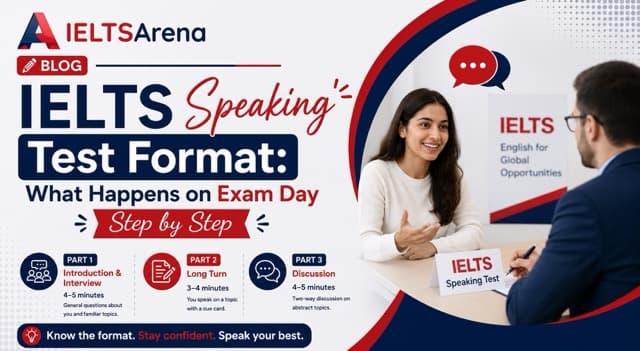
The Speaking test has three parts. Part 1 is a four to five minute interview about familiar topics like your home, work, or hobbies. Part 2 is the long turn, where you get a cue card, one minute to prepare, and up to two minutes to speak alone. Part 3 is a four to five minute discussion of more abstract ideas linked to the Part 2 topic.
The examiner scores you on four criteria, each weighted equally. These are Fluency and Coherence, Lexical Resource, Grammatical Range and Accuracy, and Pronunciation.
Notice what is not on that list. There is no mark for having a conversation partner. There is no mark for opinions being correct. The examiner is listening to how you use English, not who you practise with.
This is the key insight behind effective IELTS speaking practice alone. Every one of those four criteria can be trained by yourself, because each is about your own output, not a dialogue.
Advertisement
Why Common Approaches Fail
Most test-takers who try to prepare for Speaking make predictable mistakes.
The first is waiting for a partner. They believe they cannot practise until they find someone to speak with, so they delay preparation for weeks. When exam day arrives, they have barely spoken a full answer aloud.
The second mistake is silent preparation. They read model answers, memorise idioms, and plan what they will say, but they never actually speak. Reading about speaking is not speaking. Fluency only develops through the physical act of talking.
The third mistake is speaking without ever listening back. They talk to themselves, feel it went fine, and never record or review. Without hearing your own output, you cannot spot the long pauses, the repeated words, or the grammar slips that lower your band.
The fourth mistake is memorising scripted answers. Examiners are trained to spot rehearsed responses and will change the question to break the script. Memorised answers often lower your score because they sound unnatural.
Good IELTS speaking practice alone avoids all four traps. It means speaking out loud every day, recording yourself, listening back critically, and getting objective feedback on the four scored criteria.
A Realistic Student Story
Daniel, an engineer from the Philippines, needed Band 7.0 in Speaking for a skilled migration visa. He lived in a small town with no IELTS study groups and no tutor nearby.
"I kept telling myself I would practise once I found a partner," Daniel said. "Months passed and I had not spoken a single full answer out loud."
Three weeks before his test, Daniel started serious IELTS speaking practice alone. He recorded himself answering cue cards on his phone, then listened back. The first time he heard the recording, he was shocked. He counted long pauses, the word "actually" used eleven times in two minutes, and several tense errors he never noticed while speaking.
He built a daily routine of recording, reviewing, and re-recording the same answer until it improved. He used an AI feedback tool to score his fluency and pronunciation objectively. His band rose from an estimated 6.0 to a confirmed 7.0 on test day.
"Practising alone forced me to hear my real weaknesses," Daniel said. "A partner would have been too polite to point them out."
Data and Insight Layer
Speaking is one of the more stubborn IELTS modules to improve, but not for the reason most people think. According to global performance data published by the IELTS partners, Academic candidates often average around Band 5.9 to 6.2 in Speaking, and the gap to a Band 7.0 target is common.
The reason the gap persists is not lack of practice partners. It is lack of feedback. Analysis of test-taker habits shows that most people who practise speaking never record themselves, so they cannot identify the specific errors holding them back.
Consider fluency. A test-taker might believe they speak smoothly, but a recording often reveals pauses filling 15 to 20 percent of speaking time. Those hesitations directly lower the Fluency and Coherence score. You cannot fix what you cannot hear.
The encouraging insight is that structured IELTS speaking practice alone with recording and feedback can produce measurable gains in a short window. Because pronunciation and fluency respond to focused daily drilling, many test-takers lift half a band within four to six weeks of consistent solo work.
The Right Approach to IELTS Speaking Practice Alone
Follow this structured routine to build a strong Speaking band on your own.
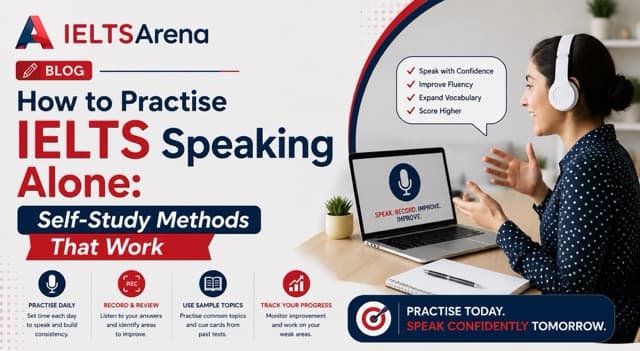
- Record every answer. Use your phone to record yourself answering Part 1, Part 2, and Part 3 questions. Recording is the single most important habit in IELTS speaking practice alone, because it lets you hear what the examiner hears.
- Listen back critically. Play the recording and note three things: how often you pause, which words you overuse, and where grammar breaks down. Write these down. This turns practice IELTS speaking alone into targeted improvement.
- Use the shadowing technique. Choose a short clip of a fluent English speaker, then repeat their words immediately after them, copying rhythm and intonation. Shadowing trains pronunciation and natural stress patterns, which are hard to build without a model.
- Practise the Part 2 long turn daily. The two-minute solo talk is where practising alone is actually ideal, because the real test also has you speaking alone. Draw a cue card, prepare for one minute, and speak for two. Do this every single day.
- Build topic vocabulary. For each common theme like technology, environment, or education, prepare a small bank of precise words and collocations. This strengthens your Lexical Resource score. Practise using the new words in spoken answers, not just reading them.
- Time yourself strictly. Part 2 requires two minutes of continuous speech. Many test-takers dry up after 45 seconds. Practising to the clock builds the stamina to fill the full time with relevant content.
- Get objective feedback. Self-review catches a lot, but you cannot fully judge your own pronunciation or band level. This is where an AI feedback tool becomes essential for IELTS speaking self practice, giving you a score on each criterion.
How IELTSArena Powers Solo Speaking Practice
The hardest part of IELTS speaking practice alone is feedback. You can record yourself, but you still need an objective answer to one question: what band am I actually speaking at right now? IELTSArena solves exactly this.
IELTSArena provides AI Speaking feedback that scores your fluency, pronunciation, vocabulary, and grammar. You answer real exam-style questions, and the platform analyses your response against the four official criteria. Instead of guessing whether your Part 2 answer was Band 6 or Band 7, you get a clear read.
This matters most for test-takers with no speaking partner. IELTSArena gives you the feedback layer that usually requires a tutor, available any time you sit down to practise. For IELTS speaking without partner situations, this is the difference between practising blindly and practising with direction.
IELTSArena also offers a bank of authentic Part 1, Part 2, and Part 3 questions, so you always have fresh cue cards for your daily IELTS speaking home practice. You are never stuck repeating the same three topics.
For test-takers who want more than AI, IELTSArena also offers expert tutor feedback. A human tutor can catch nuances that matter at the top bands, giving band-focused correction on your spoken responses. This combination of AI plus expert review is what sets IELTSArena apart from AI-only tools.
The platform tracks your Speaking scores across every session, so you can see whether your fluency is genuinely improving week over week. More than 10,000 learners have used IELTSArena to prepare, many of them practising entirely alone.
The examiner is not scoring your conversation. They are scoring your English. That is why you can train every point of it by yourself.
You can start your IELTS speaking practice alone free on IELTSArena and get your first AI Speaking score in minutes.
Self-Diagnosis: Is Your Solo Speaking Practice Working?
Answer these questions honestly to see where your preparation stands.
- Do you record yourself speaking and listen back, or do you only speak and move on?
- Can you talk for the full two minutes on a Part 2 cue card without drying up?
- Do you know your current band score on each of the four Speaking criteria?
- When you practise, are you speaking out loud, or only reading model answers silently?
- Do you get any objective feedback on your pronunciation and fluency, or are you judging yourself?
If any of these gave you pause, your IELTS speaking practice alone is missing the feedback and recording habits that drive real score gains.
Start Your Free Speaking Practice Today
You do not need a partner to build a Band 7 Speaking score. You need daily spoken practice, honest self-review, and objective feedback on the four criteria that decide your band.
Take one free AI Speaking assessment on IELTSArena and hear exactly where your fluency, vocabulary, grammar, and pronunciation stand today. In one session, you will know your real starting band and what to fix first.
Take a Free Speaking Assessment on IELTSArena →
Frequently Asked Questions
How do I practise for the IELTS speaking test when I have no one to speak with?
You can prepare fully on your own, because the examiner scores your English, not your conversation partner. Record yourself answering real exam questions, listen back to spot pauses and errors, and re-record until your answer improves. Practise the Part 2 long turn daily, since that part is already a solo two-minute talk. For objective feedback, use a tool like IELTSArena, which gives AI Speaking scores on fluency, pronunciation, vocabulary, and grammar. This replaces the missing partner with something more useful: honest, criteria-based feedback that shows your real band.
Is it possible to improve IELTS speaking without a speaking partner?
Yes, and many test-takers reach Band 7 or higher through solo preparation. The four Speaking criteria, Fluency and Coherence, Lexical Resource, Grammatical Range and Accuracy, and Pronunciation, are all about your own output, so each can be trained alone. The key is recording yourself and getting objective feedback rather than just talking to yourself. Platforms like IELTSArena provide AI Speaking feedback and expert tutor review, so IELTS speaking practice alone becomes structured and measurable. A partner is helpful, but honest feedback matters far more, and you can get that without one.
How do I record and evaluate my own IELTS speaking practice?
Use your phone to record full answers to Part 1, Part 2, and Part 3 questions. Then listen back and note three things: how often you pause or hesitate, which words you overuse, and where grammar or tense breaks down. Compare your Part 2 answers to the two-minute target to check stamina. For an objective band score, upload or answer questions on IELTSArena, which uses AI to score your fluency and pronunciation against the official criteria. Self-review catches many issues, but combining it with AI feedback gives you the accuracy that IELTS speaking self practice needs.
What daily habits help improve IELTS speaking when practising alone?
Build a short daily routine. Record one Part 2 long turn every day, listen back, and re-record it once. Spend a few minutes shadowing a fluent English speaker to improve rhythm and pronunciation. Prepare topic vocabulary for common themes and use the new words aloud. Time yourself strictly so you can fill the full two minutes. End the week by checking your band trend on a feedback tool. Consistency beats long sessions, and around 30 minutes a day of focused IELTS speaking practice alone produces steady gains within a month.
Can AI tools actually replace a human tutor for IELTS speaking practice?
AI tools are excellent for daily practice. They give instant, objective scores on fluency, pronunciation, vocabulary, and grammar, and they are available any time, which is ideal for IELTS speaking practice alone. For most test-takers, AI feedback drives the fastest early gains. However, at the top bands, a human tutor still adds value by catching subtle nuances and giving band-focused correction that AI can miss. The strongest approach combines both. IELTSArena offers AI Speaking feedback plus expert tutor review, so you get instant daily scoring and human insight when you need to push past a plateau.
![Best IELTS Book for Self Study [2026]: The 2-Book Rule Nobody Tells You](/_next/image?url=%2Fblog%2Fcover-best-ielts-book-for-self-study.jpeg&w=3840&q=75&dpl=dpl_Aqz3ysBMoiqhQVPsvpyewic5RwdT)