
Free IELTS Band Score Calculator
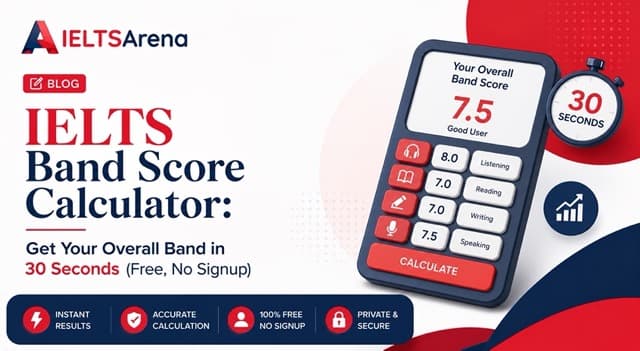
Use the free IELTS band score calculator to get your overall band instantly. Enter your four section scores and it applies the official rounding rules for you — no signup, no credit card, no data stored.
Your overall IELTS band score is the average of your four section scores (Listening, Reading, Writing, Speaking), rounded using specific official rules that always work in your favour. The calculator applies those rules automatically. The rest of this page explains exactly how the calculation works, so you know why your overall band is what it is and where the rounding thresholds create small opportunities to move up.
Advertisement
How the IELTS Band Score Calculator Actually Works
The formula is straightforward: (Listening + Reading + Writing + Speaking) ÷ 4 = raw average. That raw average is then rounded to the nearest half or whole band using IELTS's official rounding rules.
Here is the specific rounding logic every IELTS band score calculator should apply.
Averages ending in .25 round UP to the next half band. Example: 6.25 becomes 6.5.
Averages ending in .75 round UP to the next whole band. Example: 6.75 becomes 7.0.
All other averages round to the nearest half band by standard rounding. Example: 6.125 rounds to 6.0. Example: 6.375 rounds to 6.5.
The key fact: rounding always works in your favour at the .25 and .75 thresholds. A raw average of 6.5 stays 6.5. A raw average of 6.75 becomes 7.0. That single rule is why understanding where your section scores sit relative to these thresholds can make a real difference to your final band.
Worked Examples From Real Score Combinations
Example 1: Listening 7.0, Reading 6.5, Writing 6.0, Speaking 6.5. Average is (7.0 + 6.5 + 6.0 + 6.5) ÷ 4 = 6.5. Overall band: 6.5.
Example 2: Listening 7.5, Reading 7.0, Writing 6.0, Speaking 6.5. Average is 6.75. Because it ends in .75, it rounds UP to Band 7.0. Overall band: 7.0.
Example 3: Listening 7.0, Reading 7.0, Writing 6.0, Speaking 6.0. Average is 6.5. Overall band: 6.5.
Example 4: Listening 8.0, Reading 7.5, Writing 6.5, Speaking 7.0. Average is 7.25. Rounds UP to 7.5. Overall band: 7.5.
Example 5: Listening 6.5, Reading 6.0, Writing 6.0, Speaking 6.5. Average is 6.25. Rounds UP to 6.5. Overall band: 6.5.
Note how Example 2 and Example 3 both average close to 6.5, but Example 2 hits the .75 rounding threshold and becomes Band 7.0 while Example 3 lands at exactly 6.5. Moving any single section by half a band can be the difference between a "6.5" and a "7.0" on your official result.
How Raw Scores Convert to Band Scores for Listening and Reading
Listening and Reading are scored on 40 questions each. The raw score (number correct out of 40) is converted to a band score using an approximate conversion table. The exact boundaries vary slightly between test versions, but the general conversion is stable enough to plan around.
Listening (Academic and General Training use the same test):
- 39-40 correct = Band 9.0
- 37-38 correct = Band 8.5
- 35-36 correct = Band 8.0
- 32-34 correct = Band 7.5
- 30-31 correct = Band 7.0
- 26-29 correct = Band 6.5
- 23-25 correct = Band 6.0
- 18-22 correct = Band 5.5
- 16-17 correct = Band 5.0
Academic Reading (harder than General Training Reading):
- 39-40 correct = Band 9.0
- 37-38 correct = Band 8.5
- 35-36 correct = Band 8.0
- 33-34 correct = Band 7.5
- 30-32 correct = Band 7.0
- 27-29 correct = Band 6.5
- 23-26 correct = Band 6.0
- 19-22 correct = Band 5.5
General Training Reading (easier boundaries than Academic):
- 40 correct = Band 9.0
- 39 correct = Band 8.5
- 37-38 correct = Band 8.0
- 36 correct = Band 7.5
- 34-35 correct = Band 7.0
- 32-33 correct = Band 6.5
- 30-31 correct = Band 6.0
- 27-29 correct = Band 5.5
Writing and Speaking are not converted from raw scores. They are directly assessed by certified IELTS examiners against the public band descriptors, using the 0 to 9 band scale.
How the Writing Band Itself Is Calculated
Your Writing band (which then feeds into the overall IELTS band score calculation) uses a separate weighted formula because Task 2 counts twice as much as Task 1.
The Writing formula is: (Task 1 band + 2 × Task 2 band) ÷ 3.
This is why every hour spent on Task 2 practice is worth twice what the same hour on Task 1 would return in terms of your final Writing band. It is also why criterion-level diagnostic feedback matters more than volume of practice.
What This Means for Where to Focus Preparation
The rounding thresholds create real preparation opportunities. Three practical shifts come from understanding the calculator.
If your practice scores average 6.25, you already round to 6.5. Do not spend six weeks trying to raise all four sections. Focus on maintaining what you have and using the buffer to build reliability.
If your practice scores average 6.5, you are one section-half-band away from a 6.75 raw average, which rounds to Band 7.0. That section is where the next four weeks of practice should go, not another section that would only move you from 6.5 to 6.75.
If your practice scores average 6.75, you already round to 7.0. Do not risk a rounding drop by neglecting your strongest section for your weakest. Balance matters more than heroics at this threshold.
Using an IELTS band score calculator well means checking, before every study cycle, which threshold you are closest to and what section-level move would push you across.
A Realistic Student Story
Aditya, a Delhi-based civil engineer preparing for an Australian skilled worker visa, used the calculator to plan his final two weeks of preparation. His practice scores averaged Listening 7.5, Reading 6.5, Writing 6.0, Speaking 7.0. That averaged to 6.75, which rounded up to Band 7.0.
He had been planning to spend the final weeks on Reading (his weakest tested section). The calculator showed him that moving Reading from 6.5 to 7.0 would push his average to 6.875, which still rounds to Band 7.0. Moving Writing from 6.0 to 6.5, however, would push his average to 6.875 and, critically, gave him a buffer against any single section dropping half a band on test day.
He shifted his focus to Writing, hit Band 6.5 on Writing in his actual test, and confirmed his overall Band 7.0 with reliability rather than relying on a lucky rounding.
The IELTS band score calculator did not raise his English. It just told him which specific practice hour would actually change his final score.
If you have been guessing at which section to prioritise, use the calculator with your current practice scores to see which move would push you across a rounding threshold.
Where IELTSArena Fits
IELTSArena's full practice test hub gives you criterion-level scoring on Writing and Speaking and raw-score-to-band conversion on Listening and Reading, so you can enter each section's honest current band into the calculator and see exactly how they combine. Use the calculator as a planning tool for your final six weeks: identify your threshold, work the section that moves you across it.
For candidates within half a band of their target, optional expert human tutor review is available for Writing and Speaking responses flagged below your target band, which is particularly useful when a single section is what stands between you and the next rounding threshold.
A Quick Self-Check
Do you know your current band for each of the four sections separately? Do you know which rounding threshold you are closest to (below 6.25, at 6.5, at 6.75, or above)? Have you calculated which section-level move would push you across the next threshold, rather than practising all four evenly? Have you factored the (Task 1 + 2 × Task 2) ÷ 3 formula into your Writing preparation ratio?
If any of these are unclear, that is where preparation time is being spent in the wrong section, and the calculator will tell you exactly where to redirect it.
Try the Calculator With Your Current Practice Scores
Enter your latest practice scores into the calculator at the top of this page. See which rounding threshold you are closest to. Then take a free CBT practice test on IELTSArena to confirm your current section-level bands before committing to a preparation plan.
FAQ
How do I calculate my overall IELTS band score? Take the average of your four section scores (Listening + Reading + Writing + Speaking) ÷ 4, then apply the official IELTS rounding rules: averages ending in .25 round up to the next half band, averages ending in .75 round up to the next whole band, other averages round to the nearest half band. The calculator at the top of this page applies these rules automatically.
What are the official IELTS rounding rules? Three rules: averages ending in .25 round UP to the next half band (6.25 becomes 6.5), averages ending in .75 round UP to the next whole band (6.75 becomes 7.0), and all other averages round to the nearest half band by standard rounding. The .25 and .75 rules always work in the candidate's favour.
How does IELTS convert raw scores to band scores? Listening and Reading are scored on 40 questions each, with a conversion table mapping raw scores to bands. Roughly 30 correct out of 40 gives Band 7.0 on Listening, and 30 to 32 correct gives Band 7.0 on Academic Reading. Writing and Speaking are not converted from raw scores; they are assessed directly by certified examiners on the 0 to 9 band scale.
Is the overall IELTS band calculated the same way for Academic and General Training? Yes. The overall band formula is (Listening + Reading + Writing + Speaking) ÷ 4 with the same rounding rules for both Academic and General Training. Only the Reading raw-to-band conversion differs between the two test types (General Training Reading requires more correct answers for the same band).
Can my IELTS band go up because of rounding? Yes. Averages ending in .25 and .75 both round up. A candidate averaging 6.75 rounds to Band 7.0 without any single section being at Band 7. A candidate averaging 6.25 rounds to Band 6.5 without any single section being at Band 6.5. Knowing where you sit relative to these thresholds is the key to using preparation time efficiently.