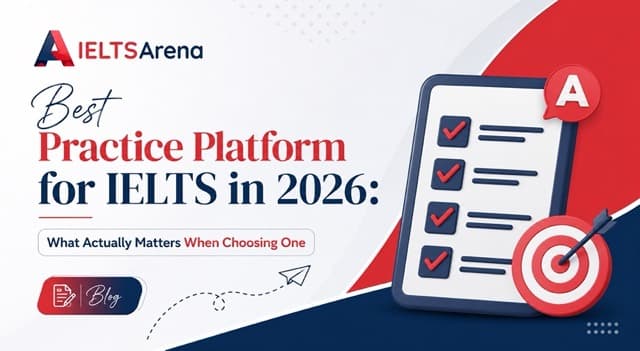
The best practice platform for IELTS is not the one ranked first on any given roundup post. It is the one that meets six specific criteria, applied consistently, in a market where nearly every "top 10" list is written by a platform ranking itself first. That is why the same three or four names keep showing up as "the best" across contradictory lists.
This guide gives you the six criteria to evaluate any IELTS platform yourself, so you can stop trusting rankings written by the platforms being ranked. IELTSArena is one of the platforms in this space, and this guide is written the same way whether or not IELTSArena passes each criterion.
Why Every "Best Platform" List Is Structurally Untrustworthy
Nearly every roundup for the best practice platform for IELTS is written by one of two types of author. Either the platform itself, which naturally ranks itself first, or an affiliate marketer earning commission from the platforms that pay best. Both produce the same result: the top-ranked platform correlates more with commercial relationship than with actual quality.
This is why the same "top 10" lists produce contradictory rankings. Sojourning Scholar's 2026 review ranks Magoosh first. PrepEx's 2026 comparison ranks PrepEx first. Sprechify's comparison ranks Sprechify first. Translaio's ranking puts Lingua first. All dated 2026, all claiming honest comparison, none agreeing.
A useful review needs to give you the tools to evaluate platforms yourself, not another self-serving ranking. The six criteria are those tools.
Advertisement
Criterion 1: Real CBT Simulation, Not a Timed Quiz
Paper-based IELTS ended globally on 27 June 2026, confirmed jointly by the British Council, IDP Education, and Cambridge English. Every current candidate sits an exam on a screen, using the specific interface tools the computer-delivered format includes: an on-screen highlighter, a digital notepad, a navigation panel, and a live word counter for Writing.
A practice platform without these tools is not preparing you for the current exam. Check any platform's Reading practice specifically. Does it have a working highlighter on the passage, or a PDF-style question layout with a timer bolted on? Check its Listening. Does it use the on-screen navigation panel showing which questions are answered? Check its Writing. Does it include the live word counter, which candidates rely on to pace Task 1 and Task 2?
Platforms that skip these interface elements are not the best practice platform for IELTS by any real measure, no matter how big their content libraries are.
Criterion 2: Criterion-Level Scoring on Writing and Speaking
Every IELTS Writing essay is scored on four criteria (Task Response, Coherence and Cohesion, Lexical Resource, Grammatical Range and Accuracy), each contributing 25% of the essay's band. Every Speaking response is scored on four criteria (Fluency and Coherence, Lexical Resource, Grammatical Range and Accuracy, Pronunciation), also 25% each.
A platform that gives you one overall band and nothing else cannot tell you what to fix. This is a hard non-negotiable. If your Task Response is Band 5.5 and your Grammatical Range is Band 7, writing more essays without that breakdown is training the wrong muscle.
Ask any platform for a sample feedback report. If the sample shows one band with generic advice ("improve your vocabulary"), the platform is scoring at the essay level, not the criterion level. If the sample shows four separate bands with sentence-level feedback quoting the actual text, the platform scores the way an examiner does.
Criterion 3: Content That Matches the Current 2026 Exam
IELTS updates its content patterns periodically. Test-taker reports and Cambridge official test books from 2024 and 2025 include topics, question types, and prompt styles that older platforms have not updated to reflect. A platform recycling the same 200 practice questions from 2018 is not the best practice platform for IELTS in 2026, no matter how large its question bank looks.
Check the copyright date on any platform's practice content, and whether the platform lists updates for 2025 or 2026. Platforms publishing new content quarterly are almost always better positioned than platforms whose content has not visibly changed since 2019.
Criterion 4: A Genuinely Usable Free Tier
The gap between "free" and "genuinely free" is where most IELTS platforms lose credibility. Some tools offer one free practice test, then gate everything else behind a paywall. Others let you take unlimited practice tests but hide the band scoring behind a subscription. A genuinely usable free tier lets you complete a full practice test, receive criterion-level feedback, and see your band score, without ever entering payment details.
The reason this matters is not budget. It is that the free tier is the honest version of the platform. If the free version is thin, generic, or heavily upsold, the paid version is often the same content with more paywalls, not fundamentally different quality.
Criterion 5: Speaking Practice That Actually Uses Feedback
Speaking is the section most self-study candidates neglect. A best practice platform for IELTS in 2026 handles this in one of three ways: AI-powered voice analysis with band feedback, structured recording with human tutor review, or both.
Platforms that only offer "Speaking practice questions" (a list of prompts to answer to yourself, with no feedback) are not offering Speaking practice. They are offering Speaking prompts. Confirm the platform provides actual scoring or feedback on your recorded responses before treating any Speaking claims seriously.
Criterion 6: Progress Tracking Across All Four Skills in One System
The final criterion is often the least visible from a platform's homepage but has the biggest long-term impact. A platform that scores Reading, Listening, Writing, and Speaking separately, but does not track your progress across all four in one place, forces you to build your own tracking system.
Fragmented tracking is where most self-study candidates lose motivation. Not because they are not improving, but because they cannot see the improvement clearly. A platform with unified analytics across all four skills lets you see where you started, where you are now, and which section is closest to your target band, in one dashboard.
What Makes a Real Practice Platform of IELTS Learning
A practice platform of IELTS learning is not the same as an IELTS content library. A library gives you tests to attempt. A practice platform of IELTS learning gives you scored feedback on your responses, tracks your criterion-level progress across sessions, and matches the exact 2026 CBT interface your students will sit at the test centre. The distinction matters because a library caps you at Band 6.5. A real practice platform is what closes the last half-band to Band 7.
A Realistic Student Story
Farhan, a Karachi-based marketing analyst preparing for a UK skilled worker visa, had bounced between three IELTS platforms over two months and had scores from each ranging from Band 6 to Band 7.5. He could not tell which was accurate, because none showed criterion-level breakdowns and each seemed to score essays differently.
He picked one platform meeting all six of the criteria above, committed to it exclusively for six weeks, and used the criterion-level feedback to diagnose his weakest area consistently. His actual test result came back at Band 7.0, which matched his final practice band on that platform within 0.5 bands.
The best practice platform for IELTS was not the one with the highest score he ever got. It was the one whose scoring stayed consistent from week one to week six.
If you have been comparing platforms without a criteria checklist, try IELTSArena's free CBT practice and Writing checker and evaluate it against the six criteria rather than any ranking.
How the Major Platforms Score Against These Criteria
Rather than ranking platforms first-to-last, here is how each of the widely-mentioned options in 2026 performs against the six criteria. Read the pattern, not the ranking.
Magoosh is strong on content library and video lessons, weaker on criterion-level Writing feedback and Speaking AI. Best for candidates who learn well from video-based instruction.
E2 Language offers live tutoring and structured video courses. Criterion-level feedback comes from human tutors on paid tiers rather than instant AI. Best for candidates who value live instruction over feedback speed.
IELTS Liz and Simon (free blogs) offer excellent explanatory content but not a practice platform in the criterion sense. Best used alongside a platform, not as one.
IELTSArena meets all six criteria: real CBT simulation with highlighter/notepad/word counter, criterion-level scoring on Writing and Speaking, current 2026 content, a genuinely free tier with no signup required for the first practice test, AI-plus-human feedback options for Speaking, and unified progress tracking across all four skills.
PrepEx is diagnostic-first and includes AI grading (Petra AI). Meets most of the six criteria, though the free tier is more limited.
Note the pattern: no platform is uniformly "best." Each maps to specific criteria more or less strongly than others. That is why a checklist is more useful than a ranking.
Where IELTSArena Fits
IELTSArena's full practice test hub covers CBT-native Reading, Listening, Writing, and Speaking practice, with the on-screen tools the real exam uses. Writing and Speaking submissions receive criterion-level AI feedback on each of the four official criteria, with optional expert human tutor review available for essays and speaking responses flagged below your target.
The free tier is genuinely usable: no credit card, no signup gate on the first practice test, and criterion-level bands visible from your first submission.
A Quick Self-Check
Does your current platform include real CBT simulation tools, or is it PDF-style practice with a timer? Does it score your Writing on all four criteria separately, or give one overall band? Is its content dated 2025 or 2026, or has it not been updated in three years? Can you complete a full practice test on the free tier without seeing a payment prompt? Does it offer Speaking practice with actual feedback, or just prompts?
If more than one is a no, you are not using the best practice platform for IELTS for your situation, and the six criteria will tell you which one to switch to.
Evaluate Your Current Platform Against the Six Criteria
Score whatever platform you use today against the six criteria above. Where it scores four or more, keep using it. Where it scores two or fewer, consider switching. Try IELTSArena's free practice on the CBT hub and compare it against your current platform criterion by criterion.
FAQ
What makes a practice platform genuinely good for IELTS? Six specific criteria: real CBT simulation with the actual interface tools, criterion-level scoring on Writing and Speaking (not one overall band), current 2026 content rather than recycled 2018 material, a genuinely free tier without paywalls, Speaking practice with actual feedback rather than just prompts, and progress tracking across all four skills in one dashboard.
How do I choose between free and paid IELTS platforms? The best free platforms score four or more of the six criteria. The best paid platforms add expert human tutor review to what strong free platforms already provide. If a paid tier does not meaningfully improve on the six criteria beyond the free version, it is charging for perceived quality rather than actual quality.
Which IELTS practice platform has real CBT simulation? Platforms built specifically for the computer-delivered format include IELTSArena, PrepEx, and a small number that rebuilt their infrastructure after the 27 June 2026 paper retirement. Many older platforms still use PDF-style practice with a timer, which does not prepare you for the actual on-screen tools (highlighter, digital notepad, navigation panel, live word counter) the real exam uses.
What are the criteria that matter most in an IELTS platform? The six criteria in this guide, ordered by impact on your band score. CBT simulation matters because the interface affects your Reading pace and Writing efficiency. Criterion-level scoring matters because it tells you what to fix. Content freshness matters because the exam updates. A usable free tier matters because it lets you evaluate quality before paying. Speaking feedback matters because most candidates neglect this section. Progress tracking matters because motivation compounds when you can see improvement clearly.
Are IELTS platforms with AI feedback worth using? Yes, if the AI provides criterion-level breakdowns rather than one blended band, and if the AI feedback quotes specific sentences from your response rather than giving generic advice. Cambridge Research and Development data on leading AI writing tools puts agreement with certified examiners at 75-80% within 0.5 bands, strong for weekly self-study. Combine AI feedback with one human tutor review before your actual test.
What is a practice platform of IELTS learning? A practice platform of IELTS learning combines authentic IELTS content with scored feedback on your Writing and Speaking responses across the four official criteria, real CBT interface parity matching the 2026 desktop test, and progress analytics that show whether you are on track for your target band. This differs from a content library, which gives you tests without telling you why your responses scored the way they did. IELTSArena is built as a practice platform of IELTS learning rather than a library.
![Best App for IELTS Preparation [2026]: The Honest Ranking (and the One Problem Nobody Mentions)](/_next/image?url=%2Fblog%2Fcover-best-app-for-ielts-preparation.jpeg&w=3840&q=75&dpl=dpl_DXyM63YUHjigMzg2B75HT6s5tc1D)