
Most test-takers who score below their target band have one thing in common: they never sat through a real IELTS full practice test before exam day. They practised Listening on Tuesday, Writing on Thursday, and Reading on Saturday. But they never sat down for three uninterrupted hours, doing all four skills back to back, exactly the way the real exam works.
That single gap costs more band points than almost any other preparation mistake.
If you want a Band 7, 7.5, or higher, completing realistic IELTS full practice tests is not optional. It is the foundation everything else rests on.
Why Doing Sections Separately Is Not Enough
Practising individual sections builds skills. But the IELTS exam is not four separate tests. It is one continuous experience that demands stamina, focus management, and the ability to shift mental gears within a single sitting.
When you practise sections in isolation, you never feel the weight of doing Listening after a full Writing session. You never discover how your concentration dips during Section 4 of Listening when your brain is already tired from an hour of Reading. You never learn how to manage the 10-minute transfer time when you are genuinely exhausted.
By the time you walk into the test centre, all of these things happen together. And if you have never experienced them in practice, your performance will drop even if your individual section skills are strong.
That is the core problem with section-by-section preparation.
Advertisement
Why Common Approaches Fail
The most common preparation mistake is treating IELTS like four separate exams and preparing for each one independently.
Students spend weeks on Writing Task 2 structure. They do Listening practice with individual audio tracks. They work through Reading passages one at a time. But they never simulate the full exam environment.
The second mistake is using untimed practice. Many students do practice tasks without a strict clock, pausing to re-read a question or think through a grammar point. This feels productive, but it trains the wrong habits. Under real exam pressure, there is no pause button.
A third error is practising in comfortable environments. Students sit at a familiar desk with their phone nearby, background music playing, and a cup of tea in reach. None of that exists in the test centre. The environment difference alone can shake your focus if you have never prepared under realistic conditions.
The result is candidates who have done dozens of practice exercises but are genuinely unprepared for what a three-hour IELTS exam actually feels like.
One Candidate Who Got It Right
Priya, a nurse from the Philippines, had been scoring Band 6.5 in practice sections for four months. Her target was Band 7 for her nursing registration. She worked through grammar books, watched YouTube lessons on academic vocabulary, and completed individual Reading passages most evenings.
Three weeks before her exam, she registered on IELTSArena and completed her first IELTS full practice test in one sitting. The result was a shock. Her combined score was Band 6.0. Her Reading score dropped significantly compared to her isolated practice scores, and her Writing Task 2 was noticeably weaker than usual.
"I didn't realise how tired I was by the time I got to Writing," she said. "In my section practice, Writing always felt fine. But after Listening and Reading back to back, I could barely think clearly."
She went on to complete four more full mock tests on IELTSArena over the next two weeks, focusing on mental stamina and recovery. On exam day, she scored Band 7.5.
The practice was not harder than the exam. The practice prepared her for the exam.
What the Data Shows About Full Mock Test Practice
Research into IELTS preparation patterns consistently shows that candidates who complete at least three to five full IELTS practice tests before their exam significantly outperform those who rely exclusively on section-based practice.
A widely cited analysis of test-taker outcomes found that candidates who simulated full exam conditions in practice were around 35 percent more likely to meet their target band score on the first attempt.
The reason is straightforward. Exam performance depends on two separate things: your skill level and your ability to apply that skill under pressure. You can develop skill through section practice. You can only develop exam stamina and pressure management through full mock tests.
IELTSArena data from thousands of test-takers shows the same pattern. Candidates who complete at least four full practice tests on the platform before their exam date achieve their target score at a rate nearly double that of candidates who use IELTSArena only for individual section practice.
The gap between skill and performance closes when you train for the full experience.
The Right Approach: How to Run a Proper 3-Hour Mock Session
Follow this structure every time you complete an IELTS full practice test.
Step 1: Set up a genuine exam environment. Find a quiet room. Sit at a desk, not a sofa. Remove your phone from the room. Use a physical clock or a dedicated timer. Do not play music. Tell anyone in the building that you cannot be interrupted for three hours.
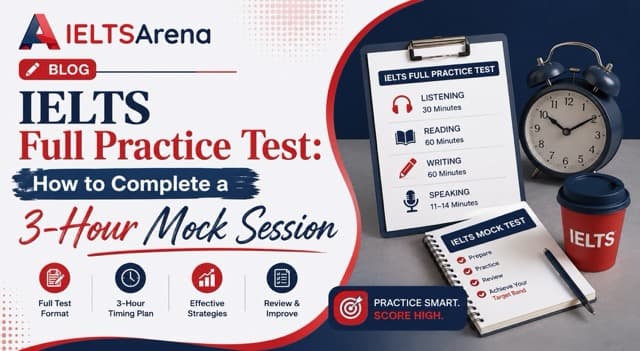
Step 2: Follow the real exam order. Start with Listening (approximately 40 minutes including transfer time). Move to Reading (60 minutes). Then complete Writing (60 minutes, both tasks). If you are preparing for Academic, use Academic materials throughout. If General Training, use General Training.
Step 3: Do not stop for any reason. No toilet breaks during sections. No checking answers between sections. No pausing the audio. If you would not be able to do it in the real exam, do not allow it in practice.
Step 4: Review your results systematically. After completing the test, take a 30-minute break, then review every section in detail. Do not just check your score. Identify why each wrong answer was wrong. Look for patterns: Are you misreading the question? Falling for distractors? Running out of time in a specific section?
Step 5: Prioritise quality over quantity. One well-reviewed full mock test teaches you more than three tests done casually. Take the time to understand each error before moving on to the next test.
Step 6: Increase difficulty over time. Your first full practice test will likely feel hard. That is normal. Each subsequent test should be completed under slightly stricter conditions. No previewing questions before Listening. Strict section time limits. This gradual difficulty increase builds the resilience you need for exam day.
How IELTSArena Makes Full Practice Tests More Effective
IELTSArena is designed specifically for candidates who want to prepare the right way.
The IELTSArena platform delivers full, exam-realistic CBT (computer-based test) practice tests that mirror the real IELTS interface. Every section is timed automatically. The environment matches what you will see at the actual test centre, so there is no adjustment required on exam day.
After each IELTS full practice test, IELTSArena provides AI-powered Writing feedback that evaluates your Task 1 and Task 2 responses against the official IELTS band descriptors. You get specific feedback on Task Achievement, Coherence and Cohesion, Lexical Resource, and Grammatical Range. This is not a generic score. It is the same framework your real examiner uses.
IELTSArena also tracks your progress across multiple full mock tests. You can see exactly how your stamina and section scores develop over time, so you know which areas still need work and which are already at your target level.
For candidates preparing for both Academic and General Training IELTS, IELTSArena offers full practice tests for both formats. You can switch between them depending on your exam type.
Thousands of test-takers across more than 40 countries have used IELTSArena to complete their full mock test practice. The platform is trusted because it works.
Self-Diagnosis: Are You Preparing Correctly?
Before your next practice session, ask yourself these questions honestly.
Have you ever sat through a complete IELTS full practice test in one sitting without stopping? If you cannot say yes, this is the most important gap in your preparation.
Do your practice scores drop when you are tired, or do they remain consistent throughout a full session? If your Writing and Reading scores are noticeably worse toward the end of a session, you have a stamina problem, not a skill problem.
Are you reviewing every wrong answer after each mock test, or just checking your overall score? Reviewing only the score misses most of the learning value of a full practice test.
Have you practised in conditions that feel uncomfortable? Most candidates prepare in conditions that are too comfortable. If your practice feels easy, it is probably not close enough to the real exam.
Are you completing at least three to five full practice tests before exam day? One or two is not enough to build genuine exam confidence.
Start Your Full Practice Test Today
If your exam is coming up in the next few weeks, do not spend another session on isolated exercises. Sit down for three full hours and do the complete IELTS full practice test experience.
IELTSArena gives you everything you need: exam-realistic full practice tests, automatic timing, AI Writing feedback, and detailed performance tracking.
Take Your First Full Practice Test on IELTSArena →
Frequently Asked Questions
Should I do a full 3-hour IELTS practice test or practise each section separately?
Both are necessary, but in the right order. Start with section-based practice to build your skills. Then, in the four to six weeks before your exam, shift your focus to full IELTS complete practice tests. These replicate the real exam experience and build the stamina and focus management that section practice cannot develop.
How do I simulate real IELTS exam conditions at home?
Remove all distractions and sit at a desk in a quiet room. Use a strict timer and follow the exact section order: Listening, Reading, Writing. Do not pause, take breaks, or use reference materials. If you are doing a computer-based test, complete your IELTS full practice test on a computer rather than paper. Platforms like IELTSArena replicate the actual CBT interface used in official exam centres.
How many full IELTS practice tests should I complete before exam day?
Aim for a minimum of four to five complete practice tests. The first one is about understanding your baseline. The second and third are about identifying patterns. The fourth and fifth are about confirming your progress and building exam confidence. IELTSArena allows you to complete as many full mock tests as you need before your test date.
What do I do if I score badly on a full IELTS practice test?
A low score on a full practice test is useful information, not a reason to panic. Review every wrong answer carefully and look for patterns. Are you losing marks in one specific section? Is your Writing score lower when you are tired? These insights tell you exactly what to work on. Use IELTSArena's detailed feedback tools to turn each poor result into a targeted improvement plan.
How does completing full practice tests help me improve faster than doing sections separately?
Section-by-section practice builds skills in ideal conditions. Full IELTS 3 hour practice tests build your ability to perform those skills under real pressure. Many candidates discover that their actual exam-day performance is significantly lower than their practice section scores, because they have never experienced the cumulative fatigue of a full sitting. Full practice tests close this gap by training both skill and stamina simultaneously.
![Best App for IELTS Preparation [2026]: The Honest Ranking (and the One Problem Nobody Mentions)](/_next/image?url=%2Fblog%2Fcover-best-app-for-ielts-preparation.jpeg&w=3840&q=75&dpl=dpl_GYEKaGV5BCFmb21AbDnxrbdK56fd)