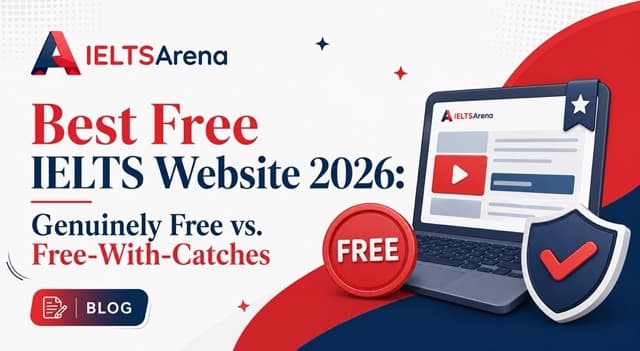
The best free IELTS website is not the one that ranks first on a search result page. It is the one where you can complete a full practice test, receive a real band score, and see criterion-level feedback, without ever being asked for payment or a credit card. That definition of "free" is different from what most sites labelled "free" actually offer, which is why so many candidates burn hours signing up for tools that turn out to be paywalled after the first attempt.
This guide separates the genuinely free IELTS websites from the free-with-catches ones, using a specific test any candidate can run in under five minutes.
What "Free" Actually Means, and What It Usually Means
The word "free" in IELTS preparation has been quietly redefined by the industry. Here are the five most common definitions of "free" that platforms use, ranked from most honest to least.
Genuinely free: You can complete a full practice test, get a criterion-level band score, and see detailed feedback without entering payment details or creating an account. This is the definition that matches what most candidates expect.
Free with signup: You need to create an account with an email, but no payment is required at any point. The signup wall is not a paywall, and everything the site offers is accessible after registration. This is honest, if slightly friction-adding.
Free trial: You get 7 to 14 days of full access, then payment is required to continue. This is not free. It is a trial of a paid product, and platforms that call this "free" are being misleading.
Freemium with paywall: You can access limited features (usually a small subset of practice tests), but the band scoring, feedback, or full test library requires payment. This is the most common "free" claim, and it is closer to a demo than a free tool.
Free with lead capture: You get initial access, but the platform sells your contact information to consultancies, coaching centres, or study-abroad agents. You "pay" through the emails and calls that follow. This is the least honest form of "free," and it is more common than most candidates realise.
Knowing which category a site falls into is the first step to identifying the best free IELTS website for your situation.
Advertisement
The Five-Minute Test That Reveals a Site's Real Free Tier
Any site claiming to be a best free IELTS website should pass this simple test. It takes about five minutes and tells you exactly what the free tier really is.
Step 1: Load the site in a private browsing window so cookies don't interfere.
Step 2: Look for the "practice test" or "mock test" section without signing up. Can you access it directly, or do you hit a signup wall immediately?
Step 3: If you can access a test, start it. Answer three or four questions, then look for a "submit" or "get score" button. Does it work without payment, or does it prompt for credit card details before showing your result?
Step 4: If you get a score, check whether it includes criterion-level breakdowns for Writing and Speaking. Is the feedback specific enough to act on, or does it say "improve your vocabulary" and then upsell you to a paid tier for the real feedback?
Step 5: Read the terms and conditions for what happens with your email address. Does the site sell your information to third parties, or is the free tier genuinely free of that hidden cost?
A site that passes all five steps is genuinely free. A site that fails any of them is free-with-catches, and knowing which catch matters most for your situation determines whether it is still worth using.
How the Most-Cited "Free" IELTS Sites Score
Here is how the widely-mentioned "free" IELTS websites in 2026 perform against the five-minute test. This is not a ranking. It is a categorisation.
British Council and IDP IELTS official sites offer genuinely free sample tests and preparation materials with no signup required. Content is limited (usually one or two full practice tests each), but what they offer is real and unpaywalled. Best for candidates who want a small quantity of officially-sourced practice material.
IELTS Liz and IELTS Simon are free blogs run by former IELTS teachers. They offer written explanations, sample answers, and lesson content but not interactive practice tests. Genuinely free, but not a "practice platform" in the interactive sense.
Mini-IELTS offers free unlimited practice tests without a signup wall for the initial test-taking. Reading and Listening are fully scored automatically. Writing and Speaking submissions require signup for automated scoring. Falls into the "free with signup" category.
IELTS Online Tests (IOT) offers a large library of free practice tests. Signup is required for score tracking. Writing and Speaking evaluations are limited on the free tier. Uses attendance-count webinar prompts ("1,500+ attending") that suggest lead-capture prioritisation over pure free access.
BestMyTest offers a "free" account but converts to a 7-day trial once you use the more advanced features. Falls into the "free trial" category, which is not the same as genuinely free.
PrepEdu offers extensive practice tests but heavily promotes a "Test Practice PRO" upgrade for AI feedback and advanced features. Falls into the "freemium with paywall" category.
IELTSArena offers a genuinely free full CBT practice test with criterion-level band scores on Writing and Speaking, no credit card, no signup gate on the first test, and no email selling. Falls into the "genuinely free" category by the five-minute test above.
Note the pattern: very few widely-marketed IELTS sites pass the strictest definition of free. That is not because platforms are dishonest; it is because "free" is expensive to actually deliver, so most platforms use free as a lead-generation strategy rather than a genuine offering.
A Realistic Student Story
Chidinma, a Lagos-based accountant preparing for a Canadian permanent residency application, had signed up for four "free" IELTS websites in her first two weeks of preparation. Two required credit card details before showing her band score. One turned out to be a 7-day trial that started auto-billing on day 8. One sold her email to three different study-abroad consultancies that called her weekly for a month.
She switched to a strategy: one genuinely free platform for daily practice, one official free source for authenticity-verified content, and one paid resource for feedback closer to her test date. The strategy took less time to set up than switching between four half-free platforms had.
The best free IELTS website was not one that gave her the most content. It was one whose free tier stayed genuinely free from week one to week eight.
If you have been burning time on sites that turn out to be paywalled, try IELTSArena's genuinely free CBT practice and evaluate it against the five-minute test above.
How Free IELTS Websites Actually Make Money
Understanding how a "free" site generates revenue tells you where its incentives point, and where the catches are likely to appear.
Paid upgrades are the most common revenue model. The free tier gives you enough to feel productive but not enough to score well without paying for more. This is the freemium pattern.
Lead generation for consultancies is the second most common revenue model, especially in Asian and African markets. You get free access; the platform gets your contact information, which it sells to study-abroad agents, university recruiters, and immigration consultancies.
Advertising is the third pattern, mostly on blog-format free sites like IELTS Liz. This is the least intrusive form of monetisation but limits the platform's ability to invest in interactive features.
Sponsorship or grant funding is the fourth, rarer pattern. Some official IELTS partner sites are funded by the parent organisation and offer genuine free tools as a public service.
Understanding the revenue model tells you what you are "paying" with even when you are not paying money.
Where IELTSArena Fits
IELTSArena falls into the genuinely-free-tier category by the five-minute test above. The full practice test hub offers CBT-native Reading, Listening, Writing, and Speaking practice with criterion-level band scoring on Writing and Speaking, all accessible without a credit card or signup gate on the first practice test. Optional expert human tutor review is available as a paid upgrade, but nothing in the free tier is gated behind that upgrade.
The reason this can work as a business model is that the free tier attracts serious candidates who convert to the human tutor review for their final pre-test review. That converts a portion of free users to paid users without paywalling the core free experience.
A Quick Self-Check on Your Current "Free" Tools
Have you actually completed a full practice test on your current "free" site, or does the score gate at signup? Do you have criterion-level Writing and Speaking feedback, or just Reading and Listening scores? Are you receiving unsolicited emails or calls from consultancies since you signed up? Have you spent any money on features you thought would be free?
If any of these reveal a catch, that is the "cost" of your current best free IELTS website, and the five-minute test will tell you which category it actually falls into.
Try a Site That Passes the Test
Run the five-minute test on whatever "free" IELTS website you currently use. Try IELTSArena's free CBT practice hub and see the difference between genuinely free and free-with-catches.
FAQ
Which IELTS website is actually free with no catches? Very few. British Council and IDP IELTS official sample tests, IELTS Liz and IELTS Simon (blog format, no interactive practice), and IELTSArena's free CBT practice tier are among the few that pass the five-minute test: full practice test access, criterion-level band scoring, no signup gate on the first test, and no email selling. Most other "free" sites gate at least one of these behind a paywall.
What should I check before trusting a free IELTS website? Run the five-minute test: can you take a full practice test without signup, do you get criterion-level Writing and Speaking scores without payment, does the site sell your email to third parties, and does the "free" tier stay free after the first attempt? Any "no" answer identifies a catch that determines whether the site is worth using.
Are all the "free" IELTS sites actually free? No. Most fall into freemium (paywall for advanced features), free trial (7 to 14 days then paid), or lead-generation (your email is sold) categories. Genuinely free (no payment, no signup gate, no email selling) is the smallest category and includes only a handful of widely-known IELTS websites.
How do free IELTS sites make money? Four main revenue models: paid upgrades for advanced features (freemium), lead generation for study-abroad consultancies (email selling), advertising on blog-format sites, and sponsorship or grant funding for official partner sites. Understanding which model a site uses tells you where the catches are likely to appear.
Which free IELTS website has the most content? IELTS Online Tests and PrepEdu have the largest content libraries, but both require signup and gate advanced features (like Writing and Speaking evaluation) behind paid tiers. British Council and IDP offer smaller libraries but with no catches. The trade-off is size versus honesty of the free tier.
![Best App for IELTS Preparation [2026]: The Honest Ranking (and the One Problem Nobody Mentions)](/_next/image?url=%2Fblog%2Fcover-best-app-for-ielts-preparation.jpeg&w=3840&q=75&dpl=dpl_DXyM63YUHjigMzg2B75HT6s5tc1D)