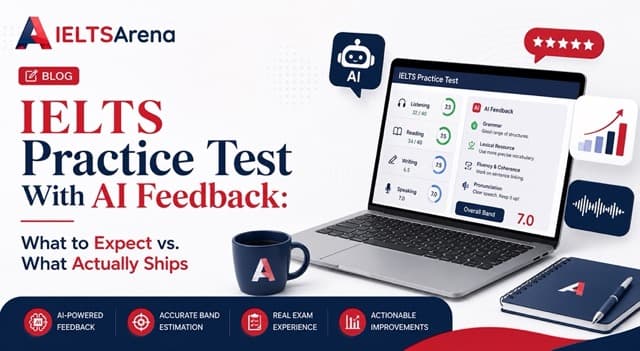
A good IELTS practice test with AI feedback gives you a separate band for each of the four official criteria within 30 seconds, quotes specific sentences from your response in the feedback, and discloses its own accuracy honestly. Marketing pages promise all three. Real tools deliver on some, hide others, and stretch the truth on the ones they cannot prove.
This guide covers what AI feedback on IELTS practice tests actually delivers in 2026, how accurate it really is according to peer-reviewed research, and how to use AI-first platforms well rather than trusting their marketing at face value.
What "AI Feedback" Actually Means in 2026
AI feedback in IELTS practice covers three genuinely different things, and most marketing pages blur them.
Criterion-level band scoring. The AI evaluates your response against the four official IELTS criteria and produces a separate band for each. This is the most valuable form of AI feedback because it tells you what to fix. Not all "AI-powered" tools do this. Some produce a single overall number.
Sentence-level annotation. The AI identifies specific sentences that raised or lowered your band and explains why. This is the form of feedback that turns a score into a learning tool. Marketing pages sometimes call generic advice ("improve your vocabulary") sentence-level feedback, which it is not.
Adaptive practice recommendations. The AI uses your performance history to suggest what to practice next. This is real for a few platforms, marketed by many, and delivered well by very few.
An IELTS practice test with AI feedback that offers only the third without the first two is closer to a study planner than a scoring engine. Confirm which type you are getting before subscribing.
Advertisement
The Real Accuracy Numbers, From Peer-Reviewed Research
Marketing pages love the word "accurate." Research papers use specific numbers.
A 2024 ERIC-indexed peer-reviewed study measured ChatGPT's IELTS Writing scoring at 0.811 QWK (Quadratic Weighted Kappa) against certified examiners, compared to 0.92 QWK between two human examiners scoring the same essays. QWK is the standard measure of scoring agreement in language testing. Higher means better agreement.
Purpose-built AI graders, trained specifically on examiner-scored IELTS essays, score in the 0.85 to 0.92 QWK range. That effectively matches human examiner-to-examiner agreement. Cambridge Research and Development data on the same tools puts agreement within 0.5 bands at 75 to 80% of the time.
A 2023 Educational Testing Service study on automated scoring in high-stakes language testing found alignment with human examiners within one full band point in 94% of responses.
Read what these numbers actually say. Purpose-built AI graders (LexiBot, English AIdol, IELTSArena's grader, and a handful of others) score essentially as accurately as a second human examiner would. General-purpose AI like ChatGPT scores meaningfully worse than either. That accuracy gap is what separates a professional IELTS practice test with AI feedback from a generic prompt-based tool.
What Good AI Feedback Actually Looks Like
Test any tool on a Task 2 essay you have already had scored by a human teacher, and compare the two feedback reports. Good AI feedback will:
- Give you four separate band scores, one per criterion, matching within 0.5 bands of the human score
- Quote your actual sentences, not paraphrase them, when identifying issues
- Explain why each issue matters using language tied to the actual band descriptors ("this shifts your Coherence and Cohesion from Band 6 to Band 6.5 because...")
- Distinguish between Academic and General Training when relevant, particularly on Task 1
- Complete the entire report in under 60 seconds
Weak AI feedback will collapse the four criteria into one blended number, give generic advice ("use more complex sentences"), and provide the same feedback template regardless of what your specific essay actually said.
The Six AI-First IELTS Platforms Compared
The major AI-first IELTS platforms in 2026 differ significantly in what they actually deliver.
LexiBot. Purpose-built for IELTS Writing. Criterion-level scoring, sentence-level feedback, honest accuracy disclosures. 350,000+ users. Best-in-class for Writing feedback specifically.
English AIdol. Covers all four skills with Band Descriptor grading. Calibrated against TESOL-certified examiners. Full mock test format with instant scoring. Best for candidates who want all four skills in one AI system.
SmallTalk2Me. AI Speaking simulator with pronunciation, fluency, vocabulary, and grammar analysis. Focused on Speaking only. Best for candidates whose primary weakness is Speaking.
Gabble.ai. AI mock exams across all four skills with personalized feedback. Positions itself as accelerated preparation.
TestAbroad. Free AI-powered practice tests for Academic and General Training, with instant AI evaluation and band-score prediction.
IELTSArena. CBT-native practice platform with criterion-level AI feedback on Writing and Speaking, plus optional expert human tutor review for essays flagged below your target band. Genuinely free tier with no credit card required for the first practice test.
Each of these delivers something meaningfully different. Pick based on which criterion of AI feedback matters most for your gap: LexiBot for Writing depth, SmallTalk2Me for Speaking depth, IELTSArena for AI-plus-human hybrid.
A Realistic Student Story
Maria, a Manila-based nurse preparing for an Australian skilled migration application, tried three AI-first IELTS platforms in her first month of preparation. The first gave her Band 7.5 on Writing. The second gave her Band 6. The third gave her Band 7. She could not tell which was right.
She paid for a certified IELTS tutor to score the same essay, who marked it at Band 6.5. The first platform (Band 7.5) was 1.0 bands too generous. The second (Band 6) was 0.5 too harsh. The third (Band 7) was 0.5 too generous but the closest.
She committed to the third platform, cross-checked one essay per month with the human tutor, and used the AI's criterion-level feedback for daily practice. Her Writing hit Band 7 on her actual test.
The IELTS practice test with AI feedback that felt best was not the one that gave her the highest score. It was the one whose scoring stayed closest to human tutor scoring across a month of essays.
If you have been trusting a single AI score without cross-checking, try IELTSArena's free Writing checker and compare its criterion-level breakdown against whatever tool you have been using.
How to Use AI Feedback Well
Three habits separate candidates who benefit from AI feedback from candidates who plateau despite using it.
Cross-check monthly. Get one essay reviewed by a certified IELTS teacher every three to four weeks. Compare the AI's score to the human score. If the AI is systematically 0.5+ bands generous or harsh, adjust how you weight its feedback. If the AI is within 0.5 bands, trust it for daily practice.
Focus on criterion-level trends, not absolute scores. AI band scores fluctuate essay to essay. What is stable is the criterion breakdown. If your Task Response is consistently the lowest of your four criteria across ten essays, that is a real signal regardless of whether the absolute score is exactly right.
Never treat AI feedback as your only feedback. The 15-25% of essays where AI is meaningfully wrong tend to be the essays you most need honest feedback on: unusual prompts, high-band attempts, non-standard argument structures. Human review closes that gap.
Where IELTSArena Fits
IELTSArena's AI feedback on Writing and Speaking maps to the criteria that matter: separate bands for each of the four official IELTS criteria, sentence-level quotes from your actual essay, feedback tied to the band descriptors rather than generic advice, and honest accuracy disclosures based on the 75-80% within 0.5 bands research range. The full practice test hub covers all four skills with CBT-native tools.
For candidates within half a band of their target, optional expert human tutor review is available on essays flagged by the AI as scoring below target. That AI-plus-human structure is what closes the 15-25% accuracy gap that any AI-only tool leaves open.
A Quick Self-Check on Your Current AI Tool
Does your AI tool give you four separate criterion bands, or one blended number? Does it quote specific sentences from your essay, or give generic advice? Have you ever cross-checked its score against a human tutor's score to know how accurate it actually is for your writing? Do you have a plan for human review before your actual test, or are you relying only on AI?
If any of these are unclear, the IELTS practice test with AI feedback you are using may be less accurate than you assume, and the marketing may have overstated what it actually delivers.
Compare Your Current AI Tool Against a Real Alternative
The fastest way to know whether your current AI tool is actually accurate is to run the same essay through two different tools and compare the criterion-level breakdowns. Try IELTSArena's free Writing checker and see how its feedback compares to whatever you have been using. No credit card required.
FAQ
How accurate is AI feedback on IELTS practice tests? Purpose-built AI graders trained on examiner-scored essays reach 0.85-0.92 QWK against certified examiners, effectively matching human-to-human agreement (0.92 QWK). General-purpose AI like ChatGPT scores meaningfully lower at 0.811 QWK. Cambridge Research and Development data on leading tools puts agreement within 0.5 bands at 75-80% of the time.
Can AI feedback really replace a human teacher? For weekly practice, mostly yes, if the AI provides criterion-level breakdowns and sentence-level quotes. For pre-test review, no. The 15-25% of essays where AI is meaningfully wrong tend to be unusual prompts, high-band attempts, or non-standard structures, exactly the essays where getting the feedback right matters most.
What should good IELTS AI feedback include? Four separate criterion bands (Task Response, Coherence and Cohesion, Lexical Resource, Grammatical Range and Accuracy), sentence-level quotes from your actual essay, explanations tied to the official band descriptors, distinction between Academic and General Training when relevant, and honest accuracy disclosures rather than "100% accurate" marketing claims.
Which IELTS platforms have the best AI feedback? Purpose-built graders (LexiBot for Writing depth, English AIdol for all-four-skills coverage, SmallTalk2Me for Speaking, IELTSArena for AI-plus-human hybrid) score in the 0.85-0.92 QWK range. General-purpose tools using ChatGPT prompts sit closer to 0.811 QWK, which is measurably less reliable. Choose based on which criterion matters most for your gap.
Are AI band score predictions reliable? For criterion-level trends across multiple essays, yes. Absolute scores on any individual essay can vary by 0.5 bands from a human examiner even with the best tools, and up to 1.5 bands with weaker tools. Use AI feedback to identify which criterion is your bottleneck, not to celebrate a single high score.
![Best App for IELTS Preparation [2026]: The Honest Ranking (and the One Problem Nobody Mentions)](/_next/image?url=%2Fblog%2Fcover-best-app-for-ielts-preparation.jpeg&w=3840&q=75&dpl=dpl_DXyM63YUHjigMzg2B75HT6s5tc1D)