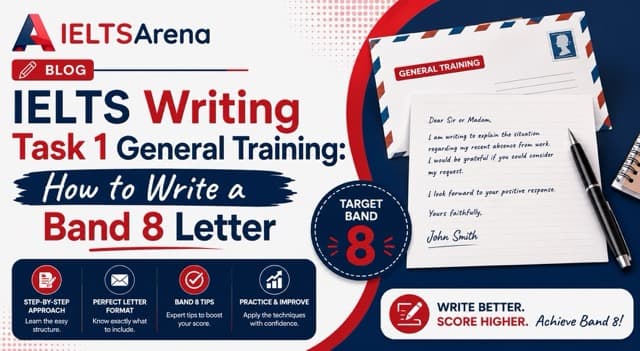
Most candidates sitting IELTS General Training underestimate Writing Task 1. It looks simple: write a letter, 150 words, 20 minutes. But the examiner is assessing four separate criteria with equal weight, and a letter written without understanding those criteria rarely scores above Band 6.
The letter you write in IELTS writing task 1 general is not the same as the email you write to a colleague or a friend. It follows a specific structure, uses a specific register, and makes specific communicative moves that trained examiners identify and score within seconds of reading the opening line.
Getting IELTS writing task 1 general right is not about writing more words. It is about writing the right things, in the right register, to the right person.
What IELTS Writing Task 1 General Training Actually Tests
In IELTS General Training Writing Task 1, you are given a situation and asked to write a letter of at least 150 words in approximately 20 minutes. The letter is addressed to a specific person or organisation, and you are given three bullet points that your letter must cover.
Every bullet point carries weight. Examiners check whether all three are addressed fully. Missing one bullet point, or covering it only partially, immediately drops your Task Achievement score, which accounts for 25% of your Task 1 mark.
The four criteria examiners use are Task Achievement, Coherence and Cohesion, Lexical Resource, and Grammatical Range and Accuracy. Each carries equal weight. You cannot compensate for a low score on one by excelling at another.
The three letter types in IELTS writing task 1 general training are:
Formal letters, written to someone you do not know or to an organisation, such as a company, employer, council, or hotel. These use "Dear Sir or Madam" and close with "Yours faithfully."
Semi-formal letters, written to someone in a position you know slightly, such as your landlord, your doctor, or a manager at work. These use "Dear Mr/Ms [surname]" and close with "Yours sincerely."
Informal letters, written to a friend or family member. These use the person's first name ("Dear James") and close with "Best wishes" or "Kind regards."
Choosing the wrong register, even slightly, costs marks on Lexical Resource and Task Achievement.
Advertisement
Why Candidates Score Below Band 7 on General Task 1
The most common reason for a low score is register confusion. Candidates write informal language in a formal letter, or stiff over-formal language in an informal one.
An example of register confusion in a formal complaint letter: "I am writing to tell you about a problem that has been really annoying me." This reads too informally for a formal context. A Band 7 version: "I am writing to bring a matter to your attention that requires urgent resolution."
The difference is not dramatic. But it is enough to hold a candidate below Band 7 consistently.
The second issue is bullet point failure. Candidates address only two of the three bullet points, usually because they run out of time or misread the task. Each bullet point is a separate communicative purpose. All three must be covered. Without exception.
The third issue is poor structure. Many candidates write in a single block of text with no paragraph logic. For IELTS writing task 1 general, the structure should be: an opening paragraph stating the reason for writing, one or two body paragraphs covering all three bullet points, and a closing paragraph that states what you want the recipient to do. This structure directly boosts your Coherence and Cohesion score.
The fourth issue is length. Some candidates write exactly 150 words, which technically meets the minimum but leaves no room to develop ideas with the depth examiners expect to see at Band 7+.
A Candidate Who Got This Wrong, Then Right
James, from Nigeria, was preparing for IELTS General Training to apply for skilled migration to Australia in 2025. He needed Band 7.0 overall, with no component below Band 6.5.
His first practice attempts placed Writing Task 1 at Band 5.5. The feedback from his tutor was consistent: register confusion and incomplete bullet point coverage.
"I kept writing the letter the way I write emails at work," James said. "I did not realise that even slight informal phrasing in a formal letter would cost marks."
James began practising formal, semi-formal, and informal letters separately on IELTSArena. The platform's AI Writing feedback identified his register errors instantly, flagging phrases too casual for a formal context and suggesting the appropriate alternatives. His expert tutor on IELTSArena then provided detailed, band-focused correction, showing exactly which phrases to replace and why each change mattered for the marking criteria.
Within four weeks, his IELTS writing task 1 general band score moved from 5.5 to 7.0. He sat his exam in February 2026 and achieved the scores his application required.
What the Data Shows About Task 1 Performance
IELTS data consistently shows that Writing is the section where candidates improve least between first and second attempts when they prepare without targeted feedback.
This is because writing errors are invisible to the person making them. A candidate who writes "I am very upset about this situation" in a formal complaint letter genuinely believes they are being appropriately direct. Without a trained examiner or structured feedback identifying the register mismatch, they repeat the same error across every practice attempt.
According to IDP IELTS data, the global mean Writing band score sits at approximately 5.9, lower than both Listening and Reading averages. IELTS General Training Writing Task 1 is one of the areas where this average is held down.
Candidates who receive structured feedback, from a human tutor or an AI feedback system trained on IELTS marking criteria, improve their Task 1 scores roughly twice as fast as those who self-study using sample answers alone. Comparing your letter to a Band 9 sample without understanding why it is rated Band 9 produces slow improvement. Getting line-by-line feedback on your own letter produces fast improvement.
How to Write a Band 7 to Band 8 General Task 1 Letter
Follow this approach for every IELTS writing task 1 general attempt.
Step 1: Read the task and identify the recipient, situation, and register before writing anything. Before you write the first word, know: who is this letter addressed to, and what is your relationship to them? This single step determines the entire tone of your letter.
Step 2: Choose the correct register and maintain it throughout. For a formal IELTS letter: "Dear Sir or Madam" and "Yours faithfully." Never mix formal and informal phrases within the same letter. Even one informal phrase in a formal letter reduces your Lexical Resource score. A Band 8 candidate writes with complete register consistency from the first word to the last.
For a semi-formal letter: "Dear Mr/Ms [name]" and "Yours sincerely." Use "I would appreciate" rather than "I really want," and "I am writing to inform you" rather than "Just wanted to let you know."
For an informal letter: "Dear [first name]" and "Best wishes." Use contractions and a conversational tone. "I'm writing to tell you" is better than "I am writing to inform you" in an informal letter, where overly formal phrasing sounds unnatural.
Step 3: Write a clear opening paragraph that states the purpose immediately. Formal: "I am writing to formally complain about the condition of my rented accommodation" or "I am writing to request information regarding your refund policy." Informal: "I thought I would write to tell you about something exciting that happened recently."
Examiners read the opening paragraph and immediately form an assessment of your Task Achievement and register. A clear, purposeful opening sets the tone for the whole letter.
Step 4: Cover all three bullet points in the body of the letter. Do not write a separate paragraph for each bullet if two of them connect naturally. The goal is to cover each bullet point fully, with specific detail. Vague references, such as "I was unhappy with the service" when the bullet says to explain what went wrong, do not earn full Task Achievement marks.
Step 5: Close with a specific outcome or request. Formal: "I look forward to receiving your response and trust that this matter will be resolved promptly. I am happy to be contacted at the above address." Informal: "Let me know what you think! Looking forward to hearing from you soon."
Step 6: Count your words. Write 170 to 200 words for Task 1. 150 words is the minimum. Below that, you lose Task Achievement marks. Over 220 words means you spent time on Task 1 that Task 2 needed. Task 2 carries double the marks. Practise writing to 170 to 200 words under 20 minutes consistently before your exam.
How IELTSArena Supports IELTS Writing Task 1 General
IELTSArena's AI Writing feedback is built around the four IELTS Writing assessment criteria: Task Achievement, Coherence and Cohesion, Lexical Resource, and Grammatical Range and Accuracy.
When you submit a IELTS writing task 1 general letter on IELTSArena, the AI identifies:
- Whether all three bullet points are covered
- Whether the register is consistent and appropriate throughout
- Specific word choices and phrases that fall below band expectations
- Grammar patterns limiting your score
You see a criterion-by-criterion score, not just an overall number.
IELTSArena also connects you to expert tutors who provide hand-corrected, band-focused feedback. A human tutor trained in IELTS marking can identify the specific register issue holding you at Band 6.5 and show you exactly what the Band 7.5 version of the same sentence looks like. This human review layer is what separates IELTSArena from AI-only scoring platforms.
More than 10,000 students have used IELTSArena to prepare for both IELTS Academic and General Training exams. The platform supports General Training candidates with dedicated Task 1 letter prompts across all three letter types, scored against IELTS marking criteria.
IELTSArena also replicates the real IELTS CBT interface, so candidates practise on the same screen layout and input format they will encounter on exam day. This removes one more source of unfamiliarity.
You can start practising IELTS writing task 1 general completely free, with no credit card required.
The difference between Band 6.5 and Band 7.5 in General Task 1 is almost always register. One sentence out of place holds an entire letter below its potential.
Practice your IELTS General Task 1 letters now.
Diagnose Your Task 1 Readiness
Answer these five questions before your exam:
- Can you identify, within 30 seconds of reading a task prompt, whether the required register is formal, semi-formal, or informal, and state the correct opening and closing phrases without hesitation?
- Have you written at least five complete 150+ word letters under timed 20-minute conditions, covering all three bullet points in each?
- Have you received feedback on your letters that assesses Task Achievement, Coherence and Cohesion, Lexical Resource, and Grammar separately?
- Do you know the correct formal, semi-formal, and informal opening and closing phrases without having to think about them?
- Can you consistently write 170 words in 20 minutes while maintaining correct structure?
If you answered no to any of these, your Task 1 preparation has a gap. The good news: IELTS writing task 1 general is the most learnable component of IELTS Writing. With structured practice and targeted feedback, improvement from Band 6.0 to Band 7.5 is achievable within four to six weeks.
Start Free on IELTSArena Today
One submitted practice letter on IELTSArena gives you instant AI band scoring, criterion-by-criterion feedback, and a clear picture of your current Task 1 level.
That is more useful than comparing your work to a sample answer without knowing why the sample scored what it did.
Start Your Free Task 1 Practice on IELTSArena →
Frequently Asked Questions
What are the three types of letters in IELTS General Training Writing Task 1?
The three letter types are formal, semi-formal, and informal. Formal letters go to organisations or people you do not know, such as a company, an employer, or a council. They open with "Dear Sir or Madam" and close with "Yours faithfully." Semi-formal letters go to someone you know in a professional context, such as a landlord, a doctor, or a manager. They open with "Dear Mr/Ms [surname]" and close with "Yours sincerely." Informal letters go to friends or family members. They open with the first name and close with "Best wishes" or "Kind regards." Selecting the wrong type, or mixing the registers, directly reduces your Task Achievement and Lexical Resource scores. The task prompt will always make clear which type is required.
How do I know if my IELTS Task 1 letter should be formal or informal?
The task prompt tells you. The key information is: who is the recipient, and what is your relationship to them? If the recipient is an organisation, a company, an employer, or someone you have not met, write formally. If the recipient is someone you know in a professional but not personal capacity, such as your landlord or a work colleague, write semi-formally. If the recipient is a friend, a family member, or someone close to you, write informally. Never use informal language in a formal letter or stiff formal phrasing in an informal one. Both errors directly reduce your Lexical Resource and Task Achievement scores, which together account for 50% of your Task 1 mark.
How many words should I write for IELTS General Training Writing Task 1?
The minimum is 150 words. Writing fewer than 150 words results in a penalty to your Task Achievement score. Most experienced tutors recommend 170 to 200 words. This is sufficient to cover all three bullet points with appropriate detail, without using time needed for Task 2, which carries double the marks of Task 1. Writing over 220 words for Task 1 is generally not beneficial. The extra length does not improve your score, and every minute spent over the 20-minute target for Task 1 is a minute taken from the 40-minute Task 2. Practise writing to 170 to 200 words consistently under a 20-minute limit.
What is the opening sentence for an IELTS formal letter in Task 1?
The most reliable formal opening is: "I am writing to [state your purpose clearly]." Examples include: "I am writing to formally complain about a product I purchased from your company" or "I am writing to request information regarding the position advertised on your website." The first sentence must state the reason for the letter. Do not begin with pleasantries, background information, or context before stating the purpose. Examiners look for the communicative purpose immediately, and a clear, direct opening sentence demonstrates Task Achievement from the very first line, which sets a positive impression for the remainder of the letter.
How do I get Band 7 or higher in IELTS Writing Task 1 General Training?
Band 7+ requires full coverage of all three bullet points, consistent register throughout the letter, a range of vocabulary used accurately, and a variety of grammatical structures without frequent errors. The most common reason candidates stay at Band 6 is register inconsistency, specifically mixing formal and informal language in the same letter, or using over-formal language in an informal one. Incomplete bullet point coverage is the second most common reason. Getting from Band 6 to Band 7 requires targeted feedback, not just reading sample letters. When you submit practice letters on IELTSArena, the AI Writing feedback and expert tutor review identify the specific errors holding you below your target band, making improvement faster and more precise than self-study alone.