
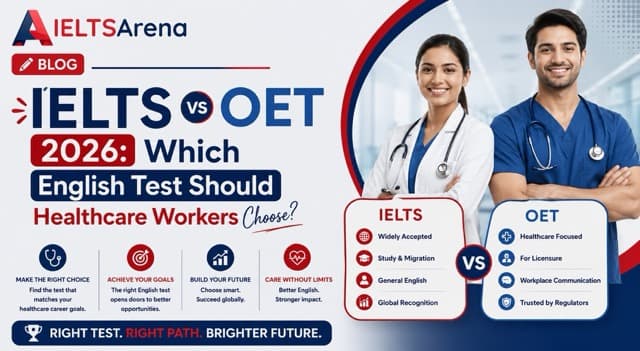
You are a nurse or a doctor planning to register abroad, and you have hit a fork that every healthcare applicant reaches in 2026: IELTS vs OET. Both are accepted by the major regulators. Both can unlock the same job. Yet picking wrong can cost you months of resits, because the test that suits one applicant is the worst choice for another.
The pressure is real this year. Healthcare migration to the UK, Australia, Ireland, and the Gulf is at record levels, regulators have held firm on their English thresholds, and this decision is now the first thing blocking thousands of qualified clinicians from booking their move.
IELTS vs OET: What Is the Real Difference in 2026?
The core difference in the IELTS vs OET choice is content. IELTS Academic tests general English across academic topics, while OET tests English using healthcare scenarios drawn from real clinical practice (EEC, "OET vs IELTS Healthcare 2026").
In OET, you read case notes, listen to patient consultations, and write a referral letter about a patient. In IELTS, you describe a graph, listen to a campus conversation, and write an essay on a general topic. Both assess the same four skills of Listening, Reading, Writing, and Speaking, but OET wraps them in the language clinicians already use every day.
That single difference drives most of the decision. If your English is strong but general topics drain your focus, OET can feel more natural. If you are a confident all-round test-taker, IELTS is cheaper and available in more places.
Advertisement
What the Regulators Actually Require
Before comparing difficulty, anchor your choice to the exact requirement of your regulator, because that is non-negotiable.
For UK nurses, the NMC requires IELTS Academic 7.0 overall with 7.0 in each section in a single sitting, or OET Grade B in each sub-test. The NMC uniquely accepts a Writing Grade C+ (300) if the other three skills are Grade B (350+), the only UK regulator that allows this concession (Dynamic Health Staff, "Minimum IELTS Score for UK Nurses in 2026").
For UK doctors, the GMC requires IELTS 7.5 overall with a minimum of 7.0 in each section, or OET Grade B (EEC, 2026). Both tests are accepted, so the GMC does not force the choice for you.
OET is recognised in roughly 20 countries and accepted by the NMC, GMC, AHPRA in Australia, the NMBI in Ireland, the Medical Council of New Zealand, the GPhC for pharmacists, and the DHA in Dubai (OET test statistics, 2026; Writing Correction Service, "IELTS vs OET," 2026). IELTS is accepted even more widely, which matters if your destination is undecided.
Why Common Approaches Fail
Healthcare candidates usually get this decision wrong for three reasons.
First, they choose by reputation, not by their own weak section. They hear "OET is for medical people" and switch, even though their real problem is grammar, which both tests assess the same way.
Second, they underestimate Writing. In both exams, healthcare candidates most often fall short in Writing, and switching tests does not fix a writing weakness that follows you across both.
Third, they ignore cost and availability. OET typically costs more than IELTS and runs at fewer test centres, so a candidate on a deadline can lose weeks waiting for an OET slot when an IELTS date was open (collected fee and centre data, 2026).
A Realistic Student Story
Chiamaka, a registered nurse from Nigeria, needed NMC registration in the UK in early 2026. She sat IELTS Academic twice and scored 7.5 in Listening, 7.5 in Reading, 7.0 in Speaking, and 6.5 in Writing both times. The 6.5 in Writing kept her below the 7.0 the NMC demands in every section.
A colleague told her to switch tests, so she weighed the two exams carefully. She realised her weakness was clinical writing structure, not general English, and OET's referral-letter task matched the writing she did every shift.
I was not failing English. I was failing the essay format. Once I wrote about a patient instead of a chart, my writing finally scored where it needed to.
Chiamaka sat OET, scored Grade B across all four sub-tests, and cleared the NMC requirement on her first OET attempt. For her the switch was right, but only because she diagnosed why she was losing marks first. A candidate weak in grammar would have carried that gap into OET unchanged.
Data and Insight Layer
The data explains why this choice is so personal.
In both exams, Writing is the section where healthcare candidates most often fall short, mirroring the global pattern in which Writing sits roughly half a band below Listening and Reading for IELTS test-takers (British Council and IDP band data, 2026). A study published on the NCBI PubMed Central archive found that nurses who trained for and sat OET were more successful at meeting NMC proficiency requirements than those using general English provision, with over half of OET candidates passing at the required level (NCBI PMC, "Levelling the playing field for the international migration of nurses," 2023).
That does not make OET universally easier. It means OET rewards candidates whose English is strong but who think in clinical language, while IELTS rewards confident general test-takers who want lower cost and wider availability. With OET recognised in around 20 countries and IELTS accepted even more broadly, your destination flexibility also weighs into the decision.
The honest conclusion is that neither test is easier in the abstract. The right test is the one that matches where you keep losing marks.
The Right Approach: A Simple Rule for Choosing
Use this decision sequence to settle the question for your own case.
- Confirm your regulator's exact requirement first. NMC wants 7.0 in every section or OET Grade B. GMC wants IELTS 7.5 or OET Grade B. Your regulator sets the floor.
- Take one timed IELTS mock test and find your weakest section. This is the most important step, because it reveals the real problem.
- If your weakness is general vocabulary or essay topics, and your clinical English is strong, lean towards OET.
- If your weakness is grammar, pronunciation, or general fluency, the test format will not save you, so choose IELTS for its lower cost and wider availability and fix the underlying skill.
- Factor in cost, test-centre access, and how many countries you might apply to. If your destination is undecided, IELTS gives broader acceptance.
How IELTSArena Helps You Decide and Prepare
The IELTS vs OET decision turns on one thing: knowing exactly where you lose marks. That is where IELTSArena gives you an honest answer before you spend money on either test.
A single full-length mock on IELTSArena shows your band in all four sections, so you can see whether your gap is general English, which favours a rethink, or a specific skill like grammar that follows you into any test. IELTSArena's AI Writing feedback breaks down your Task Achievement, Coherence and Cohesion, Lexical Resource, and Grammatical Range and Accuracy, the exact criteria where most healthcare candidates lose their seventh band.
If you decide IELTS is your route, because it is cheaper, more widely available, and accepted in more countries, IELTSArena gives you the real computer-based interface, AI feedback, and expert tutor corrections to reach 7.0 in every section. You can set your target with the free IELTS band calculator and track every mock in one dashboard. Start free on IELTSArena.
Self-Diagnosis: IELTS or OET for You?
Answer these five questions before you book either test.
- Do you know the exact score your regulator requires, in every section, for IELTS and for OET?
- When you lose marks, is it on general topics and vocabulary, or on grammar and pronunciation that no format will hide?
- Is your clinical writing, such as referral letters, stronger than your general essay writing?
- Does your timeline allow for the longer waits and higher cost that OET can involve in some regions?
- Might you apply to more than one country, where IELTS gives broader acceptance?
Your answers point clearly to one test, not the other.
See Which Test Fits You
You should not pick between IELTS vs OET by guesswork or by what a colleague chose. Take one free, full-length IELTS mock test on IELTSArena and you will see your band in every section within minutes, which tells you whether your gap is general English or a skill that follows you into any exam.
Take a Free IELTS Mock on IELTSArena →
Frequently Asked Questions
Is OET easier than IELTS for nurses?
OET is not automatically easier than IELTS, but it can feel easier for nurses whose English is strong and who think in clinical language. OET uses healthcare scenarios, so you write a referral letter about a patient instead of a general essay, which many nurses find more natural. However, if your weakness is grammar, pronunciation, or general fluency, OET will not fix it, because both tests assess those skills the same way. A study on the NCBI archive found OET-trained nurses met NMC requirements more often than those using general English provision. The right test depends on where you lose marks, not on reputation alone.
Should I take IELTS or OET for the NMC?
The NMC accepts both, so the IELTS vs OET choice for nursing should be based on your own weak section. The NMC requires IELTS Academic 7.0 overall with 7.0 in each section in a single sitting, or OET Grade B in each sub-test, with a Writing Grade C+ accepted if your other three skills are Grade B. If you lose marks mainly on general essay topics while your clinical writing is strong, OET often suits you better. If your gap is grammar or fluency, choose IELTS, which is cheaper and more widely available, and fix the underlying skill. Diagnose with one mock test before deciding.
What is the difference between IELTS and OET?
The main difference is content and audience. IELTS Academic tests general English across academic topics for students and professionals, while OET tests English through healthcare scenarios for clinicians. In OET you read case notes, listen to patient consultations, and write a referral letter, whereas in IELTS you describe a graph, listen to campus conversations, and write a general essay. Both assess Listening, Reading, Writing, and Speaking. OET is recognised in roughly 20 countries, while IELTS is accepted even more widely. OET usually costs more and runs at fewer centres. The exams test the same skills, but OET frames them in clinical language.
Does the GMC accept OET instead of IELTS?
Yes. The GMC accepts OET as an alternative to IELTS for UK doctor registration. The IELTS requirement is 7.5 overall with a minimum of 7.0 in each section, and the OET requirement is Grade B in each sub-test. Because both are accepted, the choice comes down to which format suits you. Doctors who are comfortable writing about patients and clinical cases often prefer OET, while strong all-round test-takers may choose IELTS for its lower cost and wider availability. Confirm the current requirement on the GMC website before booking, and diagnose your weakest section first so you do not carry the same gap into either test.
Which is cheaper, IELTS or OET?
IELTS is usually cheaper than OET in most regions, and it also runs at more test centres, which means shorter waits for a slot. OET typically costs more because it is a specialist healthcare exam delivered at fewer locations. For a candidate on a tight timeline or budget, that difference can matter as much as the test content. If cost and availability are your priority and your general English is solid, IELTS is often the practical choice, and you can prepare on a real computer-based interface at ieltsarena.com. If you would rather write about patients than general topics and the higher cost is acceptable, OET may justify the extra outlay.