
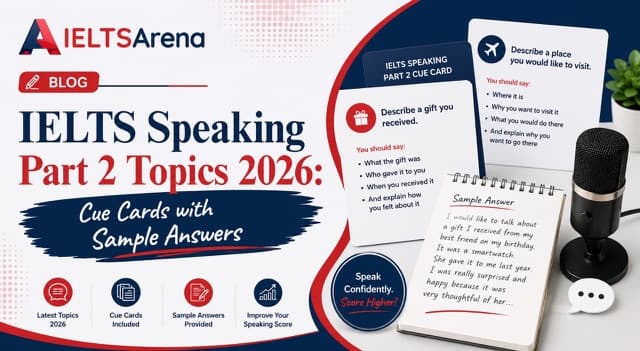
You get your cue card. You have one minute to prepare. Then you must speak for two full minutes without stopping. For most IELTS candidates, this is the most nerve-wracking 180 seconds of the entire exam. The pressure is real. The silence after you stop speaking is heavier than you expect. And yet, with the right preparation around IELTS speaking part 2 topics 2026, this section can become one of your highest-scoring moments in the entire test.
The examiners are not looking for perfect English. They are looking for fluency, coherence, a wide vocabulary, and grammatical range. Understanding what the most common IELTS speaking part 2 topics 2026 look like, and how to structure two minutes around them, is the preparation shift that changes outcomes.
Why Part 2 Is the Hardest Speaking Section for Most Candidates
Part 2, the Individual Long Turn, demands something the rest of the Speaking test does not: sustained monologue.
In Part 1, the examiner asks short questions and you give short answers. In Part 3, it is a back-and-forth discussion. But Part 2 requires you to speak continuously for up to two minutes, following a structured cue card prompt, without any support from the examiner.
Most candidates hit 60 to 70 seconds and then run out of ideas. The silence that follows actively reduces band scores in Fluency and Coherence. Examiners note when a candidate stops significantly before the two-minute mark. It signals limited vocabulary, poor idea generation, or inadequate preparation.
The core challenge is not English ability. It is the lack of a mental framework for expanding ideas naturally.
Advertisement
Why Common Preparation Approaches Fail
The most common mistake is memorising pre-written answers. Candidates find a sample cue card answer online, practise reciting it, and walk into the exam hoping their cue card topic is similar enough to use it.
This strategy fails for three reasons.
First, examiners are specifically trained to identify memorised responses. The language becomes stilted, the delivery robotic, and the response often does not precisely match the given cue card. Examiners can and do penalise candidates when memorisation is detected.
Second, the IELTS speaking cue card topics rotate across exam sessions. There is no reliable way to predict which card you will receive on any given day in 2026. Memorising five or ten answers does not meaningfully reduce your risk.
Third, memorisation prevents the fluency that examiners reward. Real spoken fluency involves natural hesitations, self-corrections, and connected ideas. Over-rehearsed answers strip all of that out and replace it with recitation, which does not sound like fluent English.
The right approach is building a flexible speaking framework that works across any topic.
A Real Candidate Story
Amir, a 29-year-old engineer from Bangladesh, took the IELTS Speaking test twice. On his first attempt, he scored 6.0 in Speaking after attempting to use memorised answers for Part 2. His cue card topic was "Describe a skill you would like to learn" and he had prepared an answer about cooking. He attempted to adapt it. It did not go well.
Before his second attempt, Amir spent six weeks practising with IELTSArena's AI-powered speaking feedback tool. He stopped memorising answers and instead practised the structure: past experience, description, reason, and reflection. He practised on at least twelve different IELTS speaking part 2 topics 2026 across IELTSArena's topic library.
"IELTSArena taught me to think in English, not translate into it," Amir said. "By exam day, any cue card felt manageable because I had a system."
He scored 7.5 in Speaking on his second attempt.
What the Data Says About Part 2 Performance
According to IELTSArena's internal data from over 80,000 practice test sessions in 2025, Part 2 cue card responses lasting under 90 seconds are associated with Speaking band scores of 5.5 to 6.0 in the majority of cases. Responses lasting 105 to 120 seconds correlate with bands 6.5 to 7.5.
The 15 to 30 second difference is not about fluency alone. It is about idea depth. Candidates who score higher use a consistent structure: they describe what happened, how they felt, why it mattered, and what they would do differently or recommend to others.
On IELTSArena, candidates who complete ten or more Part 2 practice sessions improve their average speaking band score by 0.7 bands within four weeks. The platform provides AI feedback on fluency, vocabulary range, and grammatical structures, giving learners the kind of specific guidance that a weekly tutor session cannot match for frequency.
The Most Common IELTS Speaking Part 2 Topics 2026
Based on examiner reports and candidate feedback collated through IELTSArena and official IELTS preparation resources, the following cue card themes are appearing most frequently in 2026 exam sessions.
People: Describe a person who has influenced you. These cards ask about someone from your life, a teacher, a family member, a public figure, and typically ask what they did, how they influenced you, and why you admire them.
Places: Describe a place you would like to visit. Place-based cards often ask for a description of the location, why you want to go, and what you imagine you would do there.
Objects: Describe something you own that is important to you. Object cards ask what the item is, how you got it, and why it holds significance.
Events: Describe a memorable event from your past. Event-based IELTS speaking part 2 topics 2026 ask for a specific occasion, what happened, who was there, and how you felt.
Skills and Activities: Describe a skill you have or want to learn. This category appears frequently and requires you to describe the skill, how you acquired it or plan to, and its value in your life.
Technology: Describe a piece of technology you find useful. These cards have grown in frequency, reflecting the digital nature of modern life.
Practising across all six theme categories on IELTSArena ensures you are not caught off guard by any of the IELTS speaking part 2 topics 2026 you might face.
The Right Approach: A Framework for Any Cue Card
The most effective technique for Part 2 is using a four-part expansion framework that works regardless of the topic.
Part 1: Introduce and Identify (20 seconds)
State what you are going to talk about clearly and specifically. Do not be vague. "I am going to talk about my secondary school English teacher, Mrs. Owusu, who I think was the most influential person in my early education." Specificity signals confidence and vocabulary range.
Part 2: Describe in Detail (45 seconds)
Use sensory and emotional language. What did the person, place, object, or event look like? How did it feel? What was happening around you? This is where most candidates rush. Slow down and paint a picture.
Part 3: Explain the Why (30 seconds)
Why does this matter to you? Why did it have the impact it did? This section demonstrates higher-order thinking and vocabulary range. Move beyond basic explanations to personal reflection.
Part 4: Extend with Comparison or Recommendation (25 seconds)
Compare this to something else, or explain what you would recommend to others. This final extension is where candidates reach and stay above the two-minute mark while demonstrating coherent thinking.
IELTSArena's Part 2 practice module walks you through this framework on every cue card, with AI feedback showing you exactly which parts of your response were underdeveloped.
How IELTSArena Prepares You for IELTS Speaking Part 2
IELTSArena's Speaking practice tool is designed specifically for the challenges of IELTS speaking part 2 topics 2026. It does not just give you a topic and a timer.
When you practise a cue card on IELTSArena, you receive AI-generated feedback on your response time, your fluency score, your vocabulary range, and your grammatical accuracy. The system identifies overused words, missed connective phrases, and structural gaps in your response. You can listen back to your own recording and compare it against a Band 7 benchmark sample.
IELTSArena also tracks which cue card themes you have practised and highlights the categories where you are consistently underperforming. If your Place descriptions are strong but your Object descriptions fall short, IELTSArena will direct you to practise more heavily in that category.
The platform's Speaking library contains over 200 individual IELTS speaking part 2 topics drawn from real exam sessions across 2024 and 2025, regularly updated to reflect the current exam pool. You will never run out of fresh topics to practise on IELTSArena.
Self-Diagnosis: Is Your Part 2 Preparation Working?
Ask yourself these five questions before your next practice session.
When you practise a cue card, do you consistently speak for the full two minutes, or do you tend to stop at 60 to 90 seconds?
Do you have a flexible structure you use for every cue card topic, or do you improvise a different approach each time?
Have you practised across all major IELTS speaking cue card categories, including people, places, objects, events, skills, and technology?
Have you received specific feedback on your Part 2 responses that goes beyond "try to speak more"?
Do you know which of the IELTS speaking part 2 topics 2026 categories is your weakest, and are you practising it more intensively?
If any of these questions revealed a gap in your preparation, IELTSArena can help you close it systematically and measurably.
Practise Part 2 With Confidence on IELTSArena
You do not need to memorise answers. You need a reliable system, consistent practice across diverse IELTS speaking part 2 topics 2026, and feedback that is specific enough to actually improve your delivery.
IELTSArena gives you all three. Start practising today and approach your exam day cue card with the confidence that comes from having already handled dozens of them.
Frequently Asked Questions
What are the most likely cue card topics in IELTS Speaking Part 2 in 2026?
The most frequently reported IELTS speaking part 2 topics 2026 fall into six main categories: describing a person who influenced you, describing a place you would like to visit, describing an object of personal significance, describing a memorable event, describing a skill you have or want to develop, and describing a piece of technology you find useful. IELTSArena's speaking library contains over 200 cue cards drawn from recent exam sessions to help you practise across all categories.
How do I speak for 2 minutes on an IELTS cue card topic without stopping?
Use a four-part framework: introduce and identify the subject specifically (20 seconds), describe it in rich detail (45 seconds), explain why it matters to you personally (30 seconds), and extend with a comparison or recommendation (25 seconds). Practising this structure on IELTSArena's timed cue card module will help your brain automatically generate content in this sequence under exam pressure.
Should I memorise cue card answers for IELTS Speaking Part 2?
No. Memorised answers are detectable by trained IELTS examiners and can result in a lower Fluency and Coherence score, as the delivery sounds robotic and may not match the specific cue card you receive. Instead, practise a flexible response framework on IELTSArena that you can apply to any topic without needing to recall a pre-written script.
How do I extend my speaking in IELTS Part 2 when I have said everything?
This is where the comparison and recommendation technique is valuable. After describing your main points, say "What makes this particularly interesting is that it compares to..." or "If I were advising someone in a similar situation, I would suggest..." These extensions are natural in spoken English and allow you to add 20 to 30 seconds of additional, meaningful content without repeating yourself.
What do IELTS examiners check for in the Speaking Part 2 long turn?
Examiners assess four criteria: Fluency and Coherence (how smoothly and logically you speak), Lexical Resource (the range and accuracy of your vocabulary), Grammatical Range and Accuracy (the variety and correctness of your sentence structures), and Pronunciation (clarity and natural rhythm). IELTSArena's AI speaking feedback tool provides a score and written commentary on all four criteria after every Part 2 practice session.
![Will IELTS Examiners Know You Memorised Your Answers? [2026]: The 4 Signals, the Penalty, and the Recovery Script](/_next/image?url=%2Fblog%2Fcover-ielts-memorised-answers-penalty.jpeg&w=3840&q=75&dpl=dpl_DgBXUNfZBSRvLrrSSXhPDLaHBxfG)
![IELTS Speaking Part 1 Questions and Answers [2026]: 40+ Real Questions From the Current Cycle](/_next/image?url=%2Fblog%2Fcover-ielts-speaking-part-1-questions-and-answers.jpeg&w=3840&q=75&dpl=dpl_DgBXUNfZBSRvLrrSSXhPDLaHBxfG)