
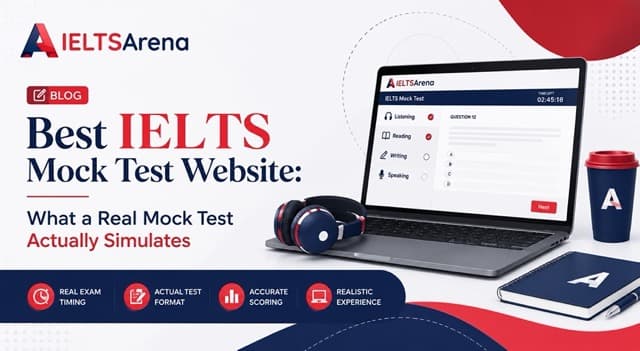
The best IELTS mock test website simulates the entire exam under real conditions: CBT-native interface with the highlighter, notepad, navigation panel, and live word counter; full 165-minute timing without pauses; and a criterion-level band report you can actually use to plan the next two weeks of preparation. Everything else, timed quizzes, section-by-section drills, video mocks you watch, is question practice. Useful, but not a mock test.
This distinction matters because a real mock test is the single most useful diagnostic tool in your IELTS preparation, and using something weaker under the same label wastes the diagnostic value.
Why the "Mock Test" Label Is Being Overused
A quick scan of the top-ranked results for the best IELTS mock test website reveals the label being stretched significantly. One site's "FREE Full Mock Test" turns out to be a 5-hour video you watch alongside a downloadable booklet, with email capture. Another offers a "diagnostic test" claiming 97% accurate band predictions, which is a specific claim no AI or human tool can currently support with published research. A third recycles the same question bank as its regular practice tests but calls the timed version a "simulation."
None of these are wrong to exist. They are just not mock tests in the sense that matters. A real mock test replicates the exam experience so completely that your performance on it is genuinely predictive of your performance on test day. That predictive value is what makes a mock test worth 165 minutes of your preparation time. Weaker versions are worth much less.
Advertisement
What a Real Mock Test Actually Simulates
Test any IELTS mock test website on these five specific dimensions. The dimensions matter because each maps to something that changes your actual exam-day performance.
CBT interface fidelity. Paper-based IELTS ended globally on 27 June 2026, confirmed jointly by the British Council, IDP Education, and Cambridge English. Every current candidate sits an exam on a screen using specific interface tools: highlighter for Reading passages, digital notepad for Writing, navigation panel showing answered questions for Listening, and live word counter for both Writing tasks. A mock test without these tools is not simulating the exam. It is simulating something that ended a year ago.
Full 165-minute timing without breaks. The real exam runs Listening (30 minutes), Reading (60 minutes), Writing (60 minutes), and Speaking (11-14 minutes with an examiner) with only the Speaking section held separately. Interruptions or pauses during the Listening-Reading-Writing block reset your stamina baseline. A mock that lets you pause between sections is measuring your best-case performance, not your test-day performance.
Criterion-level scoring on Writing and Speaking. A mock test that gives you one blended Writing band and nothing else cannot tell you which of the four criteria is your bottleneck. Real mock tests provide separate bands for Task Response (or Task Achievement for Task 1), Coherence and Cohesion, Lexical Resource, and Grammatical Range and Accuracy, plus sentence-level feedback quoting your actual text.
Fresh content that has not been in your practice pool. If the "mock test" uses recycled questions from the platform's regular practice bank, your familiarity inflates the score. Real mock tests use content you have not seen. BestMyTest, to its credit, publicly distinguishes between "practice tests" (recycled) and "simulation tests" (fresh) for exactly this reason.
A results report that supports next-step planning. A useful mock test result tells you three things: your current band per section, your criterion breakdown on Writing and Speaking, and specifically what to work on in the two weeks before your next mock. Reports that give you a single overall band with generic advice ("focus on your weak areas") fail this test.
How Often to Take a Full Mock Test
The single most-common mistake with IELTS mock tests is taking them too frequently. A full mock test measures where you are, not where you can get to. Taking one every day converts the mock from a diagnostic tool into a stamina drill.
The right cadence: one full mock at the very start of your preparation to establish your baseline, one every two to three weeks during focused practice to measure progress, and one in the final week before your exam to confirm test-day readiness. Between mocks, do section-specific practice on your weakest area, not more full mocks.
This is why the best IELTS mock test website for you is one that lets you save and compare results across multiple attempts. Without saved results, you cannot see trajectory, and trajectory is the entire point of taking mocks in sequence.
The Widely-Available Mock Test Sites, Honestly
Here is how the widely-mentioned mock test sites in 2026 perform against the five dimensions above.
IELTS Free Tests offers a genuinely free first full mock across all four sections. Auto-scored Listening and Reading, expert-evaluated Writing and Speaking. Credit-based model for additional mocks rather than a subscription. Passes the "genuinely free first mock" test.
IDP India's IELTS mock tests provide 80+ free mock tests in the current 2026 format for both Academic and General Training. Region-focused but accessible. Strong on official-style content.
BestMyTest offers 30 full-length 2 hour 45 minute simulations. Explicitly distinguishes "simulation tests" (fresh questions) from "practice tests" (recycled). Strong on the fresh-content criterion.
AllThingsIELTS provides free full Academic and General Training tests with instant scoring. Good baseline coverage though feedback depth is thinner than dedicated feedback platforms.
Magoosh offers one free practice test to sample the platform, with additional mock tests locked behind the Premium tier. Not a free mock test provider in the ongoing sense.
E2Language's "Free Full Mock Test" is a 5-hour video walkthrough plus downloadable booklet with email capture. This is a study aid, not an interactive mock test. Different category entirely.
IELTSArena offers full CBT mock tests with the highlighter, notepad, navigation panel, and live word counter matching the real exam. Criterion-level scoring on Writing and Speaking with sentence-level feedback. Genuinely free first mock without credit card or signup gate. Optional expert human tutor review as a paid upgrade for Writing and Speaking.
A Realistic Student Story
Chidinma, a Lagos-based accountant preparing for a Canadian permanent residency application, took her first "full mock test" on a platform that turned out to be a 30-minute Reading quiz labelled as a mock. She scored Band 7.5 and felt confident about her test.
Two weeks later she took a full CBT mock on a different platform, one that included the highlighter, notepad, and full 165-minute timing without pauses. Her Reading dropped to Band 6.5 under real timing pressure, and her Writing came in at Band 5.5 because she had never practised Task 1 and Task 2 back-to-back under time. Her actual test result matched the second mock, not the first.
The best IELTS mock test website was not the one that made her feel prepared. It was the one whose result predicted her real test result within 0.5 bands.
If you have been taking "mock tests" that feel too easy or too short, try IELTSArena's free full CBT mock and compare the result to whatever you have been scoring elsewhere.
What to Do With Your Mock Test Result
The mock test result is the diagnostic input, not the outcome. Three things to do with any mock result before scheduling the next one.
Identify your lowest-scoring section. Not your lowest criterion within Writing, your lowest section overall. If Reading is Band 5.5 and Writing is Band 6.5, Reading is where the next two weeks of practice should go, regardless of which section feels harder to you.
Within your lowest section, identify your lowest criterion (for Writing and Speaking) or your lowest question type (for Reading and Listening). Section-level scores tell you which section to work on. Criterion or question-type scores tell you what specifically to practise inside that section.
Set a specific measurable target for your next mock in two to three weeks. "Improve Reading" is not a target. "Move Reading from Band 5.5 to Band 6.0 by focusing on matching-headings questions for 45 minutes daily" is a target. The next mock either confirms the improvement or shows the practice was not working.
Where IELTSArena Fits
IELTSArena's full practice test hub provides CBT-native mock tests with all the on-screen tools the real exam uses, criterion-level AI feedback on Writing and Speaking, and unified progress tracking so you can compare mock results across attempts. The genuinely free first full mock lets you evaluate the platform against the five dimensions above before committing anything.
Optional expert human tutor review is available for Writing and Speaking submissions flagged below your target band, which is particularly useful on your final pre-test mock when accuracy matters most.
A Quick Self-Check on Your Current Mock Tests
Are the mock tests you take CBT-native, or are they PDF-style questions with a timer? Does the mock run 165 minutes without breaks, or does it let you pause between sections? Do you get a separate band for each of the four Writing and Speaking criteria, or one blended number? Are the mock questions fresh, or recycled from the same site's practice pool? Do you have saved results across multiple mocks so you can see trajectory?
If any of these are no, the "mock test" experience you are getting is not diagnostic in the way a real mock test is, and the best IELTS mock test website for your situation is one that fixes those gaps.
Take a Real Full Mock This Week
The most useful thing you can do is take one genuinely realistic mock test and use the criterion breakdown to plan the next two weeks of preparation. Try IELTSArena's free full CBT mock and see the difference between a real mock and a timed quiz.
FAQ
What makes an IELTS mock test website actually useful? Five specific dimensions: CBT-native interface with the exam's on-screen tools, full 165-minute timing without breaks, criterion-level scoring on Writing and Speaking, fresh content not recycled from the platform's practice pool, and a results report that supports next-step planning. Sites missing any of these are offering something weaker than a mock test.
How does a real IELTS mock test differ from a practice test? A practice test drills specific skills or question types, usually in short blocks with immediate feedback. A mock test replicates the entire exam experience, timing, interface, question freshness, so the result is genuinely predictive of your test-day performance. Both are useful. They are just for different purposes.
Which IELTS mock test websites are genuinely free? IELTS Free Tests, IDP India, BestMyTest, AllThingsIELTS, and IELTSArena all offer at least one genuinely free full mock without credit card requirements. Additional mocks on some platforms require payment or credits. Sites like E2Language offer video walkthroughs labelled "mock tests," which are useful study aids but not interactive mock tests.
How often should I take a full IELTS mock test? One at the start of preparation to establish your baseline, one every two to three weeks during focused practice, and one in the final week before your exam. Taking full mocks more frequently converts them from diagnostic tools into stamina drills. Between mocks, do section-specific practice on your weakest area.
What should a mock test result actually tell me? Your current band per section, your criterion breakdown on Writing and Speaking, and specifically what to work on in the two weeks before your next mock. Results that give you one overall band with generic advice ("focus on weak areas") are missing the diagnostic value that makes mock tests worth the time investment.
![Best IELTS Software for Institutes [2026]: The 4-Path Buying Decision Nobody Explains](/_next/image?url=%2Fblog%2Fcover-best-ielts-software-for-institutes.jpeg&w=3840&q=75&dpl=dpl_DXyM63YUHjigMzg2B75HT6s5tc1D)