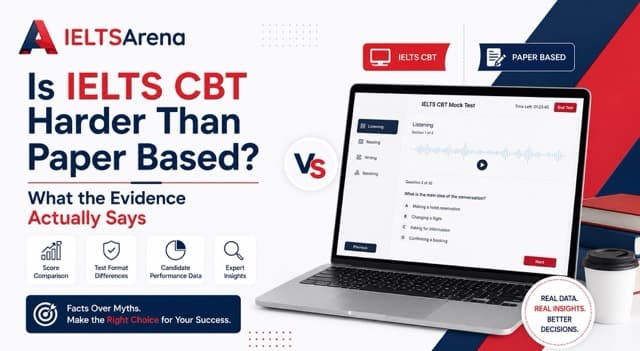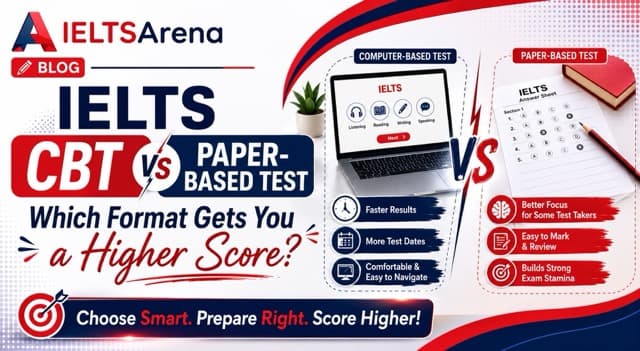
IELTS CBT vs paper based, which is easier, is not actually a fair fight anymore, and not for the reason most comparison articles give. It is not that one format is officially easier than the other. It is that paper-based IELTS ended worldwide on 27 June 2026, confirmed jointly by the British Council, IDP Education and Cambridge English in March 2026, so for the vast majority of candidates today, the comparison is closer to "which one do I already know" than "which one should I pick."
Still, the question matters, because a lot of test-takers who trained for years on paper now need to know exactly what changes, and whether that change works for or against them.
IELTS CBT vs Paper Based, What Actually Stays the Same
The content, difficulty level, and band scale are identical between formats. Reading passages test the same skills. Writing tasks are marked against the same four criteria: Task Achievement or Task Response, Coherence and Cohesion, Lexical Resource, and Grammatical Range and Accuracy. Speaking remains a face-to-face interview with a certified examiner either way.
This is the part most people asking IELTS CBT vs paper based which is easier tend to miss: your English ability does not become stronger or weaker because of which surface you write on. What changes is how efficiently you can express that ability under the format's specific conditions.
Why the Comparison Confuses So Many Students
The confusion comes from treating "easier" as a single property of the exam, when it is really a property of the individual candidate's habits. Someone who types quickly and reads comfortably on screens will likely find CBT more efficient. Someone who has spent years handwriting essays and reading printed material may need real adjustment time before CBT feels comfortable, not because the exam is harder, but because a new skill, screen-based test performance, is being tested alongside English ability for the first time.
Comparison articles that declare one format definitively "easier" are usually writing for one type of candidate and ignoring the other.
A Realistic Student Story
Maria, a nurse in Manila applying for Australian registration, had taken IELTS twice before on paper, scoring Band 6.0 both times. When paper sittings became unavailable in her city, she assumed the computer format would be harder, since she was more comfortable handwriting.
"I was afraid the screen would slow me down in Reading," she said. "What actually happened was that I typed faster than I wrote, so Writing became less stressful, but I did need real practice with the on-screen highlighter before Reading felt normal."
Her third attempt, on computer, produced Band 7.0 overall. Writing improved because typing let her edit more easily under time pressure. Reading took two full practice sessions to reach her previous comfort level, after which it matched her paper-based performance.
The format did not make her better or worse at English. It changed which specific skill needed fresh practice.
If you are unsure whether that same adjustment gap applies to you, take a free CBT mock test on IELTSArena and find out in one sitting rather than guessing on exam day.
What the Data Actually Shows
By 2024, more than 80% of IELTS candidates globally had already chosen the computer-delivered format even while paper remained available as an alternative. That is a strong signal that, on balance, most test-takers found the computer format at least as comfortable as paper, well before it became mandatory.
Computer-delivered results also arrive in 3 to 5 business days, compared to roughly 13 days for the discontinued paper track. This does not affect difficulty, but it does mean a weaker first attempt on computer costs you far less time to recover from than a weak paper attempt once did.
What Genuinely Changes Between the Two Formats
Reading speed on screen. Most people read slightly slower on a screen the first several times, before adjusting. This is a real, measurable effect, not a myth, and it is the single biggest reason some candidates feel CBT is "harder" initially.
Typing versus handwriting in Writing. Confident typists often find CBT Writing faster, since editing, restructuring sentences, and checking word count are easier on screen. Candidates who rarely type long-form text may need dedicated practice here.
Tool familiarity. The on-screen highlighter, digital notepad, and navigation panel do not exist on paper. They are advantages once you know how to use them, and mild obstacles if exam day is the first time you touch them.
Review time in Listening. Paper gave 10 minutes to transfer answers at the end. Computer gives about 2 minutes to check answers already entered directly, which rewards accuracy during the test itself rather than a careful transfer step afterward.
How to Prepare Regardless of Which Feels Harder to You
Type every practice essay rather than handwriting it, even if typing initially feels slower, since that gap closes quickly with repetition. Practice reading on a screen specifically, not just reading in general, to rebuild speed under the exact condition you will face. Use an on-screen highlighter and notepad during practice so they become automatic rather than unfamiliar on test day. Take at least one full mock test under real computer-delivered timing before assuming you know how the format will feel.
Where IELTSArena Fits
IELTSArena's simulation platform includes all of the CBT-specific tools, the on-screen highlighter, notepad, navigation panel and live word counter, so you can practice using them before the real exam rather than encountering them for the first time on test day. Because the format now applies to nearly everyone, this is a IELTS CBT vs paper based question with only one practical answer: prepare for the format you will actually sit.
AI feedback on Writing and Speaking, combined with expert tutor correction, helps identify whether any score gap you notice comes from English ability or from format unfamiliarity, which is a distinction most self-assessment cannot make on its own.
A Few Questions Worth Asking Yourself
If you are still weighing IELTS CBT vs paper based which is easier for your own habits, a few honest questions will tell you more than another comparison article.
- Do you know your reading speed on a screen compared to your reading speed on paper?
- Have you used an on-screen highlighter even once, or are you assuming it will feel intuitive on exam day?
- If your last IELTS attempt was on paper, have you accounted for the adjustment period a new format requires?
IELTS CBT vs Paper Based, Which Is Easier for You Specifically
The only reliable way to know whether CBT feels easier or harder for your specific habits is to sit one under real conditions.
Start a Free Mock Test on IELTSArena →
Frequently Asked Questions
IELTS CBT vs paper based, which is easier?
Neither format is officially easier. Content, difficulty, and the band scale are identical. What differs is which specific skills the format rewards, typing speed and on-screen reading for CBT, handwriting comfort for paper. Most candidates find CBT at least as comfortable once given a short adjustment period, which is one reason over 80% had already chosen it voluntarily by 2024.
What is the real difference between IELTS CBT and paper IELTS?
The core content and scoring criteria are the same. The practical differences are the on-screen highlighter, digital notepad, and navigation panel available only on computer, typing instead of handwriting in Writing, faster results in 3 to 5 days instead of about 13, and a shorter answer-review window at the end of Listening.
Does the computer format actually change IELTS difficulty for most people?
It does not change the underlying difficulty of the questions, but it can change perceived difficulty for candidates unfamiliar with typing long-form answers or reading on a screen under time pressure. This effect fades quickly with targeted practice on a real CBT interface.
Should I choose CBT or paper if I still have a choice?
As of mid-2026, paper-based IELTS is no longer widely available following its global retirement on 27 June 2026, so most candidates will not have a choice to make. Where limited paper sittings remain, choosing CBT is generally advisable given its faster results and the One Skill Retake option, which is exclusive to the computer-delivered format.
Why do some students find CBT harder than paper based at first?
Usually because they have spent years practicing exclusively on paper and have never timed themselves typing an essay or reading on a screen. This is a practice gap, not a difficulty gap, and platforms like IELTSArena that simulate the real CBT interface are built specifically to close it before exam day.