You have one English test to pass and two real options. Pick wrong and you could spend more money, wait longer for results, and study the wrong kind of material for months. In 2026, with AHPRA reshuffling its score tables and the NMC offering a two-test option, the choice between these exams matters more than ever.
The question of OET vs IELTS for nurses is the first big decision in any overseas registration journey. Both are accepted by the major regulators. Both test the same four skills. But they feel completely different in the exam room, and the right choice depends on you, not on which test is "better" in the abstract.
This guide breaks down the two tests across acceptance, exact scores, cost, speed, and difficulty, then gives you a way to find out which one fits before you spend a single fee.
What OET and IELTS Actually Are
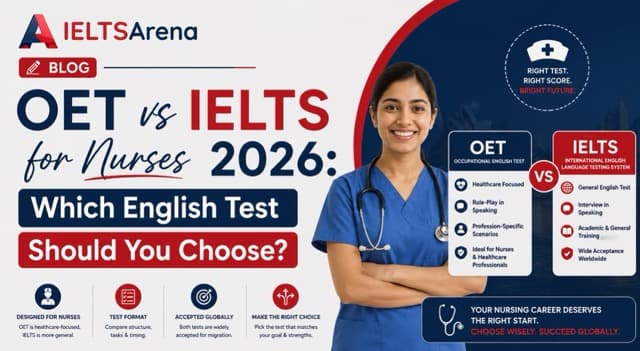
OET, the Occupational English Test, is an English exam built specifically for healthcare professionals. Its reading and listening passages are clinical, and its writing task is a referral or discharge letter rather than an essay. You write about patients, conditions, and treatments you already know.
IELTS Academic is a general academic English test used by students, professionals, and migrants worldwide. Its reading passages come from journals and newspapers, and its Writing Task 2 is an argument essay on a general topic.
Both assess Listening, Reading, Writing, and Speaking. The difference is context. OET dresses the language in scrubs. IELTS keeps it academic and general. That single difference drives almost every other comparison between OET vs IELTS for nurses.
Do NMC and AHPRA Accept Both Tests?
Yes. Both the UK Nursing and Midwifery Council (NMC) and Australia's AHPRA accept OET and IELTS, and neither prefers one over the other. A pass is a pass.
The Occupational English Test was granted equivalency by the UK NMC, the UK GMC, and AHPRA, among others, and today most healthcare regulatory bodies accept both OET and IELTS (Global Nurse Guide, 2026). OET is also recognised by registration boards in New Zealand, Ireland, Singapore, and the UAE, which makes it portable across many destinations.
So acceptance is not the deciding factor. If both tests open the same doors, the real question is which test gets you across the line fastest and cheapest for your situation.
The regulators do not care which test you pass. They care that you pass. So choose the test that gets you registered fastest, not the one with the better reputation.
The Exact Scores Nurses Need in 2026
Here is what each regulator wants, based on current reporting (Global Nurse Guide, 2026; Writing Correction Service, 2026). Always verify the live standard on the regulator's own site before booking.
NMC (United Kingdom): IELTS Academic overall 7.0 with a minimum of 7.0 in each of Reading, Writing, Listening, and Speaking. OET Grade B in all four sub-tests is accepted as equivalent. The NMC now allows a two-test option, where you combine results from two sittings within six months as long as no skill drops below 6.5 and you still reach 7.0 in each skill across the two tests.
AHPRA (Australia): IELTS Academic with Listening 7.0, Reading 7.0, Writing 6.5, and Speaking 7.0, overall 7.0. OET at the new 2026 numerical equivalents of Grade B (around Listening 350, Reading 360, Writing 350, Speaking 360). Remember the AHPRA tables were updated on 23 April 2026.
The pattern is clear. For nurses, the bar is high and it sits at the per-skill level. A strong overall score with one weak component does not pass, on either test.
OET vs IELTS for Nurses: Which Is Easier?
There is no universal answer, and any source that gives you one is guessing. The honest answer is that it depends on your background.
OET is generally easier if you read medical literature regularly and speak English with patients every day. The vocabulary, the scenarios, and the writing task all sit inside your professional world, so the content feels natural (Global Nurse Guide, 2026).
IELTS Academic is often easier if you have not worked much in an English-medium clinical setting, because OET's domain-specific vocabulary and clinical reasoning can be harder than a general essay for someone whose strength is general English rather than medical English.
Neither test is objectively easier. They test the same language skills in different contexts. The "easier" test is simply the one whose context matches your daily life. That is the real lesson here: fit beats reputation.
Cost and Speed: The Practical Tiebreaker
When difficulty is a wash, money and time decide. On both, IELTS Academic tends to win.
IELTS Academic is generally cheaper than OET. Reported figures put IELTS around AUD 395 against OET near AUD 587, which makes OET roughly 49 percent more expensive in that comparison (Writing Correction Service, 2026). For a nurse who may need to resit, that gap compounds quickly.
IELTS is also faster to results. Computer-based IELTS results are typically available in three to five days, while OET results have historically taken around 17 days. When your registration timeline is tight, two weeks can be the difference between making an intake and missing it.
So the practical scorecard reads: OET wins on familiarity of content for clinically active nurses, IELTS wins on cost and turnaround for almost everyone.
Grace's Decision in Lagos
Grace, a nurse from Nigeria with four years of hospital experience, was preparing for NMC registration and could not decide between the two tests. Friends told her OET was "the nursing test" and therefore the obvious pick.
She tried a timed sample of each. The OET letter felt natural, but the clinical listening tripped her up. The IELTS Academic essay felt formal, yet her general English carried her through comfortably, and a mock came back at Listening 8.0, Reading 7.5, Speaking 7.5, and Writing 6.5.
"OET sounded right because I am a nurse," she said. "But IELTS was cheaper, faster, and only my Writing needed work."
Grace chose IELTS Academic, spent six weeks lifting Writing from 6.5 to 7.0, and registered without paying for the more expensive exam. Her decision was not about which test was better. It was about which test fit her, her budget, and her timeline.
How to Choose: A Simple Framework
Use this to settle OET vs IELTS for nurses for your own case.
- Check which tests your specific regulator accepts. If both are accepted, keep going. If only one is, your decision is made.
- Sit one timed sample of each. Notice where you lose marks, not just which felt nicer.
- If clinical English is your strength and budget and speed are not pressing, OET is a strong fit.
- If your general English is solid, or cost and a fast result matter, IELTS Academic usually wins.
- Whichever you pick, build your plan around the weakest skill, because the per-skill 7.0 rule decides registration on both tests.
- Do not commit money until a real mock shows you are within half a band of the target.
How IELTSArena Helps You Decide and Prepare
The smartest move in this decision is to test your real IELTS Academic level before you pay for anything, and that is exactly what IELTSArena lets you do.
IELTSArena gives you a free, full IELTS Academic mock on a real CBT interface, with the on-screen timer, highlighter, and notepad, so you get an honest band score across all four skills in one sitting. That single result tells you whether IELTS is already within reach or whether OET deserves a closer look.
If you choose IELTS, the platform keeps working for you. The AI Writing feedback scores your essays instantly against Task Achievement, Coherence and Cohesion, Lexical Resource, and Grammatical Range and Accuracy, which is where most nurses lose the half band that blocks a 7.0. Expert tutors add band-focused human correction on Writing and Speaking, and the progress dashboard tracks every mock so you can watch your weakest skill climb to target.
Find out where you stand free on IELTSArena before you spend a fee on either exam.
Self-Diagnosis: Which Test Fits You?
Run through these before you book anything.
- Is your daily English more clinical (patient notes, handovers) or more general (reading, conversation, writing)?
- Can you already score 7.0 in each skill on a timed mock, or do you need weeks of focused work?
- Does cost matter enough that a roughly 49 percent price gap would change your choice?
- Is your registration timeline tight enough that a results wait of days versus weeks matters?
- Have you actually tried a sample of each test, or are you choosing on reputation alone?
Your answers point to the test that fits, not the test that sounds right.
Take One Free Mock Before You Decide
You should never pay for an English test on a guess. Take one free IELTS Academic mock on IELTSArena and you will know, in a single sitting, exactly where each of your four skills stands against the 7.0 nursing target.
Start Free on IELTSArena → and make the OET vs IELTS for nurses decision with a real score in hand, not a friend's opinion.
Frequently Asked Questions
Is OET easier than IELTS for nurses in 2026?
It depends on your background, not on the test itself. OET tends to feel easier for nurses who read medical literature and speak English with patients daily, because its content is clinical and its writing task is a referral letter (Global Nurse Guide, 2026). IELTS Academic tends to feel easier for nurses with strong general English who have not worked much in English-medium clinical settings, since OET's medical vocabulary can be demanding. Neither is objectively easier; they test the same skills in different contexts. The best way to know is to sit a timed sample of each and see where you actually lose marks.
Which English test should a nurse take, OET or IELTS?
Take the test that your regulator accepts and that fits your strengths, budget, and timeline. If both OET and IELTS are accepted, weigh three things: content fit, cost, and speed. OET suits clinically active nurses because its content is medical. IELTS Academic suits nurses with solid general English and is usually cheaper and faster to results. For most nurses the deciding factor is not difficulty but cost and turnaround, where IELTS often wins. Try a free IELTS Academic mock first to see whether it is already within reach before paying for either exam.
Do NMC and AHPRA accept both OET and IELTS?
Yes. Both the UK Nursing and Midwifery Council and Australia's AHPRA accept OET and IELTS Academic, and neither prefers one over the other. OET was granted equivalency by the NMC, the GMC, and AHPRA, and is also recognised in New Zealand, Ireland, Singapore, and the UAE (Global Nurse Guide, 2026). Because acceptance is not the deciding factor, your choice should come down to which test fits your background and gets you registered fastest and cheapest. Always confirm the current requirement on your regulator's own site, as these standards are updated periodically.
What is the IELTS score for nurses for NMC registration?
For NMC registration, you need IELTS Academic with an overall band of 7.0 and a minimum of 7.0 in each of Reading, Writing, Listening, and Speaking. OET Grade B in all four sub-tests is accepted as equivalent. The NMC also allows a two-test option, where you combine two sittings taken within six months, provided no skill falls below 6.5 and you reach 7.0 in each skill across the two tests. The per-skill requirement is strict, so plan your preparation around your weakest skill rather than your overall average.
Can I take IELTS instead of OET for nursing registration?
In most cases, yes. Major nursing regulators including the NMC and AHPRA accept IELTS Academic as an alternative to OET, so you can choose IELTS if it suits you better. Many nurses prefer IELTS because it is generally cheaper and returns results faster, often in three to five days for the computer-based version (Writing Correction Service, 2026). The trade-off is that IELTS content is general rather than clinical, so if your strongest English is medical you may find OET more comfortable. Confirm acceptance with your specific regulator, then pick the test that fits your strengths and timeline.