Canada changed the rules. And if you are a graduate planning to work in Canada in 2026, the IELTS score for Canada work permit has become one of the most critical numbers in your immigration plan.
Since November 2024, IRCC — Immigration, Refugees and Citizenship Canada — requires every Post-Graduation Work Permit applicant to submit proof of English or French proficiency. The minimum IELTS score for Canada work permit depends on what you studied and where. And the band score requirement applies to each individual skill, not to your overall average.
Getting Band 6.5 overall does not help you if your Writing band is 6.0 and you needed 7.5. This guide gives you the exact numbers, explains what Canada's April 2026 co-op work permit changes mean for your timeline, and sets out how to reach your target band score before your application window opens.
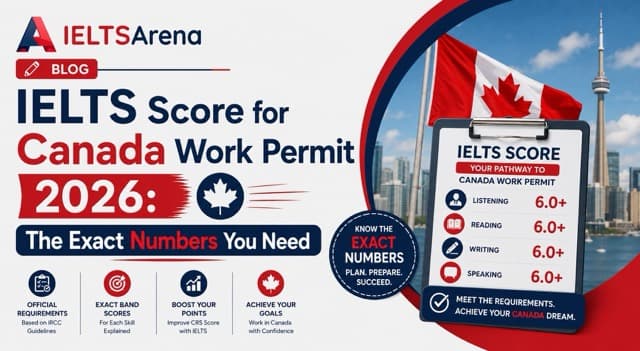
The Exact IELTS Score Required for Canada Work Permit 2026
The IELTS score for Canada work permit in 2026 is tied to the Canadian Language Benchmark (CLB) system. IRCC has set two thresholds based on program level, and these apply per skill — not as an average.
University graduates (bachelor's, master's, PhD):
CLB 7 in all four skills requires:
- Listening: Band 8.0
- Reading: Band 7.0
- Writing: Band 7.5
- Speaking: Band 7.5
College and polytechnic graduates:
CLB 5 in all four skills requires:
- Listening: Band 5.5
- Reading: Band 5.0
- Writing: Band 5.5
- Speaking: Band 5.5
These are minimum per-skill thresholds. Your overall IELTS band average is not what IRCC assesses. If you score Band 8.5 in Listening, Band 8.0 in Reading, Band 8.0 in Speaking, but only Band 6.5 in Writing, you do not meet the CLB 7 standard. Your PGWP application will be declined.
Your IELTS results must also be less than two years old at the point of PGWP application submission — not at your graduation date. A test taken in April 2024 will expire before a mid-2026 graduation cohort can realistically submit.
Advertisement
Why Graduates Get the IELTS Score for Canada Work Permit Wrong
The most consistent mistake in PGWP IELTS preparation is optimising for an overall band average rather than individual skill minimums. These are two very different targets.
Three specific errors repeat across PGWP applicants:
The Writing gap is underestimated. Writing is the skill where the gap between a student's confidence and their actual band score is widest. Students who read and speak English well often score lower in Writing because IELTS Academic Writing requires specific structural awareness — Task Response, Coherence and Cohesion, consistent academic register — that does not develop from general English use.
Outdated results are assumed to qualify. Students who took IELTS for their undergraduate admission may assume those results carry forward. They do not. IRCC requires results less than two years old at the time of PGWP application, which is typically six to twelve months after graduation.
CLB-IELTS conversion is not checked per skill. Many IRCC-focused guides quote an overall IELTS band equivalent to CLB 7 rather than the per-skill breakdown. The per-skill breakdown is what matters. Band 7.0 overall is not the same as meeting CLB 7 in Writing (which requires Band 7.5).
Why Common Preparation Approaches Fall Short
Most international students preparing for the IELTS score for Canada work permit focus on overall score improvement without isolating their weakest skill.
General IELTS preparation courses spread practice time evenly across four sections. This approach is efficient for students targeting an overall band score for university admission. For PGWP CLB compliance, it is inefficient.
The correct approach is to identify, within the first week of preparation, which single skill is furthest below the CLB threshold — and focus 60 percent of preparation time there. For university graduates, Writing Band 7.5 is consistently the hardest threshold to cross. For college graduates, Writing Band 5.5 and Speaking Band 5.5 are the most common failure points.
Spreading preparation evenly when one skill is the blocking factor adds weeks to your timeline unnecessarily.
Kwame's Story
Kwame Asante, 24, graduated with a Bachelor's degree in Computer Science from a Canadian university in May 2026. He had assumed his IELTS results from his undergraduate admission — taken in early 2023 — would be valid for his PGWP application.
When he reviewed his documents in April 2026, he realised his original test results would expire before he could submit. He needed to retest. His CLB 7 target meant Band 7.5 in Writing and Speaking, Band 8.0 in Listening, Band 7.0 in Reading.
"I thought my English was strong enough. It is — I work in English every day. But when I took a full practice test, my Writing came back at Band 6.5. I had no idea Task 2 needed that specific structure. Nobody explained what Task Response actually means in scoring terms."
He gave himself six weeks. He focused on Writing first — submitting eight timed Task 2 essays for AI feedback and then human tutor review to identify exactly which criterion was limiting his score. He also practised Listening with non-native fluent accents, which IELTS has incorporated more heavily from 2026.
His final result: Listening 8.5, Reading 7.5, Writing 7.5, Speaking 8.0. CLB 7 met in every skill. PGWP application submitted on schedule.
The April 2026 Co-op Change and Why It Matters for Your IELTS Timeline
Beyond PGWP, Canada made a significant change in April 2026 that directly affects the timeline for international students still studying.
As of April 1, 2026, post-secondary international students in Canada no longer need a separate co-op work permit for work placements that are integral to their program. A valid study permit with on-campus work authorization is now sufficient, as long as the placement is required by the program and does not exceed 50 percent of total program hours.
According to IRCC (April 2026), students who had active co-op work permit applications in queue as of April 1 had those applications automatically withdrawn.
The IELTS score for Canada work permit implications of this change are practical: students completing co-op placements may see their graduation date shift by a semester depending on program structure. A later graduation date means a later PGWP application window — and potentially a different IELTS test result validity window. Students who took IELTS in 2024 should check whether their results will still be within the two-year validity period when they are ready to apply.
According to IRCC data (2025), approximately 42 percent of PGWP applications in the 2024-25 cycle came from students who had completed co-op or work-integrated learning programs. The co-op permit removal affects a large share of Canada-bound international graduates.
One expired test result — or one skill band falling below the CLB threshold — is enough to delay your Canadian work authorisation by months. The number to track is not your overall IELTS average. It is your weakest skill's current band score.
How to Reach the IELTS Score for Canada Work Permit Efficiently
The preparation path differs depending on whether you are targeting CLB 5 or CLB 7.
For CLB 5 (college graduates):
Band 5.5 in Writing and Speaking, Band 5.0 in Reading, and Band 5.5 in Listening. For most students whose program was conducted in English, this is achievable with four to six weeks of targeted practice. The most common failure point is Writing Task 1 structure — whether you are doing a General Training letter or an Academic graph description, the format must match what IELTS examiners expect within the 20-minute time limit.
For CLB 7 (university graduates):
Band 7.5 in Writing is the threshold most students struggle to reach. The path is:
- Take a full diagnostic computer-based IELTS mock test and receive a per-skill band score
- Identify the single skill furthest below target
- Complete eight to ten timed Writing tasks with detailed criterion-level feedback before retesting
- Build Listening practice using non-native fluent accents — IELTS 2026 audio includes more European, South Asian, and East Asian English speakers
- Use the IELTS One Skill Retake if one section falls short on your first attempt — available on computer-based tests within 60 days of your original test date
The Writing Band 7.5 requirement means consistent paragraph structure, lexical variety above B1 level, and minimal grammatical errors across both Task 1 and Task 2. Submitting essays for expert review — not just checking your own work — is the fastest way to identify which of the four writing criteria is the limiting factor.
How IELTSArena Helps You Hit the IELTS Score for Canada Work Permit
Meeting per-skill CLB minimums requires feedback that is specific to each criterion — not a generic overall impression.
IELTSArena provides exactly that for PGWP applicants targeting CLB 7:
The AI Writing feedback on IELTSArena evaluates your Task 2 essays instantly across all four IELTS writing criteria: Task Response, Coherence and Cohesion, Lexical Resource, and Grammatical Range. You see which criterion is pulling your Writing band below 7.5 and you know specifically what to fix — not just that you "need to improve."
Expert tutor corrections on Writing and Speaking add the layer that AI-only platforms cannot replicate. An experienced IELTS tutor identifies whether your cohesive devices are mechanical (which costs Coherence and Cohesion marks) or genuinely functional — the distinction that separates Band 6.5 Writing from Band 7.5.
The real CBT simulation interface means your practice is always in the format you will use for your PGWP-qualifying IELTS test. After June 2026, all new tests are computer-based. Practising in the actual interface prevents interface unfamiliarity from costing band points on test day.
Progress analytics track your band score across every mock test, showing you the gap closing in measurable increments — which helps you decide when you are genuinely ready to rebook rather than retesting too early.
The Band Calculator at /band-calculator helps you map your individual skill targets to CLB levels clearly.
IELTSArena is trusted by 10,000+ students globally, rated 5.0 stars from 2,500+ reviews, and supports both Academic and General Training test types.
Start your free IELTS practice on IELTSArena — one free mock test gives you a current per-skill band score so you know exactly where you stand for your Canada work permit application.
Is Your IELTS Preparation Canada-Ready? Self-Diagnosis
Before you book your test, answer these five questions:
- Do you know whether you need CLB 5 or CLB 7 based on your specific Canadian program level — college or university?
- Have you taken a full computer-based IELTS mock test and received an individual band score for each skill — not just an estimated overall average?
- Is your Writing band score currently at or above Band 7.5 (CLB 7) or Band 5.5 (CLB 5) under timed conditions?
- Will your IELTS test results be less than two years old on the date you plan to submit your PGWP or work permit application, accounting for any co-op semester extension?
- Do you know that the IELTS One Skill Retake allows you to retake one underperforming section within 60 days of your original computer-based test?
If any answer is "no" or "not sure," your preparation has a gap that targeted, feedback-driven practice can close before your application window opens.
Take a Free Diagnostic Test Today
The IELTS score for Canada work permit is not flexible. CLB 7 means Band 7.5 in Writing, every single skill, every time. One band below that threshold is enough to delay your PGWP application by months.
Take a free computer-based IELTS mock test on IELTSArena now. You will see your current band score across all four skills, identify which skill needs the most work, and start building toward your CLB target from today.
Start Your Free IELTS Practice on IELTSArena →
Frequently Asked Questions
What IELTS score do I need for a Canada work permit in 2026?
The required IELTS score for a Canada work permit in 2026 depends on your program level. University graduates (bachelor's, master's, PhD) must meet CLB 7: Listening Band 8.0, Reading Band 7.0, Writing Band 7.5, and Speaking Band 7.5 — in every individual skill. College and polytechnic graduates must meet CLB 5: Listening Band 5.5, Reading Band 5.0, Writing Band 5.5, and Speaking Band 5.5. Your overall IELTS average does not determine eligibility. IRCC evaluates each skill band individually against the CLB threshold. Results must be less than two years old when you submit your PGWP or work permit application. (Sources: IRCC, 2024; ielts.ca, 2026; fragomen.com, 2026.)
Is IELTS required for the Canada PGWP in 2026?
Yes, IELTS is one of the accepted language tests for the Canada Post-Graduation Work Permit (PGWP) in 2026. IRCC introduced mandatory language requirements for PGWP applicants from November 1, 2024. Accepted tests include IELTS, CELPIP (for English), and TEF Canada (for French). If you submit IELTS results, you must meet the per-skill CLB band score for your program level — not just an overall average. University graduates need CLB 7, college graduates need CLB 5. Test results must be no more than two years old at the time of PGWP application. There are no exemptions based on country of origin, citizenship, or language of instruction.
What is CLB 7 in IELTS band score?
CLB 7 — Canadian Language Benchmark Level 7 — corresponds to the following IELTS band scores per skill: Listening Band 8.0, Reading Band 7.0, Writing Band 7.5, Speaking Band 7.5. These are minimum per-skill scores, not a combined average. CLB 7 is the English standard required for PGWP applicants who graduated from a Canadian university-level program (bachelor's, master's, or PhD). It reflects upper-intermediate to advanced English proficiency. The CLB-to-IELTS conversion table is published officially by IRCC and is the reference used by immigration officers when assessing PGWP applications. (Source: IRCC official CLB conversion table, 2024.)
Can I get a Canada work permit with IELTS 6.0?
It depends on your program level and application type. If you graduated from a Canadian college-level program and are applying for a PGWP, IELTS 6.0 overall may be sufficient if you meet CLB 5 in each individual skill (Listening 5.5, Reading 5.0, Writing 5.5, Speaking 5.5). However, if you graduated from a university-level program, IELTS 6.0 does not meet the CLB 7 requirement. For Express Entry federal immigration streams, the minimum IELTS score required varies by program — the Federal Skilled Worker program typically requires CLB 7 or higher depending on your Comprehensive Ranking System points profile. Use the IELTSArena Band Calculator alongside the official IRCC CLB conversion table to check your specific situation.
How do I improve my IELTS score for Canada PR quickly?
To improve your IELTS Writing score for Canada PR, focus on the four marking criteria equally. Task Response means directly answering the question with a clear position throughout the essay. Coherence and Cohesion means logical paragraph structure and varied cohesive devices that guide the reader. Lexical Resource means precise academic vocabulary without repetition. Grammatical Range means complex sentence structures used accurately. The fastest improvement path is submitting timed Task 2 essays for expert band-focused feedback, not self-review alone. IELTSArena offers both AI Writing feedback with instant band breakdowns and expert human tutor corrections that identify specifically which criterion is holding your score below your CLB target. Students who complete eight to ten reviewed essays in focused preparation typically see a 0.5 to 1.0 band improvement in Writing within four to six weeks.