You scored well in three sections and missed your target by half a band in one. It is the most frustrating result in IELTS, and for years the only fix was to book the entire four-skill test again, pay the full fee, and risk your strong sections slipping. That is no longer the case. The IELTS One Skill Retake 2026 lets you resit a single section and keep the scores you already earned.
This feature has become genuinely important this year. As IELTS completes its move to computer-delivered testing through mid-2026, the One Skill Retake, which is exclusive to the computer-delivered format, is now available in most countries worldwide. That means far more candidates can use it in 2026 than ever before.
Used well, the IELTS One Skill Retake 2026 can turn a near miss into a pass in a matter of days. Used carelessly, it becomes a wasted fee and a repeated disappointment. The difference is whether you actually move the weak skill, and that comes down to how you prepare in the 60-day window you are given.
Here is exactly how the IELTS One Skill Retake 2026 works, who is eligible, what it costs, and the strategy that makes the retake worth booking.
What the IELTS One Skill Retake 2026 Is
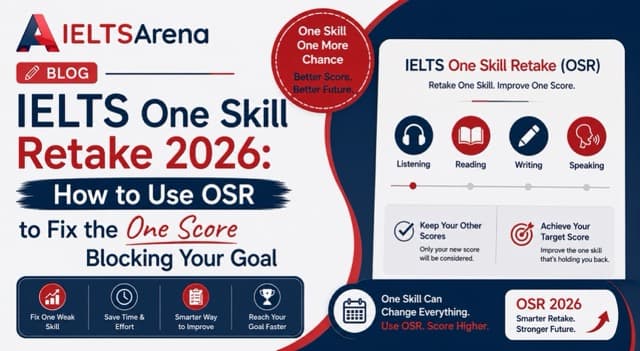
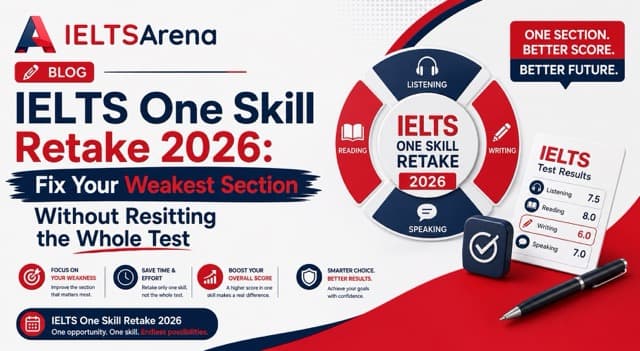
The IELTS One Skill Retake 2026 is an option that lets you resit just one of the four IELTS sections, Listening, Reading, Writing, or Speaking, instead of sitting the entire four-skill test again, according to the official ielts.org One Skill Retake page (2026).
After your retake, you receive a single combined Test Report Form (TRF) that shows your original scores for the three sections you did not resit, alongside your new score for the section you retook. You then choose which TRF to submit to your university, employer, or immigration authority.
The feature exists for one practical reason. Most candidates do not fail IELTS across the board. They miss in one place. The IELTS retake one section model recognises that resitting Listening, Reading, and Speaking when only your Writing fell short is wasteful, expensive, and risky, because strong sections can drop on a bad day.
Advertisement
IELTS One Skill Retake Eligibility and the 60-Day Rule
IELTS one skill retake eligibility comes down to three core conditions, confirmed by the British Council Take IELTS OSR FAQs (2026).
First, you must have taken your original IELTS on computer. The One Skill Retake is exclusive to the computer-delivered IELTS. If you sat a paper-based test, you are not eligible, which is one more reason the format migration matters this year.
Second, the IELTS OSR 60 day rule applies. You must complete your retake within 60 days of your original test date. Miss the window and you have to book a full test again.
Third, you can retake only one skill per full IELTS test. You cannot resit two weak sections through OSR from a single sitting. You pick the one that matters most.
A few more practical points. Results for the One Skill Retake are typically available within 3 to 5 days, which is fast compared with planning a fresh full exam. The retake section follows the identical format and timing as in a full test, so Listening still runs around 30 minutes and Writing still gives you 60 minutes for both tasks. And availability, while now broad, is not universal: the One Skill Retake is available in most countries worldwide as of 2026 but is not currently offered in the United States, so candidates there must take the full test to improve a score.
Why Some Candidates Waste Their One Skill Retake
The most common mistake is treating the One Skill Retake as a second roll of the dice rather than a targeted fix. Booking a retake without changing how you prepare usually returns the same score. The exam did not misjudge you the first time; the skill genuinely needs to move.
The second mistake is choosing the wrong skill to retake. You only get one. Candidates sometimes retake the section they feel most anxious about rather than the one that actually unlocks their target overall band after rounding. The right choice is the section where a realistic 0.5 to 1.0 gain changes your final result.
The third mistake is ignoring rounding. The overall IELTS band is the average of the four sections rounded to the nearest 0.5. A 0.5 improvement in one section sometimes does not move the overall band at all, while a 1.0 improvement almost always does. Knowing the maths before you book tells you whether the retake is even worth it for your specific scores.
The fourth mistake is leaving preparation too late inside the 60-day window. A retake booked for day 58 with no focused practice in between is a fee spent on hope.
A Real Candidate Story: Carlos From the Philippines
Carlos, a 29-year-old nurse from Cebu in the Philippines, needed a high IELTS result for overseas registration. His target was 7.0 in every section. His computer-delivered results came back Listening 7.5, Reading 7.5, Speaking 7.0, and Writing 6.5. Three sections cleared the bar. Writing, at 6.5, did not.
Under the old system, Carlos would have rebooked the full test, paid the full fee, and gambled his three strong sections on a single new sitting. Instead he used the IELTS One Skill Retake 2026 and resat Writing only, within the 60-day window.
"I did not need to prove my Listening or Speaking again," Carlos said. "They were already where they needed to be. I only had to fix one thing, so I put everything into that one thing."
For five weeks Carlos drilled Writing alone. He wrote Task 1 and Task 2 under the real clock, typing on screen, and reviewed feedback on his Coherence and Cohesion and Lexical Resource after every attempt, the two criteria that had been holding him at 6.5. His retake came back at 7.0. With his original three scores intact, he met his 7.0-per-section requirement and kept moving toward registration. One section, fixed properly, was all it took.
The Data Behind the One Skill Retake
The numbers explain why this feature spread so quickly. According to IELTS data referenced in 2024 to 2026 OSR guidance, approximately 91 percent of test-takers who use the One Skill Retake choose to resit their lowest-scoring skill, and most see an improvement of 0.5 to 1.0 band on the retaken section.
That single statistic captures the logic of the feature. Nine in ten users are not retaking on a whim; they are targeting the one skill dragging down their result, and the majority succeed in lifting it. Writing is the most common choice, which matches the wider pattern of Writing being the lowest-scoring section globally.
The cost data reinforces the appeal. The One Skill Retake fee is typically a fraction of the full IELTS fee, commonly cited at between roughly 40 and 70 percent depending on the country and test centre, per Magoosh and SimplyIELTS (2026). You pay less, you risk only one score instead of four, and you get your result in 3 to 5 days. The economics favour the retake, provided you actually raise the skill.
The candidates who win with a One Skill Retake are not the ones who book fastest. They are the ones who treat 60 days as a focused training block for a single skill.
The Right Way to Use Your One Skill Retake in 2026
A disciplined approach to the One Skill Retake looks like this.
First, do the rounding maths. Calculate your overall band, then model what happens if your weak section rises by 0.5 and by 1.0. If only a 1.0 gain changes your overall result, plan for that, not for a token improvement.
Second, choose the highest-leverage section. Pick the one skill where a realistic improvement actually changes your final outcome, not simply the one you dislike most.
Third, diagnose why you lost marks. For Writing, identify which of the four criteria capped you. For Speaking, work out whether it was Fluency, Lexical Resource, Grammar, or Pronunciation. You cannot fix a score you have not diagnosed.
Fourth, practise in the computer-delivered format. Because the computer delivered IELTS retake uses the same on-screen interface, rehearse typing your Writing answers and navigating the screen so retake day feels routine.
Fifth, use the full 60 days deliberately. Build a short, focused schedule for the single skill, with feedback after every practice attempt, and book the retake once your practice scores are consistently above your target.
Sixth, re-test under real conditions before you commit. Sit timed, single-section mocks so you walk into the retake knowing your current level, not hoping for it.
How IELTSArena Makes Your Retake Count
The IELTS One Skill Retake 2026 rewards focused, single-skill improvement inside a tight window, and that is exactly the kind of targeted practice IELTSArena is designed for.
Because OSR is exclusive to the computer-delivered test, format familiarity matters. IELTSArena replicates the real IELTS CBT interface, including the on-screen highlighter, notepad, and navigation panel, so your retake section feels identical to your practice. There is no format surprise on the day.
For the section most candidates retake, IELTSArena's AI Writing feedback gives an instant band estimate and specific corrections across Task Achievement, Coherence and Cohesion, Lexical Resource, and Grammatical Range and Accuracy, so you can see precisely why you were capped and fix it. For Speaking retakes, AI Speaking feedback scores fluency, pronunciation, vocabulary, and grammar, and expert tutors add one-to-one, band-focused correction that pushes a 6.5 toward a 7.0.
Crucially, IELTSArena's progress analytics let you drill and track a single skill across repeated attempts, so within your 60-day window you can watch your weak section climb from its starting point to consistently above target before you spend money on the retake. More than 10,000 learners have used IELTSArena to reach their goal. Start free.
Should You Book a One Skill Retake? Self-Diagnosis
Run through these questions before you decide:
- Is exactly one section holding back your overall band, while the other three meet your target?
- Have you calculated whether a 0.5 or a 1.0 gain in that section actually changes your overall result after rounding?
- Did you take your original test on a computer, making you eligible for the One Skill Retake?
- Are you still inside the 60-day window from your original test date?
- Can you already score above your target in that one skill in timed practice, or are you booking on hope?
If you answered yes to the first four and are working toward yes on the last, a One Skill Retake is a smart, economical move. If your practice scores are not yet there, fix that first, then book.
See Which Section to Retake, Free
You do not have to guess which skill to resit. Take a free mock test on IELTSArena, see your score in every section, and you will know exactly which one to target for your IELTS One Skill Retake 2026. Then drill that single skill with instant feedback until it clears your target.
Start Your Free Practice on IELTSArena →
Frequently Asked Questions
What is the IELTS One Skill Retake and how does it work in 2026?
The IELTS One Skill Retake 2026 lets you resit just one section of IELTS, Listening, Reading, Writing, or Speaking, instead of the full four-skill test, according to ielts.org (2026). It is available only for the computer-delivered IELTS, and you must complete it within 60 days of your original test date. After the retake you receive a combined Test Report Form showing your original three section scores plus your new score for the retaken skill, and you choose which TRF to submit. Results typically arrive within 3 to 5 days. It is ideal when one section narrowly missed your target while the others met it.
Can I retake just the Writing section of IELTS in 2026?
Yes. If your original IELTS was computer-delivered, you can use the One Skill Retake to resit only Writing while keeping your existing Listening, Reading, and Speaking scores. Writing is the most common section candidates choose to retake, since it is the lowest-scoring skill globally for most test-takers. You must book within 60 days of your original test, and you can retake only one skill per sitting. To make a Writing retake count, diagnose which of the four Writing criteria capped your score and drill it with feedback. IELTSArena's AI Writing feedback identifies exactly where you lose marks across all four criteria.
How long do I have to book an IELTS One Skill Retake?
You must complete your One Skill Retake within 60 days of your original test date, under the IELTS OSR 60 day rule confirmed by the British Council (2026). If you miss that window, you can no longer use the One Skill Retake and must book a full four-skill test instead. Because results take 3 to 5 days and you need time to prepare the weak skill properly, it is wise to plan your retake date early in the 60-day period rather than leaving it to the final days. Use the window as a focused training block for the single skill you are resitting.
Does a One Skill Retake change my overall IELTS band score?
It can, but not always, because of rounding. Your overall IELTS band is the average of the four sections rounded to the nearest 0.5. A 0.5 improvement in one section sometimes does not change the overall band, while a 1.0 improvement almost always does. Before booking, calculate your current average and model what a 0.5 and a 1.0 gain would do to your overall result. If only a 1.0 gain moves your overall band, prepare for that larger jump. This rounding maths is the single most important calculation to do before spending on a One Skill Retake.
Is the IELTS One Skill Retake cheaper than taking the full test again?
Yes, in nearly every market. The One Skill Retake fee is typically a fraction of the full IELTS fee, commonly cited at roughly 40 to 70 percent depending on the country and test centre, according to Magoosh and SimplyIELTS (2026). Beyond the lower fee, you also avoid risking your three strong sections, since only the retaken skill changes while the others are preserved. The main condition is that your original test was computer-delivered and you act within 60 days. For a candidate one section short of target, it is almost always the cheaper and lower-risk route, provided you actually raise the weak skill through focused practice.