A qualified nurse with ten years of ward experience can have a job offer in the UK waiting, and still be blocked by a single half-band in IELTS Writing. It happens constantly. The clinical skills are not the problem. The English test is.
For internationally trained nurses, IELTS is often the last and most frustrating gate between qualification and registration. The score bars are high, the per-section requirements are strict, and one weak skill can hold back an entire application even when the other three are strong.
This guide lays out what IELTS for nurses actually requires in the UK, Australia, and the UAE in 2026, why the per-section rule trips up so many candidates, and how to build a targeted preparation plan that protects your weakest skill instead of leaving it to chance. Always confirm the exact current figures with the relevant nursing regulator before you book, because requirements are reviewed periodically.
What IELTS for Nurses Actually Demands
Nursing registration uses the Academic version of IELTS, not General Training, in the major destination countries. The Academic paper tests the kind of formal English used in professional and clinical settings.
The thing that makes IELTS for nurses harder than a university application is the per-section minimum. Universities often care mainly about your overall band. Nursing regulators care about every single skill.
That means you cannot lean on a strong Listening score to rescue a weak Writing score. Each of the four skills, Listening, Reading, Writing, and Speaking, has to clear the bar on its own.
Here is the general picture for 2026, which you must verify against each regulator's official site before applying.
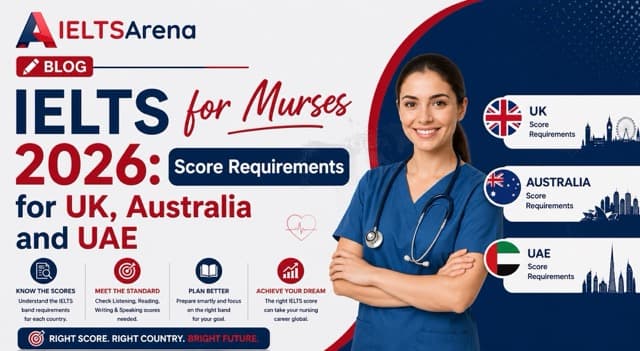
For the UK, the Nursing and Midwifery Council has typically required IELTS Academic with an overall Band 7.0, with 7.0 in Listening, Reading, and Speaking, and a long-standing concession allowing 6.5 in Writing.
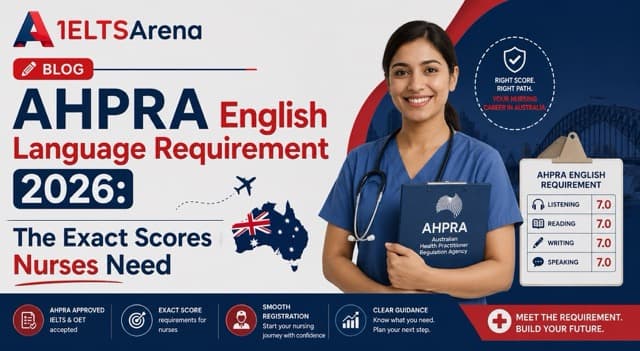
For Australia, the Nursing and Midwifery Board, through AHPRA, has typically required IELTS Academic with a minimum of 7.0 in each of the four skills, with no section below that.
For the UAE, the various health authorities generally require IELTS Academic, with the exact band depending on the emirate, the role, and the seniority level, so checking the specific authority is essential.
Why Common Approaches Fail for Nurses
The first failure is treating IELTS like a general English test. Nurses often have strong spoken English from clinical work but underestimate the academic Writing task, which is the most common section to fall short on.
The second is ignoring the per-section rule until results day. A nurse celebrates an overall 7.0, then sees Writing came in at 6.5 against an Australian requirement of 7.0 in every skill, and the whole result is rejected for registration even though the average looked fine.
The third is preparing without timed practice. Experienced professionals are busy, so they study in fragments, one question here and there, and never sit a full timed paper. The real exam is a continuous, pressured event, and untimed practice does not prepare you for it.
The fourth is the feedback gap in Writing and Speaking. These two skills have no answer key, so without external correction a nurse repeats the same Task 2 structure error or the same pronunciation habit for weeks, certain they are improving.
The fifth is retaking blindly. Many nurses sit the exam again and again without changing their method, paying each time, hoping the score lifts on its own.
A Realistic Student Story
Joy, a registered nurse from the Philippines, had a UK sponsorship lined up and needed to clear the NMC English requirement. Her first attempt looked almost there: 7.5 Listening, 7.0 Reading, 7.0 Speaking, and 6.0 Writing.
That 6.0 stopped everything. The Writing band sat below even the 6.5 concession, so her overall 7.0 did not matter.
"I was devastated," Joy said. "I speak English at work every day. I never imagined Writing would be the thing to fail me."
She changed her whole approach. Instead of general practice, she focused almost entirely on Writing Task 1 and Task 2, submitting every essay for feedback and rewriting it based on the corrections. She kept her other three skills warm with one timed session each per week.
"Once I could see my exact Writing mistakes named back to me, week after week, the band started moving," Joy said. On her next attempt she scored 7.0 in Writing and cleared every section. Her registration moved forward.
For nurses, IELTS is rarely lost on the skill you fear most. It is lost on the one skill you ignored because the other three felt safe.
Data and Insight: Where Nurses Lose Marks
The pattern in IELTS data explains exactly why so many nurses stall on the same skill.
Public IELTS performance reports consistently show Writing as the lowest-scoring skill for Academic candidates worldwide, with global average Writing bands sitting around 5.5 to 6.0 in recent reporting years. That average sits well below the 7.0 that UK and Australian nursing registration usually demands.
For nurses specifically, the gap is sharper because the bar is higher. A university applicant might pass comfortably at an overall 6.5. A nurse facing a 7.0 per-section requirement has almost no margin for a weak skill.
Speaking is often a relative strength for nurses, since clinical work builds spoken fluency. The risk concentrates in Writing, and to a lesser degree Reading under time pressure, where dense academic passages slow down readers who are out of academic study habits.
The practical insight is clear. For most nurses, the highest-value preparation hours go into Writing, because that is statistically the most likely skill to drop below the per-section minimum and sink the whole result.
The Right Approach: A Targeted Plan for Nurses
Build your preparation around the per-section rule, not the overall average.
Step 1: Confirm the exact requirement for your destination and role. Check the NMC, AHPRA, or the relevant UAE health authority directly. Know the per-section minimum before you do anything else, because it shapes your entire plan.
Step 2: Sit a full timed Academic mock test. Get a real band for each skill under exam conditions. This tells you which sections already clear the bar and which do not.
Step 3: Pour your hours into the skill closest to failing. For most nurses that is Writing. Protect the strong skills with light weekly practice, but spend the bulk of your time lifting the one that threatens the whole result.
Step 4: Close the feedback gap on Writing and Speaking. Get every essay scored and corrected, then rewrite it. Record Speaking answers and have them evaluated on fluency, vocabulary, grammar, and pronunciation.
Step 5: Practise in the real exam format. If you are taking the computer-based test, train in that interface so the screen, timer, and tools are familiar on the day.
Step 6: Re-test before you book the real exam. Only book when your mock scores clear every section with a small margin, so a single bad day does not push you below the bar.
How IELTSArena Supports Nurses
The skill that most often holds nurses back is Writing, and that is exactly where IELTSArena focuses its strongest feedback.
On IELTSArena you practise full Academic tests in the real CBT interface, with the same timer, highlighter, and navigation panel as the exam. For busy nurses moving from paper habits to the computer-based test, this removes a real source of stress on the day.
When you submit a Writing task, the AI feedback on IELTSArena scores it across all four criteria within seconds and names the exact problems holding your band down, so you stop guessing why Writing keeps landing at 6.5. The AI speaking feedback does the same for fluency, pronunciation, vocabulary, and grammar.
For the precision a high-stakes 7.0 requirement demands, expert tutors on IELTSArena review your Writing and Speaking and give band-focused corrections that target the difference between a 6.5 and a 7.0. The progress analytics track every skill across your mocks, so you can confirm your weakest section is clearing the per-section bar before you pay for the real test.
More than 10,000 learners have used IELTSArena to reach their target band, and because it supports the Academic module that nursing registration requires, your practice matches the exact test you will sit.
Self-Diagnosis: Are You Ready for the Nursing Bar?
Check yourself against these questions before booking.
- Do you know the exact per-section IELTS requirement for your specific destination and nursing role in 2026?
- From a real timed Academic mock, does every one of your four skills currently clear that bar, not just your overall average?
- Is your Writing band safely above the minimum, given that Writing is statistically the most likely skill to fall short?
- Are you getting external feedback on your Writing and Speaking, or are those two skills going unchecked?
- Have you practised full papers in the computer-based format you will actually face on test day?
If your Writing answer is shaky, that is your priority. For nurses, Writing is the section that most often turns a passing average into a failed application.
Find Your Real Band Before You Book
The most expensive mistake in IELTS for nurses is booking the real exam before you know your true per-section scores.
Take a Free Nursing-Targeted Academic Mock on IELTSArena →
Frequently Asked Questions
What IELTS score do nurses need to register with the NMC in the UK?
The UK Nursing and Midwifery Council has typically required IELTS Academic with an overall Band 7.0, including 7.0 in Listening, Reading, and Speaking, and a long-standing concession that accepts 6.5 in Writing. Every section must meet its minimum on its own, so a strong overall average cannot rescue a weak skill. The NMC also accepts certain combinations of test sittings under specific conditions, and it reviews its requirements periodically, so you must confirm the current rules on the official NMC website before applying. Practising Academic Writing with feedback on IELTSArena helps target the section that most often falls short for nurses.
Does Australia require IELTS Academic or General Training for nursing registration?
Australia requires the Academic version of IELTS for nursing registration, not General Training. Through AHPRA, the Nursing and Midwifery Board has typically required a minimum of 7.0 in each of the four skills, Listening, Reading, Writing, and Speaking, with no section below 7.0. This per-section rule is stricter than many university requirements, so the most common reason nurses fail is one skill dropping below the bar, usually Writing. The board reviews its English standards from time to time and accepts certain test combinations, so always verify the current requirement on the official AHPRA site before booking your exam.
How do nurses from the Philippines prepare for the IELTS nursing registration exam?
Filipino nurses often have strong spoken English from clinical work, so the priority is usually Academic Writing and timed Reading rather than Speaking. Start with a full timed Academic mock to find your real band in each skill, then aim most of your study at the section closest to the per-section minimum, which is commonly Writing. Build a feedback loop so your essays and speaking responses are corrected, not just practised. On IELTSArena, you can sit full Academic mocks in the real CBT interface and get instant AI feedback plus expert tutor review, which targets the exact skill gap that holds back registration.
What band score do I need in each section for NMC IELTS requirements?
The UK NMC has generally required IELTS Academic with 7.0 in Listening, 7.0 in Reading, 7.0 in Speaking, and at least 6.5 in Writing under its writing concession, for an overall Band 7.0. The key point is that the requirement is per section, so each skill must independently meet its minimum. An overall 7.0 with a Writing score of 6.0 would still be rejected. Because the NMC updates its English language evidence rules periodically and recognises certain combined test results, confirm the exact current figures on the official NMC website before you sit the exam.
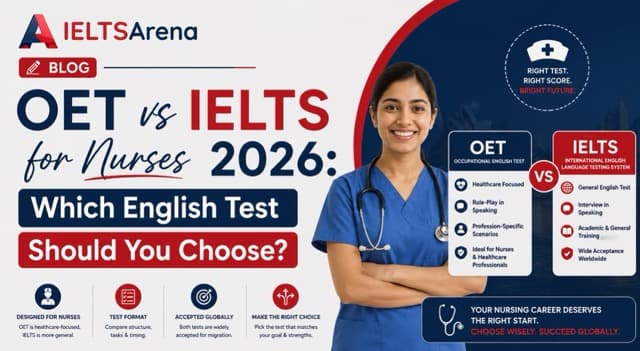
Is IELTS or OET better for nurses applying to work in the UK or Australia?
Both IELTS Academic and OET are accepted for nursing registration in the UK and Australia, so the better choice depends on you. OET is healthcare-specific, with tasks built around clinical scenarios, which some nurses find more relatable. IELTS Academic is more widely available, often cheaper, and useful if you may also need it for visa or study purposes later. Many nurses choose IELTS for its availability and broader recognition. Whichever you pick, the deciding factor is per-section performance, especially in Writing. Practising full Academic mocks with feedback on IELTSArena helps you judge whether IELTS is the right fit before committing.