
You can be a brilliant clinician and still be blocked from practising in the UK by a single 6.5 in IELTS Writing. That is the reality of IELTS for doctors, and it surprises thousands of international medical graduates every year. The General Medical Council does not just want a strong overall score. It wants a high floor under every single skill, and the gap between knowing this early and discovering it late can cost you months of your career.
With the UK tightening English requirements across its 2026 immigration and registration routes, attention on the exact doctor threshold has spiked. This guide explains the precise IELTS for doctors requirement, why one weak band ends most attempts, and how to close that gap before test day.
What IELTS Score Do Doctors Need for GMC Registration
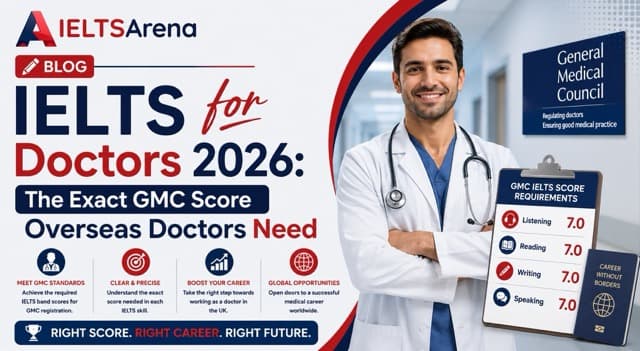
The IELTS for doctors requirement is an overall band of 7.5 with no individual band below 7.0, taken in IELTS Academic, in a single sitting (GMC, 2026; Health Careers NHS, 2026). That is the definitive answer, and every part of that sentence carries weight.
The overall 7.5 is only half the rule. The per-band floor of 7.0 is what stops most doctors, because a single 6.5 in any of Listening, Reading, Writing, or Speaking voids the whole result for registration purposes.
This standard applies to doctors using IELTS for the GMC's English requirement before or alongside the PLAB and UKMLA route to a licence to practise. It is a communication-safety bar, not an academic one, which is why the GMC sets it higher than typical university entry.
Advertisement
Why the 7.0 Floor Matters More Than the 7.5
Most guidance leads with the 7.5 and treats the four skills as interchangeable. They are not. The IELTS for doctors rule is unforgiving precisely because of the per-band minimum.
A doctor who scores 8.0 Listening, 8.0 Reading, 8.0 Speaking, and 6.5 Writing has an overall well above 7.5 on paper, yet fails the GMC standard because Writing dropped below 7.0. The strongest three skills cannot rescue the weakest one.
This is the structural reality that separates IELTS for doctors from ordinary university requirements. Your registration depends on your floor, not your ceiling, so the entire preparation strategy must protect your weakest skill.
Why Common Approaches Fail Doctors
Overseas doctors usually make three avoidable mistakes.
First, they prepare like the test is about medical English. It is not. IELTS Academic Writing Task 1 asks you to describe a graph or chart, and Task 2 asks for a general argumentative essay, neither of which rewards clinical vocabulary.
Second, they over-prepare Listening and Reading, where strong test-takers often already sit above 7.0, and neglect Writing, where the four criteria of Task Achievement, Coherence and Cohesion, Lexical Resource, and Grammatical Range and Accuracy each take 25 percent of the band.
Third, they forget the single-sitting rule. The IELTS score for GMC registration must come from one test date, so a strong Writing from a later attempt cannot be bolted onto strong earlier scores.
A Real Student Story: Dr Maria from the Philippines
Dr Maria, a 29-year-old physician from Manila, planned her GMC registration around the PLAB route for 2026. Her first IELTS Academic result read 8.5 Listening, 8.0 Reading, 7.5 Speaking, and 6.5 Writing, an overall 7.5.
On paper she hit 7.5 overall. For the GMC it was a fail, because her Writing sat below the 7.0 floor, and the single-sitting rule meant she could not keep her excellent other scores and retake only Writing.
"I was devastated," Dr Maria said. "My overall was exactly 7.5. I thought I had passed. Nobody warned me that one 6.5 in Writing would force me to sit the whole exam again."
She spent four weeks rebuilding Task 2 structure and grammar accuracy, retook the full test, and scored an overall 8.0 with 7.0 in Writing. Her registration moved forward. Her takeaway: for IELTS for doctors, protect the floor, not the average.
The Data Doctors Need to See
Cambridge Assessment English data indicates the global average Writing band hovers around 5.8, well under the 7.0 floor the GMC demands. That single statistic explains why Writing is the band that derails the most medical applicants, even highly fluent ones.
The GMC accepts two English tests for registration: IELTS Academic at overall 7.5 with no band below 7.0 in a single sitting, or OET at Grade B in all four sub-tests (GMC, 2026). IELTS results stay valid for two years, and the GMC requires your certificate to be current when you apply.
The pressure on this pathway is rising. The UK raised Skilled Worker English to B2 from 8 January 2026 and moved its visa English tests to computer-only from 22 March 2026 (Jobbatical, 2026; OTS Solicitors, 2026), sharpening attention on every English threshold an overseas doctor must clear, including the registration standard itself.
For doctors, IELTS is not won by your best skill. It is lost by your weakest one. The 7.0 floor is the real exam.
How to Hit the IELTS for Doctors Score
Follow this sequence.
- Confirm you are sitting IELTS Academic, the module the GMC requires, not General Training.
- Identify your weakest skill immediately. For most doctors that is Writing, and occasionally Speaking.
- Treat 7.0 as your minimum in every skill, not 7.5 overall. Build a margin so a single tough question does not drop you below the floor.
- Drill Writing Task 2 structure, paragraphing, and grammatical accuracy, since Grammatical Range and Accuracy is where fluent doctors quietly lose half a band.
- Plan for a single sitting. Every band must clear 7.0 on the same day, so do not test until your weakest skill is stable.
- Watch your validity window so your certificate stays current through your GMC application.
How IELTSArena Closes the Doctor's Weak-Band Gap
The entire IELTS for doctors challenge comes down to lifting one stubborn skill, usually Writing, above 7.0 without letting the others slip. IELTSArena is designed to solve exactly that problem.
IELTSArena's AI Writing feedback scores your Task 1 and Task 2 essays instantly against the four examiner criteria and pinpoints whether you are losing your band on Task Achievement, coherence, vocabulary, or grammar. For the precision a 7.0 floor demands, expert tutors give you one-to-one, band-focused corrections that AI-only tools cannot match, which matters when you need a reliable 7.0 rather than a lucky one.
The real CBT interface removes test-day surprises, and the progress analytics dashboard tracks every mock so you can confirm all four skills are sitting safely above 7.0 before you book. Doctors preparing for GMC registration can start free on IELTSArena.
Self-Diagnosis: Are You Ready for the GMC Standard
Be honest before you spend another test fee.
- Is every one of your four skills already at or above 7.0, not just your overall?
- Can you write a Task 2 essay in 40 minutes that holds 7.0 on grammar and coherence?
- Are you certain you booked IELTS Academic rather than General Training?
- Do you know which single skill is most likely to fall below the floor on a bad day?
- Will your certificate still be valid when you submit your GMC application?
A hesitation on any of these is the exact gap that forces a full retake.
See Where Your Doctor Band Stands Today
In one free mock test, you will know whether your weakest skill clears the 7.0 GMC floor or quietly sits below it. For a doctor, that single answer can save you a wasted test attempt and weeks of delay.
Take a Free GMC-Targeted Mock on IELTSArena →
Frequently Asked Questions
What IELTS score do doctors need for GMC?
For GMC registration, the IELTS for doctors requirement is an overall band of 7.5 with no individual band below 7.0, in IELTS Academic, taken in a single sitting (GMC, 2026). The overall figure alone is not enough, because a single 6.5 in any skill voids the result for registration. The GMC sets this higher than most university entry because it is a patient-safety communication standard. Doctors who prefer an alternative can use OET at Grade B in all four sub-tests instead. Always aim for a clear margin above 7.0 in every skill rather than scraping the overall 7.5.
Is IELTS 7.5 hard for doctors?
The overall 7.5 is achievable for most fluent doctors, but the no-band-below-7.0 rule is what makes IELTS for doctors genuinely demanding. Many international medical graduates already score above 7.0 in Listening and Reading, so the difficulty concentrates in Writing, where the global average band sits near 5.8. The challenge is lifting that one weak skill to a reliable 7.0 while keeping the others stable, all on the same test day. With focused Writing practice and instant feedback on the four examiner criteria, the 7.0 floor becomes far more predictable than it first appears.
Can I take IELTS General Training for GMC?
No, the GMC requires IELTS Academic, not General Training, for doctors using IELTS to meet the English requirement. Academic Writing Task 1 asks you to describe data such as graphs and charts, and the module is designed to assess the formal English used in professional and academic settings. General Training is built for general migration and work routes, so submitting it will not satisfy the registration standard. If you booked the wrong module, you will need to retake IELTS Academic. Confirm with your test centre before your exam date that you are sitting the Academic version.
How long is IELTS valid for GMC registration?
IELTS results are valid for two years, and the GMC requires your certificate to be current at the point you apply for registration. If your test is approaching the two-year limit during your PLAB or UKMLA timeline, sit a fresh exam early so an expired certificate does not stall your application. Because the single-sitting rule applies, plan your test date carefully so all four skills clear 7.0 together and remain valid through the full registration process. Tracking your validity window is as important as hitting the score itself for doctors.
IELTS or OET for doctors, which is easier?
The GMC accepts both, so the right choice depends on your strengths. OET uses healthcare-specific scenarios, which some doctors find more natural because the content mirrors clinical communication. IELTS Academic is more general, with a graph-description Writing Task 1 that has nothing to do with medicine, which can feel unfamiliar. Neither is universally easier, but IELTS for doctors is often chosen because it is more widely available and accepted across multiple visa and registration routes at once. Whichever you pick, the deciding factor is your weakest skill, so practise that skill under real exam conditions before committing. IELTSArena lets you test your IELTS Writing band with instant feedback before you choose.