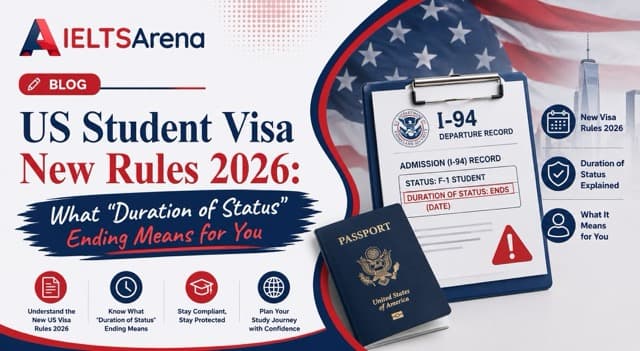
If you are planning to study in the United States, the rule that quietly governed your stay for decades is about to disappear. On 5 May 2026, the Department of Homeland Security submitted a final rule ending "Duration of Status," the policy that let international students remain in the country for as long as they stayed enrolled. From September 2026, a fixed period of stay replaces it.
For most students that means a defined window, commonly four years, to finish your program. Miss it, and you may have to file for an extension with USCIS rather than simply continuing.
This is not a reason to panic. It is a reason to plan, and to make sure every part of your application, including your English test, is solid before you go.
What the US student visa new rules 2026 actually change
For years, an F-1 visa holder was admitted for "D/S," or Duration of Status. There was no hard end date on your stay. As long as you were a full-time student in good standing, you were in status.
The US student visa new rules 2026 remove that open-ended arrangement. In its place comes a fixed admission period. According to reporting from ICEF Monitor in May 2026, most students will be admitted for the length of their program up to a four-year cap, while language-training students face a 24-month maximum that includes breaks and vacations.
If your program runs longer than your admission period, you will need to request an extension of stay from USCIS rather than relying on continued enrolment alone.
Advertisement
Who is affected and who is not
The change applies to the F category (academic students), the J category (exchange visitors), and the I category (foreign media). The most affected group is F-1 students, which is the visa most international degree-seekers hold.
The rule is scheduled to take effect in September 2026. Students already in the US will transition into the new fixed-period framework, so this is not only a concern for new applicants. Anyone whose program will run past their admission window needs to track their program end date carefully.
Non-immigrant visa categories such as H-1B, O-1 and TN are not the subject of this particular rule, though students often move into those routes after graduation.
Why "I'll sort it out later" is the wrong approach
The most common mistake students make with US immigration is treating compliance as something to handle after arrival. Under Duration of Status that was survivable. Under a fixed admission period it is risky.
A defined end date means delays now have consequences. A semester lost to a failed module, a deferred start, or a visa interview pushed back by months can eat into your window. The students who struggle are usually the ones who left the controllable parts of their application until the last minute.
The single most controllable part of your application is your English test score. You decide when to sit it, how prepared you are, and whether you have to retake it. A weak first attempt that forces a retake can cost you a full month, and under the new rules, a wasted month matters more than it used to.
A realistic student story
Take Daniel, a 23-year-old engineering graduate from Lagos, Nigeria, planning a two-year master's in the United States starting in 2027. He assumed his English was strong enough and booked his test with two weeks of casual preparation.
His first attempt came back at an overall Band 6.0, with Writing dragging him down to 5.5. His target program wanted a 6.5 with no band below 6.0. He had to rebook, wait for the next available date, and prepare again. That cost him five weeks.
"I treated the English test like a formality," Daniel said. "If the four-year clock had already been running, those five weeks would have come straight out of my study time."
On his second attempt, after structured practice and feedback on his essays, Daniel scored 7.0 overall with Writing at 6.5. The difference was not talent. It was preparing properly the first time.
Data and insight: where students actually lose time
Across global IELTS data, Writing is consistently the lowest-scoring section for academic candidates, with average band scores trailing Listening and Reading by roughly half a band. That gap is exactly where retakes come from.
The students who finish on time are the ones who removed every avoidable delay before they ever boarded the plane.
A retake is rarely about ability. It is about walking into the test without knowing how the exam is scored, how the computer-based interface works, or how to manage 60 minutes across two writing tasks. Fix those before test day and you protect the timeline the new US student visa new rules 2026 now make so important.
The right approach: lock your English score early
Here is a clear sequence to follow.
- Confirm the exact score your target university and visa route require, including the minimum per section.
- Sit a full timed mock test under real conditions before you book the official exam.
- Identify your weakest section from that mock, almost always Writing or Speaking.
- Get specific feedback on why you are losing marks, not just a score.
- Re-test under timed conditions until you clear your target with margin to spare.
- Only then book your official test date.
Doing this means your first official attempt is your only attempt. No retake, no lost month, no pressure on your fixed admission window later.
How IELTSArena keeps your timeline safe
The reason most students retake is that their first real exposure to exam pressure is the exam itself. IELTSArena removes that surprise.
IELTSArena replicates the real IELTS computer-based test interface, including the highlighter, notepad and navigation panel, so the format never costs you marks on test day. Its AI Writing feedback identifies the exact reasons you lose points on Task 1 and Task 2 essays instantly, and expert tutors give band-focused corrections that a score alone never explains.
Progress analytics track every mock test so you can see your weakest skill and watch it improve before you commit to an official date. More than 10,000 learners have used IELTSArena to reach their target band the first time. You can start free and take a full mock today.
Are you actually ready? A quick self-check
Ask yourself honestly:
- Do you know the exact English score and per-section minimum your US program requires?
- Can you complete IELTS Writing Task 1 and Task 2 within 60 minutes and hit your target band?
- Have you ever taken a full IELTS test on a computer-based interface, not on paper?
- Do you know which of your four skills is weakest right now, with a number to prove it?
- If your first attempt fell short, do you have weeks to spare in your timeline?
If any answer is "no," that is a gap to close now, while it is free to fix.
Start your free practice today
The US student visa new rules 2026 reward students who plan ahead and punish those who leave things to chance. Your English score is the one piece you fully control.
Take one free mock test on IELTSArena and you will know exactly where your band score stands today, before it ever affects your timeline.
Start your free mock test on IELTSArena →
Frequently Asked Questions
What is duration of status for an F-1 visa?
Duration of Status, written as "D/S" on immigration documents, was the policy that admitted international students to the United States for as long as they remained enrolled full-time and in good standing, with no fixed end date. A final rule submitted in May 2026 ends this arrangement. From September 2026, students are admitted for a fixed period instead, commonly up to four years for degree students and 24 months for language students. If your program runs longer, you must apply to USCIS for an extension of stay rather than continuing automatically.
How long can I stay in the US on a student visa in 2026?
Under the new rules taking effect in September 2026, most degree-seeking F-1 students will be admitted for the length of their program up to a four-year maximum. Language-training students face a 24-month cap that includes breaks and vacations. If your course is longer than your admission window, you will need to request an extension from USCIS. The key change is that your stay now has a defined end date, so tracking your program end date and avoiding delays becomes far more important than before.
Will the new US visa rule affect current students?
Yes. The rule is not limited to new applicants. Students already in the United States will transition into the fixed-period framework once the rule takes effect in September 2026. If your program will run past your assigned admission window, you will need to plan for a USCIS extension of stay. Current students should confirm their program end date, keep their I-20 and SEVIS records accurate, and avoid any delays that could push their completion date beyond the new fixed period.
Do I still need IELTS for a US student visa in 2026?
The visa rule on duration of status does not remove English requirements. US universities still require proof of English proficiency for admission, and IELTS remains one of the most widely accepted tests. The change simply makes your timeline tighter, which raises the cost of a retake. Preparing properly the first time matters more than ever. Platforms like IELTSArena let you practice on a real computer-based interface with AI and expert feedback, so you can clear your target band on the first attempt and protect your study timeline.
What happens if I don't finish my degree in 4 years in the USA?
Under the new fixed-period rules, if your program extends beyond your admission window you must apply to USCIS for an extension of stay before your authorized period ends. Approval is not automatic, so you should apply well ahead of your end date and keep strong academic standing. Common reasons for needing extra time include changing majors, failed or repeated courses, and research delays. The practical lesson is to avoid avoidable setbacks early, including a slow English test process, so your timeline stays comfortably inside the fixed window.